
The reading is from the first book of Maccabees.
Then Judas detailed men to fight against those in the citadel until he had cleansed the sanctuary. He chose blameless priests devoted to the law, and they cleansed the sanctuary and removed the defiled stones to an unclean place. They deliberated what to do about the altar of burnt-offering which had been profaned, and he thought it best to tear it down, lest it bring reproach upon them, for the Gentiles had defiled it. So they tore down the altar and stored the stones in a convenient place on the Temple hill until there should come a prophet to tell them what to do with them.
Then they took unhewn stones, as the law directs, and built a new altar like the former one. They also rebuilt the sanctuary and the interior of the Temple, and consecrated the courts. They made new holy vessels and brought the lampstand, the altar of incense, and the table into the Temple. Then they burned incense on the altar and lighted the lamps on the lampstand, and these gave light in the Temple. They placed the bread on the table and hung up the curtains. Thus they finished all the work they had undertaken.
Early in the morning on the 25th day of the ninth month, which is the month of Chislev, in the 148th year, they rose and offered sacrifice as the law directs on the new altar of burnt-offering which they had built. At the very season and on the very day that the Gentiles had profaned it, it was dedicated with songs and harps and lutes and cymbals. All the people fell on their faces and worshiped and blessed heaven which had prospered them. So they celebrated the dedication of the altar for eight days, and offered burnt offerings with gladness. They offered a sacrifice of deliverance and praise. They decorated the front of the Temple with golden crowns and small shields. They restored the gates and the chambers for the priests and furnished them with doors. There was very great gladness among the people, and the reproach of the Gentiles was removed.
Then Judas and his brothers and all the assembly of Israel determined that every year at that season the days of the dedication of the altar should be observed with gladness and joy for eight days, beginning with the 25th day of the month of Chislev. At that time, they fortified Mount Zion with high walls and strong towers round about to keep the Gentiles from coming and trampling them down as they had done before, and he stationed a garrison there to hold it. He also fortified Beth-zur so that the people might have a stronghold that faced Idumea.
This is the word of the Lord. [Thanks be to God.]
Tonight’s the fourth, isn’t it? Which means we’ve just finished up the second day of the feast of dedication. The Hebrew word is Hanukkah. I think this is the only parish in the Orthodox Church that actually celebrates Hanukkah, and I’m hoping the other Orthodox will get on board in due time. I’ve always said this was a cutting-edge parish. We’re cutting our way back to the past; that’s mainly what it is.
Now, tonight’s chapter tells of the events that took place in Jerusalem during the year 164 before Christ. While much of that year was occupied with the Temple’s purification, the re-dedication itself took place on December 14, 164 before Christ, and three days later on the third anniversary of the Temple’s defilement, the first sacrifices were offered on the new altar. As we saw tonight, Judas Maccabeus then decreed an annual feast to commemorate the dedication of the Temple.
It was a fairly minor feast, as feast-days go. It’s a late feast; it’s fairly minor. But because it appears in December, it’s become a fairly major feast among American Jews as a competition with Christmas. So I’m going to go them one better: I’m simply going to steal their feast! Like the feast of tabernacles, described in Leviticus 13, and Hezekiah’s dedication, described in 2 Chronicles 29, this feast would last for eight days. It is traditionally called Dedication or Hanukkah, and was well known to Jesus. There was reference to it in the tenth chapter of the gospel of John, Jesus preaching on Hanukkah.
In popular American culture, this feast is portrayed as a feast of liberation and lights and general good-feeling. It incorporates an idea or a set of ideas which were deemed to hold a place of respect in American consciousness. Few Americans, consequently, think of it as the anniversary of an event, much less do they suspect what event. I feel very confident if Americans had any idea of what this feast was all about, they would run from it as from a fire!
In the beginning of the second century before Christ, the religion of the Holy Land endured what today we would call “culture wars.” Many Palestinian Jews, chafing under the restrictions of the reforms of Ezra and Nehemiah, coveted the softer life represented by Hellenic culture. This was especially true of the ruling classes, and more particularly of the priestly family. This was a period of very bad priests! The high priesthood itself became a political prize, sold to the highest bidder.
Among those who reacted to this cultural apostasy, mention should be made of Ben Sirach, who wrote his book near the beginning of the second century. Just below the surface of Sirach’s important work lay a deliberate cultural polemic. His purpose included a vindication of the superiority of Jewish religious culture over the circumambient Hellenism of Judah’s overlords. I refer you to a book called Wise Lives, which is a commentary on the book of Sirach, I think the first Orthodox commentary on that book in more than a thousand years.
The Jews found themselves forced into conformity with the world views and cultural standards of paganism. Does that sound familiar? Being forced into the worldviews and cultural standards, cultural expectations of paganism, on a scale surpassing their experience of Assyria, Babylon, and Persian in the past. The Jewish religion had been able to survive the Babylonian captivity; now the question was: Could the Jewish religion survive in the Holy Land?
The height of the outrage against the true worship came on December 7, 167, when an altar to Zeus was erected in the Temple itself. This is known in sacred Scripture as the abomination of desolation, when the altar of Zeus was erected in the Temple. It was constructed over the traditional altar to the Lord before the holy of holies. Idolatry became rampant, and violent efforts were made to destroy Israel’s defining religious literature. Open persecution followed. In response to these developments, the family of the Maccabees arose in rebellion. Tonight’s reading shows what they were able to accomplish over the ensuing three years. A major task was to purify and rededicate the Temple. The Church needs to do that from time to time. It really does; it needs to do that from time to time.
The Jews learned the hard way that friendship with the world is enmity with God. The worship of the true God, my brothers and sisters, is not something that can be simply attached to a worldly life. The world wants nothing less than to violate the holiness of the Temple, to set its idols right in the holy of holies, the very heart of the life of God’s people.
One of the psalms I make it a point to recite every day—at least every day but Sunday—is Psalm 73. I make it a point to do that very early every morning, while it’s still dark: recite Psalm 73, which is a psalm about the pollution of the Temple, the defilement of the altar, the abandonment of the feast days.
The reaction of Judas and his brothers testifies that the world cannot be permitted to do this. The influence of the world must be kept at a distance from the heart of our identity. Let me suggest that this is the true meaning of Hanukkah. It’s rebellion against everything the world stands for. Far from being a calm, peaceful, and harmless celebration of general religious significance, Hanukkah is the feastday for cultural warriors: those who know the strength of the enemy and the difficulty of the battle. This is a feastday for ascetics and educators in the Church, those whose lives are especially dedicated to the pursuit of the purity of heart, the integrity of Christian doctrine, and especially the maintenance of what the Fathers of the Church call the nous, the mind.
We’ve almost lost the concept of what the Latin Fathers called the intellectus, the mind. It almost does not exist any more. It’s been replaced by something called “reason.” I explained to somebody the other day when I was counseling: Reason is a tool! It’s absolutely nothing else, and reason never gives you the truth. Never! It is a tool. It’s one of the things the mind uses. To glorify reason is like thinking you have a house simply because you own a saw! It’s one of the things you use is your reason, but it’s very different from what the Greek Fathers called the nous, the Latin Fathers called the intellectus, which is the thing described by St. Isaac of Nineveh as the mind’s immediate, direct intuition of the truth. That isn’t even taught any more!
This is also the day of encouragement for Christian parents. Charged with the task of keeping idols and pollution from the sanctuary of the home. Christian parents have to be very careful what sort of music is heard in the home, what sort of entertainment is exposed to our children.
Hanukkah is a celebration of spiritual warfare, and today’s reading is a proclamation of spiritual victory.
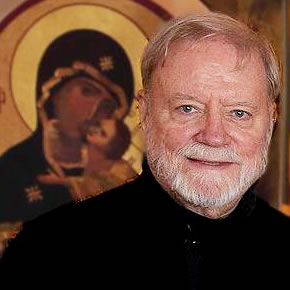 Fr. Patrick Henry Reardon