
In the name of the Father and of the Son and of the Holy Spirit. Amen.
This morning’s story, beloved, from the gospel is about the call of the first four apostles, a story that serves as a paradigm for the Christian calling generally. Most of the translations say something like, “Come, follow me.” It’s more elaborate than the very simple Greek text, “Defte opiso mou; come after me,” very faithfully rendered in the Latin Vulgate, Venite post me. I’d like to consider with you this morning three qualities of this calling.
The first is the priority of Christ himself: “after me, post me.” You know, the world tends to arrange its life with “me first,” and then everything else is second. The Christian arranges his life with Christ first. Christ is the one to be followed. More, Christ is the one to be pursued. The Christian is not a person concerned mainly about himself, and certainly not in the first place. A Christian is not somebody preoccupied with his own needs, much less his own aspirations and wishes. The Christian life is not centered on oneself. It is dominated by the Person of Christ and is the life of obedience.
Now there is a biblical word: obedience. Recently at the Parish Life Conference over in Michigan, Fr. Wilbur gave a talk in the early morning Bible study. I didn’t attend it because it was early, but I heard about it. [Laughter] It was based on a book that was published this past December, Recovering the Atonement or something like that. He talked about the Christian life as a life of obedience, and one of the things he stressed is that in a home where there is no obedience, there’s not the slightest chance the children will end up being Christian. That’s the first thing that you teach them is obedience. And he was contrasting that with those other cases.
The model of this Christian coin we find in those whom the Bible identifies as the followers of Christ, Peter for sure. “Behold, we have left all things and have followed thee.” This morning’s gospel described how he left all things and had followed him. Now, what did he leave, really? What did he leave? He left a couple of leaky fishing boats, some nets that always seemed to need mending, because every time they’re mentioned they’re being mended, and I’m not sure how successful he was as a fisherman. In the Bible, every time he catches a fish, it’s regarded as a miracle! [Laughter] But he left everything to follow Christ.
St. Paul: “Forgetting those things that are behind, I press forward to the goal: Christ Jesus.” Press forward to the goal: Christ is the goal. Mary Magdalene and her women companions are described in the gospel of Luke as those who follow Jesus, all around Galilee.
When I was 18—and some of you are 18 now—one of the most important books I read in my whole life, I read when I was 18. That was a little volume of the seven letters of St. Ignatius of Antioch. And I note that the founders of this parish have all read that book. That was part of your reading for joining the Orthodox Church. I’m hoping, Gabe, that the letters of Ignatius of Antioch will find an important place in our curriculum. But in the letters of St. Ignatius of Antioch, that’s what I was most struck by when I was 18, and in fact so struck by it, it drove me to tears: I sat there crying as I read the book. How anxious he was to get to Christ, and that’s why he wanted to be martyred, in order to get to Christ, to be in the presence of Christ, and, as he says, to enjoy Christ; he wants to be with Christ! He’s not preoccupied with himself; he’s preoccupied with Christ. So observe the emphasis.
In the following after Christ, the accent is entirely on Christ. It’s not on one’s own concerns. In fact, it’s not even on one’s spiritual concerns. Now contrast this perspective with the popular expression of modern American religion, summarized in this expression: To accept Jesus as one’s personal Savior. That’s very confident. I’ve been asked that question—not so much in Chicago, where they don’t really care, but back down in the lowly Ohio River in God’s country, where they do—“Have you accepted Jesus as your personal Savior?” I always say yes. You see, there’s nothing wrong with accepting Jesus as your personal Savior. I’m in favor of that. I don’t want to come out against accepting Jesus as your personal Savior. No, no, no, I’m not against that. This is something good and blessed, to accept Jesus as your personal Savior.
For all of that, however, it is surely significant that the Bible never speaks of the Christian vocation in this way. It’s a fairly unbiblical way of talking about it. In the Bible, the emphasis is invariably on Christ and the pursuit of, the following of Christ. It’s not about me, but it’s about Christ. And not even about my salvation first; second it is, but it’s about Christ.
Contrast this with the great religious and philosophical teachers of antiquity. A couple of years after I read Ignatius of Antioch, I read the Socratic dialogues, starting with Plato’s dialogue with Euthyphron, and going on to the Apology, the Crito, the Phaedo, and so forth. And I became massively preoccupied with Socrates. For Socrates, the whole business of life was the care and cultivation of one’s soul, which involved a concentration on one’s soul. Now, once again, this is not a bad thing. Nowadays, this would be a big step in the right direction. You get people to even know that they have a soul, that would be… That’s one thing about the classical pagans: they knew they had souls, unlike secular people today who don’t seem to know this. So the care and cultivation of one’s soul is a good and blessed thing to take care of—the soul, the psyche—but the emphasis is different from that of the Bible.
In the Bible, the accent is on Christ. Truly to follow Christ, to come after Christ, one leaves his soul in the care of Christ. If he is our Teacher and Lord, we have no need to fear for our souls. One thing surely he has promised: “Learn from me,” he says, “and you will find rest for your souls.” Preoccupation even of one’s spiritual state raises the danger of total self-absorption.
The second feature: the Christian calling involves both decision and process. In other words, it contains both a resolution and a program. As for the decision, the resolution, it pertains in a special way to baptism, although baptism is a one-time thing, the biblical expression is hapax—hapax, one time—the one-time thing: so baptism is a one-time thing, nonetheless the decision part of baptism is one we renew each day, even several times a day. Please don’t ever start your hand toward your brow that way without remembering your baptism. Don’t ever let this be automatic. And never do it three times, because you’ll certainly rush it. But whenever you raise your hand to begin the sign of the cross, remember your baptism. Think about that: remember your baptism. It was in that sign we were all baptized.
As for the Christian program, let me start by examining with you the word itself. It’s a wonderful word, “program.” We observe that the word “program” comes from the same root as the word “grammar.” The verb there is grapho, which means to write; it goes with with Latin scribo: grapho, to write. Gramma comes from the participle “written.” Now what do you say about this? You see, writing is the art of preserving language; it’s the art also of refining language. Sometimes people say one doesn’t speak grammatically. It’s not always necessary to speak grammatically; it’s not always necessary. “Hand me that towel”: you don’t have to worry about it. Everybody understands what that means; it’s just a little communication. It’s not necessary always to speak grammatically.
It is, however, to write grammatically, something almost impossible to do, by the way, if you’re sending a tweet. And when I think that people nowadays actually communicate with tweets—oh, I’m sure that leads to a shriveling of the soul! I won’t live to see its… But I’m sure the tweet is going to lead to the downfall of civilization. I do not—no question in my mind about that, and I rejoice that I will not live to see it.
Grammar pertains to writing, and it’s supposed to be more serious. Grammar is an important component of human existence. Grammar is what separates human beings from other creatures who inhabit the earth. Other animals also communicate by sounds; they do not communicate by writing. Mom and me, we have—you see, I just said “Mom and me”; that’s very ungrammatical—Mom and me, we have three cats at our house, and I’ve had a lot of opportunity to observe these cats. First thing I noticed about them, almost right off the bat, is that they’re not very grammatical. They don’t really analyze the structure of their words, and they use them rather haphazardly. I’ve discovered that exactly the same cat sound can stand for “clean my litterbox” or “what is the equatorial circumference of the world?” [Laughter] It’s hard to know sometimes which one they have in mind. [Laughter]
Cats have a pronounced inattention to grammar, because grammar is a human and spiritual thing. Without grammar you do not have a pro-gram, a program. What, then, is the Christian program? A program is literally written down ahead of time: a pro-gram, written down ahead of time. It says that the Christian life depends on an inherited text. It is a pro-gram. If we shifted from Greek to Latin; we should say the following of Christ has a script; more than that, it is something pre-scribed. It’s a prescription: it’s written down ahead of time. Program and prescription mean exactly the same thing, just shifting between languages.
Fidelity to Christ, beloved, requires an inherited text. It requires an inherited text. When a priest—oh, no, even a deacon—when a deacon is ordained in the Church, he’s handed a book: that’s the text. That’s the text. Think about this text, the sacred text, and the importance of it in the apostolic teaching. The apostles themselves are constantly citing this text. It’s a program already there. When Jesus came into this world, the Son of God became flesh, he got a program. “At the head of the book it is written of me”: from the psalms, Psalm 49, quoted in the epistle to the Hebrews. “At the head of the book, it is written of me.” Jesus receives a program. In fact, he stands there and holds a program, and he holds it up next to his heart. Even Jesus needed a program, which is why, at the mountain of Transfiguration, as you see in the icon furthest back, he’s standing there talking to whom? He’s standing there talking to Moses and Elijah, the Law and the Prophets. There’s no Christian life without the program.
And third, let’s reflect on the ironic ambivalence of the word “after”: opizo in Greek, post in Latin. Now, ambivalence is not ambiguity. Ambiguity, you don’t know what it means; ambivalent means it means two things. Ambi-, ambi-valence, meaning two things. This command of Christ, “Come after me,” look at the word “after.” You know, in a quantitative way, this is fulfilled just immaterially. In fact, in human history, everything since Christ has been after Christ. That seems so obvious that we maybe miss the significance of it. The apostles who became fishers of men did their work so effectively that the historical appearance of the Jewish Messiah became the dividing mark of historiography. The whole world now fixes the dates of events with respect to their chronological reference to Christ: before or after Christ.
All events in all of world history are now dated that way, and they will be, by the way, until the end of time. Only one government has ever tried to overthrow that, and that was France. That did not last very long, because that little blip in history known as the French Revolution, which was going to re-date everything by some other standard beside Christ, didn’t work out. Even the Russians stopped short of that. The whole world now fixes the date of every event with respect to the chronological reference to Christ. That’s the way it’s done in India, Japan, China, and other places which have not been that strongly touched by the Gospel. Things are said to be before or after Christ. Even secular historians, when they write “BCE” and “CE,” before the Common Era and Common Era, they know exactly what that means! They don’t want to refer to Christ, but they know exactly what the meaning of those terms is.
Christ has become so central to human experience that it becomes impossible to ignore him. The choice he presents in the gospel, “Come after me,” is not a choice that can be evaded. That invitation, “Come after me,” not only divides time, it also divides humanity. And here let me take you back to the fifth psalm we prayed this morning at matins; it’s the fifth psalm of every matins. Last night I talked about the sixth psalm, 142, but the one now is Psalm 102. Listen to these lines from Psalm 102. One of our chanters did it at matins this morning; I’m not sure which one. [Transcription note: The psalm referred to is Psalm 102 (101 LXX), not the fifth psalm read at matins (102 LXX).]
Thou, O Lord, in the beginning, hast laid the foundations of the earth, and the heavens are the works of thy hands. They shall perish, but thou remainest. As a garment, they will grow old, and as a vesture shalt thou fold them up.
It’s talking about the whole universe. The whole universe is going to grow old, and God’s going to come in and fold it up—fold it up. “Thou shalt fold them up, and they shall be changed. But thou art the same.” The word there is ho aftos. “Thou art the same” is the best we can do, I suppose. It’s a translating of ho aftos: Thou, O Lord, are he himself. Ho aftos: he himself. “And thy years shall never fail.”
Now these lines from the psalter are quoted in the first chapter of Hebrews, not about God as God; they’re quoted about Christ.
Thou, O Lord, in the beginning, has laid the foundations of the earth, and the heavens are the work of thy hands. They shall perish, but thou remainest. They all shall wax old as a garment, and as a vesture shalt thou fold them up, but thou art ho aftos: thou art the one, the same, and thy years shall never fail.
Though the text speaks of Christ, who will outlive the world, who will outlast the world, he himself tells us, “Heaven and earth will pass away, but my words will never pass away.” He is more permanent than the earth on which we live. He is more permanent, more steadfast, than the universe in which we breathe. That same expression appears later on in the 13th chapter, the last chapter of Hebrews, which uses this marvelous expression: Christos ho aftos, Christ himself—yesterday, today, and forever. Christ himself, yesterday, today, and forever.
This aftos, this “himself” is the foundation, not only of history, but also of cosmology. When God first created the world, everything was all mixed up. He did not begin by separating land from water. He doesn’t do that until the second day. The first one is to get light in there. Why did God need the light? He had to see what he was doing, very simple as that: he had to see what he was doing. He had to get light in there. Yehi or. That created light comes from the uncreated light, which is the light of God’s eternal Word, identical to Christ. He is the foundation not only of the historical order; he is the basis of the order on which we stand. Amen.
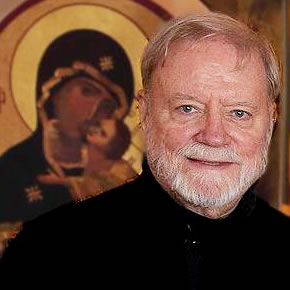 Fr. Patrick Henry Reardon