In the name of the Father and of the Son and of the Holy Spirit. Amen.
All right. Today’s gospel takes us to the gateway of the village of Nain. That is one of my favorite places to fall asleep. In fact, I fell asleep there last night. Sometimes I fall asleep at Peter’s fishing boat; sometimes I fall asleep and am in danger of breaking my neck: I fall asleep in a sycamore tree at Jericho. But one of my favorite places to fall asleep is there at the gate of that village.
I want to take for you this morning, beloved in the Lord, three phrases, just phrases, from today’s gospel. If I rely a little bit on the Greek here, it’s because of the technical vocabulary of the Greek texts. The first phrase is “a large crowd of the city, ochlos tes poleos hikanos.” In this morning’s gospel, “a large crowd of the city” is on the move, the polis, a large crowd of the polis: ochlos tes poleos was on the move. The Vulgate very literally [has] civitas, a large part of the civitas was on the move.
Now, polis is probably one of the most important words in the history of language. It designates a very complex thing. This polis, this city, it points to a very advanced place in civilization. Certainly in Greek culture there’s hardly any word that’s more important than the word polis, as everything is formed “from the city.” But in the Bible, the word “city” is not so positive. We recall that the first city in the Bible is built by a murderer. You see, the city is the great enterprise of brotherhood, isn’t it? where we’re all working together. A city requires an enormous division of labor. Just think about all the different kinds of labor that are essential to the maintenance of a city. So the city should be a great enterprise of brotherhood and sisterhood.
But notice in the Bible there’s something wrong at the heart of it: it’s founded by a murderer. In one of the most important books of Western civilization, a book called The City of God by St. Augustine of Hippo—one of the absolutely indispensible books for the understanding of Western civilization… It can’t be… You simply can’t not read it. It’s absolutely… It has to be read. Augustine draws the parallel between the founding of the first city by a fratricide—someone who killed his brother—with the founding of the major city at that time, which is Rome, that the founder of Rome also kills his brother. Augustine goes to great meditation about how the seeds of destruction are within the very construction of the city.
Another image that comes to mind in this morning’s gospel is life as a journey. That’s really very old, very standard. What could we do without that theme of life as a journey? It’s the basis, for example, of Homer’s Odyssey, Vergil’s Aeneid, Chaucer’s Canterbury Tales. But here, this morning, we’re not talking about the journey of an individual, like Odysseus returning to his home, or Aeneas traveling from Troy to establish Rome, or the pilgrimage of individuals—because each of them has his own story in The Canterbury Tales. In this morning’s gospel, the journey is that of a large crowd. It’s not about each man’s journey through life, but the journey of the human race as such. Now, this is an idea that never crossed the minds of Homer, Vergil, or Chaucer: the journey of the human race as such.
It is one of the most striking aspects of the 19th century that a great number of serious people conceived the idea that the human enterprise was “going somewhere.” That’s a product of the 19th century: the idea that the human race is going somewhere. The only empirical evidence for this new idea were the significant technical inventions and scientific discoveries that did, in fact, improve many aspects of life. Was it GE that said, “Progress is our most important product”? Mom and I owe a great deal to GE, don’t we, Mom? When the General Electric plant was constructed back in Burkesville, Kentucky, back in the early ‘50s, about 1950, I suppose, it pretty much brought our families out of starvation. So I’m not going to knock GE. Who doubts GE? But, see, “progress is our most important product” could never have been said by anybody if it hadn’t been thought by 19th-century philosophers.
You see, in the realms of medicine and travel, for example, it was not unreasonable to speak of progress. How long did it take you to get back from Europe this past week? [Fifteen hours.] A shorter time than it would take to walk to Indianapolis. Well, that’s something to think about. But with respect to human history itself, was it valid to think of man’s existence in the world as progressive? Darwin’s biological theories, of course, supported the idea. We’d already “progressed” from being apes, according to that theory.
Even when I was a young man—it wasn’t all that long ago: a bit over half a century—there were still religious Darwinians pushing the idea. A best-selling author in those days, in spite of his condemnation by the Vatican, was a Jesuit by the name of Teilhard de Chardin, who spoke about rising and converging through the omega point, a very interesting way to describe what was actually happening in the 20th century; it’s a very interesting way of describing it.
Indeed, I have distinct memories, when I was a student in Europe in the 1960s, distinct and explicit memories, detailed memories, of conversations with highly intelligent people who contended, with great seriousness, that the Marxist atrocities in Cambodia, to take an example, were simply a necessary component of social and political progress. But all those people, those millions of people, had to be slaughtered in Cambodia so that Cambodia and the rest of southeast Asia could have the glorious and wonderful future that God provided for us. It was a theory on the basis of nothing, nothing!
So when we look closely this morning at this ochlos tes poleos, this crowd of the city, we observe that some of them are walking rather strangely. In fact, some of them seem to be walking on their hands. It’s so unnatural. But we do observe that some of them are moving in a dialectical pattern, taking one step backwards for every two steps forward; that’s dialectical progress. Others are walking in great circles, all trending, finally, towards some obscure future goal. We can say at least this much for Oswald Spengler: unlike Karl Marx, he had actually read history. Spengler actually knew some history! His theory runs around in circles, literally, but at least he had studied some history.
Now, all theories about human progress, however, are dashed to pieces on a single stone, and it’s a gravestone; it’s a memorial stone. You see, this ochlos tes poleos, this great crowd, what are they walking in? It is a funeral procession. They’re following a dead man to his grave. And that dead man is the reason we are all in this procession at all. We human beings carry death in our very flesh, and no amount of alleged progress gets rid of that. It can postpone the physical aspects of death, sure; it can postpone those. Science can do absolutely nothing—nothing, zero—for the spiritual death in the soul. It might postpone physical death for a while…
A book you might want to read in connection with this is a great satire by Aldous Huxley, entitled, After Many a Summer Dies the Swan. It’s not a very large book, perhaps 150 pages; a marvelous book. I taught it several years; back when I was teaching college in the ‘70s I used to use that book in my theology and modern literature course, about a man who tries to delay death. Well, I won’t tell you the rest of the story. You read it for yourselves. A very interesting read.
We human beings carry death in our flesh. All philosophical speculations about human progress amount to no more than shopping sprees to purchase better and more comfortable shoes for the journey. That’s all it is. Find better shoes for ourselves so we somehow get through it without blisters on our feet—but we’re heading in one direction, and it’s not a good direction.
Back when I was reading Teilhard de Chardin, I was chaplain at the Army base at Fort Knox, and I will always credit the Lutherans with redeeming me from that delusion. There was another chaplain, another military chaplain, a Lutheran chaplain, who simply asked me, “How would you square that with Genesis 3 and the epistle to the Romans, Romans 5, particularly?” And I saw he was absolutely right, and I gave up any notion of that whatever.
Point two: “he entered into the city, eporeveto eis polin, entered into the city.” It’s a description of Jesus, isn’t it? Jesus enters into the city. That’s the way we can talk about the Incarnation, because we believe in the Incarnation as the entrance, the full entrance, of the Word into human social life. We’ve concentrated a great deal, because of the history of christology, on the Word’s assumption of our human nature, and that’s all correct, but he did more than assume our human nature: he assumed our human life. God’s eternal Word did not simply take on our essence; he entered into our existence. He entered the city. He became part of the culture, part of the economy, part of the thought-life of the human race. What Jesus of Nazareth did became an active component in human history—not just his ideas—not just his ideas, because his ideas have no value except in connection with his person.
The human mind, because of Jesus, took a special look at history, and in the fifth century the Christian mind took a particular and concentrated look at the Incarnation. This is the true significance, I believe, of that transforming experience known to history as the Council of Chalcedon in 451, which I can only regard as one of the turning points of the world: the Council of Chalcedon in 451, where the clear and explicit assessment of God’s eternal Logos assumed the full dimensions of the full human existence. It was always there. The truth was always there, because the truth is what happened. But Chalcedon reflected on it and made it real.
That council in 451 laid the foundation of something truly new in history, a unique experience of the polis, and that experience was known as “Europe.” That council created Europe. Alas, Europe as created is currently in advanced stages of death. I’m currently reading a very depressing book, but it’s only revealing what I already sort of knew. It’s a book by Douglas Murray, entitled The Strange Death of Europe.
We list Europe as one of the continents. Europe was a continent in a way no other continent was. It was founded on a theological idea, not a common blood, not even a common religion, certainly not a common nation. It was founded on a theological idea, an idea expressed in the Council of Chalcedon. One of the merits of Douglas Murray’s book is that it goes beyond anything to do with immigration, low birth rates—all those things contributed to the current disintegration of Europe, but it started out as theology. In fact, one of the major arguments that Murray makes in his book is that the German critical approach to the Bible in the 19th century did more to destroy Europe than anything else, because it took away the foundational text upon which European culture was built.
Three: it’s the word of Jesus in this morning’s gospel: “Stop crying.” I felt like saying that several times this morning: “Stop crying. Me klaie.” You see, when Jesus touches the open casket, the funeral procession stops. It goes no further. It is at that point that St. Luke refers to Jesus by the name Kyrios. Up to that point in the gospel, he has not called Jesus Kyrios. At that point, when he puts his hand down, touches the open casket and stops the procession, Luke calls him Kyrios. It means no more business as usual, because now we have the fulfillment of the great promise of Israel’s prophets, the promise that should be written over the doorway of every Christian home: “He will wipe away every tear from their eyes.” He will wipe away every tear from their eyes.
Jesus does not simply raise the young man, but Luke says he restores him to his mother. In other words, the death that society endures is now reversed. He returns him to his mother. All of this, says Luke, takes place at the gateway to the polis, the gateway to the city. You know most people believe—that actually believe in the Incarnation—that God sent his Son to make bad people good. Those would be, I suppose, fundamentalist Evangelicals. Then you’ve got the mainline Christian who believes that God sent his Son to make good people better. God sent his Son to raise the dead! To make dead people live! Contrast that with what is promised in Buddhism, make good people better, or at least make people better, not to give us eternal life, not to reintegrate the body and soul of human beings who have been condemned to death. We meet him at the gate of the city.
I urge each of you to make the scene of this morning’s gospel one of your favorite places. If not one of your places to fall asleep, at least one of your favorite places to go when you pray. Go back to that scene, sit there, open your Bible, sit there quietly—and watch what happens, and enter into the joy of the Lord.
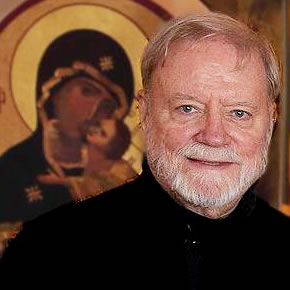 Fr. Patrick Henry Reardon