
In the name of the Father and of the Son and of the Holy Spirit. Amen.
This morning, sweet people, if we were to summarize the story in the gospel with a thesis statement, it probably would best be expressed in the final verse: “So likewise will my heavenly Father do also unto you if you do not from your hearts forgive everyone his brother their trespasses.” Now I submit to you nonetheless that the force of this story is not reducible to its thesis statement. The details of the story likewise carry a more ample message. I propose this morning that we look more closely at three of these details.
First, the two debtors are not just debtors; they’re identified as servants, douloi, ebedim in Hebrew. This word identifies their relationship to the king in the parable. We should start, I think, our understanding of this story by considering what it means to be the servants of the king. To me, this seems important because our Lord sets the drama of this parable and its moral message entirely in the context of service to the king. Before these two debtors are related to each other, they are, each of them, related to the king in terms of service. We should start, then, by asking what is meant by “service to the king.”
Now I propose to address that question with an illustration from a modern pagan author. Notice I call him a pagan, not a secularist. In fact, I could spend the rest of my life very well if I just preached paganism, because it would be such a vast improvement over what most of the world has right now, but I’m not going to quite do that. But I think it doesn’t hurt from time to time to cite a pagan author; after all, St. Paul did that on the Areopagus, didn’t he? Now the pagan I’m citing is not a very edifying pagan; I encourage none of you to copy his example. The pagan I have in mind is Lord Byron, in his long dramatic poem, Heaven and Earth. It’s a dramatization, a rather fanciful dramatization, of the sixth chapter of the book of Genesis. In this long dramatic poem, Byron describes the prologue to the flood, the deluge. In fact, the poem ends with the ark appearing on the horizon. It’s not a very long poem; I think my edition is maybe a hundred pages.
As the water is rising in the story, one of the characters, who’s described simply as “a mortal,” delivers a soliloquy on a mountain cliff. As he’s standing there and the waters are rising and it’s very clear to him, because the rain is still falling—very clear to him that he’s not protected at all. The waters are rising and threatening him. He knows he is facing likely destruction, and how does he react to this? I give you this illustration because I think it means something about how to be a servant to the king. Here is how Byron portrays the dilemma.
Blesséd are the dead
Who die in the Lord!
And though the waters be o’er the earth outspread,
Yet as his word,
Be the decree adored!
“As his word, be the decree adored.” As this mortal came to life by the word of God, so he should perish by the word of God. God owes him nothing. According to the gospel of St. Luke, he is an unprofitable servant. God is never our debtor. Can everybody hear that? That God is never our debtor! He owes us nothing! I think I could use that to summarize the book of Job. God is never our debtor. He does not exist for us. He is not Santa Claus. He owes us nothing!
Byron continues. Here’s the mortal standing on the cliff as the waters rise.
He gave me life—he taketh but
The breath which is his own:
And though these eyes should be for ever shut,
Nor longer this weak voice before his throne
Be heard in supplicating tone,
Still blessed be the Lord…
Now this, beloved, I submit, is the proper expression of faith, in life and in death. Some of you may recognize that I’m quoting here the first article of the Heidelberg Catechism. In life and in death, I put my complete trust in God. He owes me nothing. I place my entire reliance on the king, even if the waters rise to overwhelm this highest peak which I can stand, still I will stand there. In faith, I will gladly yield back to him the life he gave me. Everything I have, everything I know belongs to him.
I suspect this may be a truth more obvious as we get older. Now that I face the final flood, it really is obvious to me. Byron continues:
For what is past,
For that which is:
For all are his,
From first to last—
Time—Space—Eternity—Life—Death
The vast known and immeasurable unknown.
Faith informs us that God is and that he is the rewarder of those who diligently seek him. Faith informs us of that, that God is and that he is the rewarder of those who diligently seek him. That is the truth, and everything else is commentary. The soliloquy of Byron’s character ends in a couplet:
No; let me die, as I have lived, in faith,
Nor quiver, though the Universe may quake!
The sustaining supposition in today’s parable, beloved, is faith. Each of us is a servant of the king to whom we owe everything. I spoke last night about murmuring. Why is murmuring the sin most condemned—most condemned!—in the Scriptures? Because the underlying presupposition is: God owes me something. That’s the underlying presupposition: God owes me something, and he’s not coming through with it. But, you see, our entire existence is one of debt. Before God there’s no such thing as merit. There is no such thing as karma. Each of us to the depths of the roots of our being is a debtor. Each of us is an unprofitable and unworthy servant of the King. None of us is in any position to negotiate with God.
I think we’re ready for point two. The two debtors in the parable are fellow servants: syndouloi. Syn, together, douloi as the plural of doulos: syndouloi. If doulos, servant, designates our relationship to the king, syndouloi (singular syndoulos), fellow-servant, indicates our relationship to one another. Whatever other relationship we have to one another, this basic and more democratic relationship abides, because God is no respecter of persons. When the Lord looks down upon this assembly this morning, he does not see priest and people; he sees fellow servants. When God looks down upon this service this morning, he does not see parents and children; he sees servants. There’s the underlying relationship we have. On hardly any other point is holy Scripture more emphatic than this, that God is no respecter of persons.
For this reason, God never addresses us with a title. If the Most High were to speak to the mayor of this city—and I really wish he would—he would call him “Ron,” not “Your Honor.” If the Lord were to speak to the Prince of Wales—once again, I wish he would—he would not address him as “Your Royal Highness.” If he were to speak to the Pope, he would not say, “Holy Father.” On those occasions which, as I am sure, Jesus speaks to our metropolitan archbishop, I think he probably calls him “Joseph,” not “Your Eminence.”
Now I emphasize this point because, although we know in theory that God is no respecter of persons, in practice we sometimes act as though it were not so. I have in mind those instances in which one or the other of us presumes to pass judgment on a fellow servant. St. Paul treats of this problem in chapter 14 of the epistle to the Romans. The Apostle asks, “Who are you to judge someone else’s servant? To his own master he stands or falls.” The Christian recognizes that passing judgment on anyone else is an exceedingly risky business. In the final assizes every one of us will depend entirely on what the Bible calls the hesed of God, traditionally translated into Latin as misericordia, in English as “mercy,” or hesed of God.
That’s all I have when I appear before the throne. That is all I have. I have nothing of my own that I can bring to him. It’s not a question of weighing good karma against bad karma. There isn’t any karma—that’s a mirage—there is only grace. There is only grace; there is only mercy.
Which brings me to point three: the sin in today’s parable comes when one of the debtors pretends to be a creditor. Isn’t that right? He’s a debtor, but he pretends to be a creditor. He assumes the attitude of a master. “Pay what thou owest!” according to the King James Version. The man refuses to forgive from the heart. That’s a very important line, by the way, “from the heart,” because I’ve had people say, “Well, I forgive you,” when it’s very clear they don’t. If you say, “I forgive you,” and the other person feels worse for it, you haven’t forgiven him. You see, if he refuses to forgive from the heart, he is implicitly claiming the place of God. He is acting like the king, not the servant. The hesed, the mercy of God—when we think of it, I believe as a human translation of God’s being. This is the point in the sermon where I thought, “If I’m guilty of heresy, this must be the place.”
I think that the hesed of God we may think of as a human translation of God’s being. His hesed, the Psalmist says, endures la holam, forever. The hesed of the Lord endures la holam, forever. But is the mercy of God really a trait, an internal trait of God? Because if God had never made anything, would there still be this mercy? A God apart from creation would have no occasion for mercy. That’s why I think that the divine mercy is the being of God translated into human expression.
When Jesus instructs us to be merciful as the heavenly Father is merciful, he’s telling us how to be like God, how to partake of the life of God, how to arrive at theosis, deification. He condemns only when he is forced to condemn. The point of today’s parable is ironically positive. The king wants to forgive, and this is why we human beings must forgive. Amen.
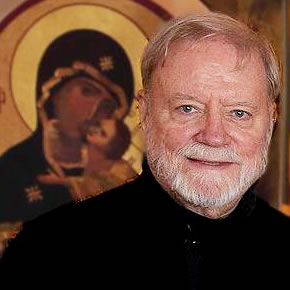 Fr. Patrick Henry Reardon