
In the name of the Father and of the Son and of the Holy Spirit. Amen.
In this morning’s reading from the gospel of John, chosen, by the way, because of the feast of St. Raphael Hawaweeny, in that reading Jesus calls himself three things: the door, the shepherd, and the voice. Now these three images, beloved in the Lord, are metaphors of Christ himself: the three ways in which Christ thought of himself with respect to us. You see, the whole business of confessing Jesus—which is what we do, and which is part of the baptismal service this morning, when the godparents stood there and confessed Jesus—is not an objective proclamation. That reduces the proclamation of faith to a very strange kind of truth. “Jesus is the Lord” is not an objective proclamation like “Two and two is four.” You see, I can say, “Two and two is four” without being committed to it. In fact, I’m not terribly committed to it: I’ve been trying to find for years a way around it. And the recent politicians have shown me how that’s done! [Laughter] You see, it’s not on the same parallel at all. It’s not the same thing.
When I say, “I believe in one God,” I’m not affirming the existence of God; that’s not the point of it! I’m saying I believe in him; I’m involved. It’s something very different from saying, “There is a God.” “There is a God” is an expression of religious opinion, nothing more. It may or not be true, taken from outside. When I say, “I believe in God,” I’m saying more than the existence of God; I’m talking about my belief in him. When we call Jesus, or Jesus calls himself the door, the shepherd, the voice, we’re talking about the self-consciousness of the Son of God. Three aspects of what St. Paul calls the nous Christou, translated in most English translations as the “mind of Christ,” but better translated, I think, by St. Jerome in the Vulgate, as sensus Christi. That’s a lot more than “mind”: sensus Christi. There’s a sense, I suppose, that you could say there’s nous, abstractly considered in a computer; certainly a mind in the computer. If you don’t believe that, try playing chess with it sometimes, as I’ve tried. But the nous as sensus, I think Jerome caught it: it’s Christ’s sense, his infallible sense of who he is. He’s making sense of who he is.
He calls himself the door, the shepherd, and the voice, thus giving us three points for reflection. First of all the door. The door, a door, any door, is an instrument of passage, isn’t it? It’s the middle and the means of something. Specifically it’s the middle and the means by which God comes to us and we go to God. God has no dealings with this world except through his eternal Word. That’s not simply the teaching of the New Testament, by the way; that’s the teaching of the Hebrew Scriptures, that God has no dealings with this world except through his memra, his devar, or in Greek his logos.
This is why Christians believe that when God spoke to the Hebrew prophets, it was through the voice of his Word, his eternal Word, who became flesh for us. We believe that it was Christ who walked with Adam and Eve in the garden. We believe it was Christ, with the Father and the Holy Spirit, who came to sup at Abraham’s table. I think you all recognize where that icon comes from: the 18th chapter of Genesis: the three angelic apparitions. The one in the center, the one who’s holding out the two fingers over the chalice, is God’s Word. We believe that the voice and the Person who spoke from the burning bush to Moses was the voice of God’s Word.
Why do we believe that? Jesus says so; he claims to be that. He claims to be that. “Abraham, your father, desired to see my day,” he said. “Abraham, your father, desired to see my day. He saw it, and he laughed.” Remember the word for “laugh”? Yasak, Isaac? He saw it and he laughed. Jesus said, “Moses wrote of me. Moses wrote of me.” He’s claiming to be the revelation of God that appeared to Israel. And then David, when Jesus cites the psalm, “The Lord says to my Lord…” If he is the son, then how is he his Lord?
When I say these things, I’m often asked, “Is it possible for the non-Christian to come to God?” I believe it’s quite possible for everybody to come to God. Indeed, we devoutly hope that everyone will come to God; we want everyone to come to God. But whatever that process is, it will involve God’s eternal Word, the same Word that we recognize as Christ our Lord. There is no other mediation between God and men, and “everyone who is of the truth hears my voice,” he says to Pontius Pilate, “Everyone who is of the truth hears my voice.” And this is why we pray to the Father in Jesus’ name. He is the door in the sense of his mediation. He is the one Mediator between God and man. He is the place of passage through which God comes to us and we go to God.
And second this morning, he describes himself as the shepherd. Not just any shepherd, but the good shepherd. Now, I have a passing acquaintance with what it means to be a shepherd. Just a passing acquaintance, because it only involved one summer, back in the late ‘60s, when I was tending sheep in the French Alps. [Laughter] I don’t get to do that very often, but when I get the chance I do it. Back when I was an Alpine shepherd—I’ve heard a lot about sheep. When I say, “The Lord is my shepherd,” what does that mean: “The Lord is my shepherd”? Have you ever observed sheep rather closely? They’re about the dumbest animals. When he says, “I’m the good shepherd,” that is not a compliment to us. [Laughter] What he’s saying is: “You guys don’t have a clue where you’re going to find your next meal, and without me you’re going to starve to death, and without me the lions are going to get you.”
Being a shepherd implies guidance, and that’s the sense in which Jesus is Lord: guidance. “The Lord is my shepherd.” Set in protection, because we need it. This morning’s gospel talked about when the lion comes. The one who’s taking care of the sheep, not really the shepherd, he runs away; he’s scared of the lion. It takes an awful lot of sheep, by the way, to intimidate a lion. I haven’t got the number yet. [Laughter] The more sheep you get in there, the lion’s meal just gets bigger.
This kind of protection—we really need this protection. Sheep are not smart animals. They’re completely clueless with respect to dangers. For example, one of the differences between a sheep and other animals that feed on grass is the sheep will continue to feed on that grass until it’s all gone, until there’s nothing there. They would simply eat it all. A goat will not do that; a horse will not do that. A sheep will just stay there and eat; he doesn’t know there’s any other grass in the world. That’s why the shepherd must take the sheep to different pastures.
My best memory of tending sheep—I have a number of interesting memories; I won’t share them all with you. My best memory is that of the French shepherds: the dogs, shepherd dogs, French. I had no experience of the German shepherd, but I did of the French shepherd. All these dogs were fantastic; they did all the work for you. And this tradition was handed down from father to son among the dogs and from mother to daughter among the dogs. I remember walking with the sheep along these country roads, fairly near Albertville, about 40 miles south of Mont Blanc. And the dogs would see the car or the truck coming down the road, way ahead. The dogs would go out there right away, get the sheep off the road. The sheep wouldn’t know. They don’t know! And they recognized the superior intellect in the dog. In fact, most human beings should probably recognize the superior intellect in the dog. The cats, not so much. [Laughter]
See, one of the things the good shepherd does is move us on. He moves us on. Christ does that for us as the good shepherd. He moves us on. When it’s time to move, he will move us, because sheep cannot remain in a single pasture forever; they must move on, and a good shepherd knows when it’s time to move on. I think most of us resist that, when the good shepherd tries to move us on. We’re fairly comfortable where we are, but he moves us on. He maintains—the good shepherd—both a rod and a staff. He’s not supposed to use the rod on the sheep. He might have to, but he’s not supposed to. He’s supposed to use the rod on the wolf or the lion, for the sheep he uses a staff with a crook in it, which means he reaches out, grabs a sheep by the neck, pulls him back into line. He maintains both a rod and a staff, and of this rod and the staff, the psalmist says, “They comfort me.”
Third, let us talk about the voice. Let’s return to that text in the gospel of John where Jesus speaks to Pontius Pilate. “Everyone who is of the truth hears my voice.” What does it mean to be “of the truth,” to belong to the truth? The chief attraction of Christ our Lord, I believe, beloved, are the contents and the modulations of his voice: the what and the how he speaks. He is the Word of God, the Word with God, from all eternity, and he is the one who speaks to us on God’s behalf. So the human voice of Christ is the voice of God, speaking to us.
Now this says a great deal about anthropology. In my youth, back when I was tending sheep in the south of France, I was reading in German—reading in French, too, but reading in German. And one of the most important books that I read for myself back in those days was by a German named Karl Rahner. Very difficult German, by the way, and also difficult thought. His brother, Hugo Rahner, said that someday he was going to translate his brother into German. [Laughter] His most important book, I believe, is called Hörer des Wortes, [Hearers] of the Word. It’s a work of anthropology: [Hearers] of the Word. If man is essentially and chiefly a hearer of the Word, hearing is man’s major access to God—which is why you came to church this morning, by the way, because hearing is man’s major access to God.
Back when I was still a heretic, but pastoring a church, I had parishioners tell me, “Well, you know, I can worship a lot better in the woods on Sunday morning.” If I had had the money, I would have hired a detective to go out in the woods and see how many of them were actually out there. [Laughter] No, you can’t worship better in the woods on Sunday morning! You need the Word of God! It has to be an intelligible word that you can wrap your head around it, that can be planted in your soul like a seed in the ground. And because man is essentially a hearer of the word, the Christian Church has a special concern for the nature and quality of language. We are accustomed to people lying to us. We’re very accustomed to that, that people lie to us. We expect this from people who are advertising; we expect this. Alas, we’ve also come to expect it of politicians, and right now we’re going through a fairly intense period of mendacity. It’s about 72 more hours that we have to put up with this intense expression of utter mendacity, ruthless mendacity.
But the Church has a special concern for the integrity of language, and that’s why children who speak ungrammatically should be immediately corrected. When children start to use nouns and verbs, cut that off right away, because if you do not speak correctly, you will not think correctly, because all thought happens with speech. There’s no such thing as human thought that does not involve speech. That’s why it’s extremely important—the Church has a great concern on the preservation, maintenance, and cultivation of language. The pollution of language is an attack on the very identity of the human race. I suppose all the adults here at least have read the story 1984 by George Orwell. If they haven’t—if they haven’t!—don’t admit it. Go out and get a copy right now. [Laughter] I’m going to look around. I think some of you just pulled out your phones to get it on Kindle. [Laughter] That’s okay. If you want to pull out your phones to get it on Kindle, get it now! And you can ignore what I say during the rest of the sermon, but read that book, about the pollution of language. Interesting: it wasn’t a Christian who pointed this out to us.
The pollution of language is an attack on the very identity of the human race. We use the expression, “the ring of truth.” Oh, what a great expression! “The ring of truth.” You can tell by the ring of it, by the tone of it, whether or not it’s true. Does the philosophy back me up on this one? Does he think the philosophy backs me up on this one? Thank you. Oh, I knew it did, I just wondered if you would.
The voice, according to Christ, must be recognized. “The sheep recognize my voice.” This recognition has to do with moral and intellectual integrity of the listener. If one has no moral or intellectual integrity, he will never recognize the Voice.
And I believe, finally, that this is a lesson we learn chiefly in prayer. Prayer is not just talking to God; prayer is having a conversation with God. It’s not supposed to be a monologue. Don’t picture God as somebody like an old grandfather who likes to be read to. Prayer is a dialogue with God, and the medium of that dialogue, the door of that dialogue, is Christ our Lord. Prayer is the place where we listen to and respond to the voice of Christ.
Now this morning’s reading came from the gospel of John, and you will notice that this is a characteristic of John’s gospel. It’s structured around conversations: people meeting Christ in conversations. The first apostles in the early chapters, and Nicodemus in chapter three: it was a conversation. The Samaritan woman in chapter four, the paralytic, the centurion, the man born blind. This morning at matins, it was Thomas: Jesus and Thomas. And then there’s the story of Mary Magdalene at the tomb with Jesus. The special example is surely when Christ calls Lazarus out of the tomb; he speaks to him. He speaks to him and brings him to life.
An Orthodox Christian has special reasons for loving that text in particular. After you’ve finished 1984, go to Crime and Punishment. Read what Dostoevsky says about that text, as Sonya reads that text to Raskolnikov at the beginning of his conversion. When Christ speaks to us, he leads us out of the tomb. He does that all the time, because we have a tendency to keep returning to the tomb. He speaks to us and brings us out.
Let us be resolved, beloved in the Lord, to cherish the voice of Christ, to discern the ways in which he speaks to us. The infallible way he speaks to us, of course, is through the Scriptures themselves, given to us by the Holy Spirit. It is the voice of Christ that will someday summon each of us out of the tomb, lead us forth, and bring us to life everlasting. Amen.
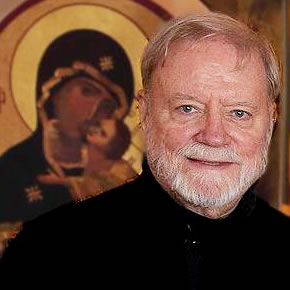 Fr. Patrick Henry Reardon