
Fr. Patrick Henry Reardon: In the name of the Father and of the Son and of the Holy Spirit. Amen.
It is not hard to find at least a general theme on which to preach on Pentecost. I decided to speak on the Holy Spirit and the mission of the Holy Spirit, three points of which I wish to reflect with you this morning, beloved. The Holy Spirit consecrates; he con-sacrates. Hear the word sac in there, “holy”? Sacris, sacra, sacrum? Con-sacrates. Consecration has about it something of finality and setting-aside for divine purposes. We bless your automobile; we don’t consecrate it. I think if you consecrate it, you could only use it for liturgical processions or something like that. There’s a difference between a blessing and a consecration. We don’t bless marriages. Other people may bless marriages; we do not bless marriages—we consecrate them. There’s something about a consecration. It has some notion of setting-aside finally. It’s finality.
The word the Church uses to express this is a biblical word. It’s the word sphragis, which we translate as “seal.” So, following an ancient custom of the Church, as soon as someone is baptized—I mean, they’re already consecrated by their baptism—we seal them. The Church anoints with holy chrism which comes from the apostolic succession. We don’t consecrate the chrism in this church; we don’t do that. We get the chrism from the Holy See of Antioch, the same church that sent out the Apostles Paul and Barnabas to preach the Gospel, the same one that sends us our consecratory chrism.
The newly baptized person is sealed, and as the priest goes through putting this anointing seal on all of his senses, the Church herself stands there and over and over again shouts out the imperative verb, “Seal! Seal! Seal!” You’ve done that many times. That person is consecrated. The person becomes the temple of the Holy Spirit. There’s something epicletic about that. In fact, we even consecrate that water; even the water we are baptized in is consecrated. That’s why that water is not thrown down the sewer. It’s consecrated, holy water.
The bishop lays his hands on a deacon or a priest or another bishop, and there’s a sealing. It’s epicletic; there’s an epiclesis. The Holy Spirit comes down and consecrates. That person is ordained forever. He may not function in the ministry, but forever he’s ordained.
In this morning’s gospel at matins, we listened to Jesus’ words to the apostles in the upper room, which he speaks about the forgiveness of sins as a gift of the Holy Spirit. “Receive the Holy Spirit. Whosoever sins you forgive, they are forgiven them.” That’s why when you walk away from this place, after you’ve confessed and your sins have received absolution, those sins are gone. They’re gone; it’s final. You don’t have to answer for those sins again. You might have to for something else, but you’ll never answer for those things again.
When the Holy Spirit is invoked on a couple, consecrates their marriage, that’s final. That is absolutely final. The Orthodox Church teaches that. Even death does not dissolve a sacramental marriage. It is not dissolved. We’re going to have that this morning, by the way. The Coatneys are back. They’ve been married ten years; they’ve decided to do it up right this time. [Laughter] We’re going to consecrate their marriage. You had her married in some other, what, fly-by-night church?
Mr. John Coatney: City hall.
Fr. Pat: City. Hall. Oh really? [Laughter] We definitely need to do something about that! Because what city hall joins together, city hall can dissolve.
So this is the most obvious in the sacraments, but there’s other ways in which things are consecrated that are sort of sacramental. For example, in the consecration of a church building, in the consecration of an altar, we use chrism. The same chrism that anoints the newly baptized is poured out on the altar, and parts of the building are anointed with the chrism, because that building is consecrated.
You don’t just consecrate any building, do you? There’s a whole bunch of restrictions on what buildings can be consecrated. For example, we can’t consecrate this church until the mortgage is paid off! which means it won’t happen in my lifetime. There are advantages to not paying off the mortgage, but those are financial advantages. But you don’t consecrate a church till the mortgage is paid off. I myself, I must tell you, have never seen the consecration of a church, and you probably have, lots of times, several times.
When something is consecrated, if someone violates the consecration, it’s called a de-secration. It means you’re going to de-holify it. And a desecration, of course, that’s among the top of sins; I mean, that’s right up at the top. That one’s right under blasphemy. To blaspheme God, and then to desecrate something that God has consecrated. That’s why the Church has always said that sins committed after baptism are far more serious than sins committed before baptism. We’ve always said that. In fact, early in the third century, when he wrote his treatise on baptism, Tertullian gave that as a reason for not baptizing people right away. He certainly did not believe in the baptizing of infants. He said all you’re doing is laying heavier responsibilities on them than they’d had before. So any sins they commit are much worse than they would have been otherwise. That was his reasoning, and as far as it went, it was logical, and the Church followed that for quite some time.
The man chiefly responsible for refuting that idea was St. Augustine. If you’ve read the Confessions of St. Augustine, you remember how he talks about that. He was not baptized as a child, even when he was very sick and might die; he was not baptized as a child, so he was not baptized until he was an adult. Lots of the Fathers of the Church were not baptized until adulthood because of that reasoning. The Church finally rejected that idea and insisted the baptism of children, and one of the people who most pushed that was St. Augustine. Augustine was widely, universally acclaimed in the patristic Church in the early fifth century. He was invited to the Council of Ephesus in 451; he just happened to die the previous August, or he would have been at the Council of Ephesus. Augustine has a very good argument for consecrating a Christian pretty much as soon as he’s born. There’s a finality of what the Holy Spirit does.
You see, our bodies themselves are temples of the Holy Spirit. This is what makes bodily sins worse than other kinds. St. Paul would make that argument, doesn’t he? He says every other sin is somewhat outside the body, but there are certain sins that require the body; he says they’re far worse. “Shall I take the members of Christ and make them members of a whore?” He asked that question, because our bodies are consecrated. That’s why certain kinds of sins are far more serious. Some people think all sins are the same. The Bible does not teach that at all; they’re not all the same. Certain sins are worse. Any sins against our bodies are worse, because our body is the temple of the Holy Spirit.
Now, you know, beloved, the world has no idea of what is meant by a consecration. In fact, that’s fairly lost even among other Christians. Nothing in the world prepares the mind for this experience of consecration. The Holy Spirit consecrates. When the Holy Spirit came down upon the ark of the covenant, the ark of the covenant was set aside as a holy thing. I was going to say, if you don’t believe that, just watch Indiana Jones, but I don’t… [Laughter] That doesn’t help, now that I think about it.
The burning bush is not less like any other bush. The burning bush is a place of God’s presence. He comes to speak through the burning bush. The burning bush is consecrated. There are those Christians, but only recently, only recently, who don’t believe in the perpetual virginity of the Virgin Mary, although all of the Protestant Reformers believed in that—Luther, Calvin, Zwingli, Oecolampadius, Butzer—all of them believed in the perpetual virginity of Mary, because they still had some notion of consecration. We would not use a chalice as a beer mug, because it’s given contour and shape to the blood of Christ. It’s consecrated. The Holy Spirit does all of this. It’s something the world knows absolutely nothing about.
Second point on the Holy Spirit: the Holy Spirit has imitators and impersonators. In the course of 54 years in June, 54 years as a minister of the Gospel, I’ve heard all sorts of things being ascribed to the Holy Spirit. Because the Holy Spirit has many impersonators and imitators, a great deal of the world right now has unrest, geopolitical unrest, terrible unrest; largely because a false prophet was spoken to by an evil spirit back in the sixth century. A false prophet heard an evil spirit and believed him. That’s why we speak of the importance of testing the spirits. St. John tells us to test the spirits and believe not every spirit. Because, says John, even then, he says, many spirits have gone forth.
Is there any sin more obviously condemned in the Bible than that of false prophecy? What does the Bible say you’re supposed to do with a false prophet? Stone him to death. There are times I think we need to bring that rule back; it would be an improvement—not that I want to throw the first stone. Polycarp, I’ll let you throw the first stone. I’m not real seriously arguing for that, but it does say something about the gravity of the sin of the false prophet, who claims to be speaking for God.
And one of the chief ways of detecting a false prophet is that he usually says exactly what people want him to say and expecting to hear. False prophets can be found in the highest places, even in the Church, the bishops and priests. No subdeacons, I think. No subdeacons have been among the false prophets. I think of the heresy of Montanism in the second century, a movement that we would call today a charismatic or Pentecostal movement: Montanism. It’s the Holy Spirit, or what claims to be the Holy Spirit, separated from Christ. The real Holy Spirit is the Spirit of the Messiah. “The Spirit of the Lord is upon me.” Jesus reads that text from Isaiah in Luke 4: “The Spirit of the Lord is upon me.”
The spirits are tested, therefore, by the memory of the Church, because deep in the memory of the Church is the Person of Christ. The memory of the Church is bound to certain forms, institutions, and structures. Chief among these, surely, is the word of God written in the Bible. That’s the chief institution in the Church against which we test every spirit, is holy Scripture. The Creed: that’s why we do not alter the Creed. There are those who think we ought to alter the Creed, and there are those who tried to alter the Creed, but that actually split the Church. After the Creed was elaborated in the year 381 of the Second Ecumenical Council, the question arose: Can the Church alter that Creed? Can we add something, for example? And the Council of Ephesus in 431, the Fathers at Ephesus pronounced an excommunication and an anathema against anybody who added even a syllable to the Creed, and that was respected in 451 at the Council of Chalcedon. The Council of Chalcedon put out a very important doctrinal statement: it would not touch that Creed. That’s the measuring-stick.
The biblical canon, that’s an institution. Another institution of the Church, which cannot be touched, is what I’ll call the paternal structure, the paternal structure of the authority of the Church. Last Sunday, at Divine Liturgy last Sunday, we read the 20th chapter of the book of Acts, where Paul is talking to the elders in the Church of Ephesus. Remember the scene at Miletus on the seashore. He says, “The Holy Spirit has made you the episkopoi (bishops) of the Church.” The pastors of the Church derive their authority from the Holy Spirit. And that’s why we may promptly dismiss any spirit that would alter the paternal structure of the Church’s authority. This has been challenged in recent decades, across wide sweeps of Christians. That’s an institution, a firm institution, unaltered from the apostolic times. People believe that now the Holy Spirit is telling us to alter it. That’s how we know that it’s a bad spirit.
That Christians should be distracted by this is not surprising, when I think of modern confusions, contemporary confusions about the structure of sex. We even speak of sex changes as though we could do that. We can’t change anybody’s sex; that can’t be done. That’s something given us by God. And there’s no such thing as a man in a woman’s body and a woman in a man’s body. That is pure fantasy. It’s a fantasy that has demonic origins. Sex is not arbitrary; it is not malleable. There is no such thing as a sex change. All we can do is mutilate bodies; that’s all we can do. We can’t change the sex. This is physically impossible. When I say “physically,” I’m talking about the Greek root. I really never use words unless I’m quite sure what they mean in their roots. “Physical” comes from the Greek word physis. “Physics” is the same root. Physis is the nature of the things.
This popular confusion about sex has found its way even into the Church. This hierarchical paternity of the Church is what we call “holy orders.” Both words are important: “holy orders”; “holy” and “order.” This challenge often disguises itself as coming from the Holy Spirit, but, you see, just like the human body, we cannot alter the DNA of the Church. It’s God-given. And that’s why, beloved, prophecy never gets the last word in the Church. Prophecy never gets the last word in the Church.
I’ve had folks come to me, at least the last 25 years I’ve been Orthodox; they come to me and: such-and-such a saint has said such-and-such a thing, and they come to me and: this is of the Holy Spirit. I sit there saying, “No, it’s not. I don’t know where it’s coming from. This is not from the Holy Spirit.” I remember one case, the person decided to get a second opinion. It only happened once that I know.
“Fr. Pat doesn’t think this is something of the Holy Spirit.” So he went over to the monastery in Michigan and asked the same question, and Fr. Roman Braga said, “That’s of the devil!” which is much further than I went. [Laughter] I guess it wasn’t of the Holy Spirit. “That’s of the devil!”
The prophet does not get the last word in the Church. The economy of the Holy Spirit is never separable from the economy of Jesus Christ, our Lord. The prophet usually gets the second-to-last word in the Church. “Test the spirits,” says St. John.
And third, the Holy Spirit animates. An-i-mates. Hear that word again? Anima. It’s the soul. The soul is that which animates us. Five minutes before I die, and ten minutes after I die, the body is still the same. Same stuff is all there, but there’s no animation; the spirit is gone.
The Holy Spirit, beloved, is the soul of the Church. The Holy Spirit animates the Church, as the soul animates the body. The same soul gives structure to my thought and causes my fingernails to grow—same soul. Philosophers speak about the soul, describing it as totus in toto [et] totus in qualibet parte: whole in the whole and whole in each part. My soul is in each part of my body. The humblest part of my body is animated by the same soul that animates the highest regions of my mind. It is the same with the Holy Spirit. St. Paul discusses this, doesn’t he, in chapter 12 of 1 Corinthians, and then about three years later—yeah, about three years later, roughly—in chapter 12 of the epistle to the Romans. He talks about the animation of the whole body of Christ, each part of it, each member, through the same Holy Spirit.
There are many activities in process in my body; there are many activities in process in the living body of the Church. The Holy Spirit is what gives co-ordination to the Church. Hear the word “order” in there again? Co-ordination, to the Church. The Greek word for that is the Holy Spirit is what provides the taxis, the structure of the Church. See, order and animation are both essential. Without animation is death, and animation without order is chaos.
The volcano is not a good image of the Church. I can say that safely today because you’re watching on television. “Look at all the vitality of the volcano! It’s bursting out everywhere!” Well, that’s not necessarily a good thing. When we baptize somebody, we actually set aside a structure, a form. We put them into it. We don’t come in with a firehose and spray them down. May I have a show of hands of those who want that? Just put the baby down and spray him down with a firehose? Why? There’s no taxis! There’s no ordo! There’s no structure to it.
The living water, without order, simply will drown us. This was a problem back at Corinth. They had that problem. That’s why Paul wrote the first epistle to the Corinthians. In fact, we can thank God for his providence that the Corinthians had that problem, because if they hadn’t we wouldn’t have had the first epistle to the Corinthians to talk about. It’s why the first epistle to the Corinthians still remains our basic text for life in the Church.
Among ourselves, there are various ministries and gifts. These are all from the Holy Spirit. The same animation that drives the bishop, same animation drives the choir director, and the treasurer—same Holy Spirit—the Sunday school teacher, the mother and the father—same Holy Spirit, who’s everywhere present and filling all things, the treasury of blessings and giver of life. And we pray: to come and abide in us and cleanse us from every impurity and to save our souls, for he is good.
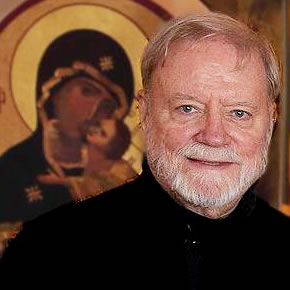 Fr. Patrick Henry Reardon