
In the name of the Father and of the Son and of the Holy Spirit.
Today we come to the last part of the Lord’s Prayer, which begins with: “And lead us not into temptation, but deliver us from the evil one.” Sometimes when people read this, they wonder what does it mean for God to lead us into temptation, and they see a possible contradiction between what St. James says in his epistle. He says:
Let no man say when he is tempted, ‘I am tempted of God,’ for God cannot be tempted with evil, neither tempteth he any man, but every man is tempted when he is drawn away by his own lust and enticed.
As a matter of fact, you might remember a couple of years ago, the Pope had revised the translation of the Lord’s Prayer in Italian to where it said in English, “Do not submit us to temptation.” Other people tried to say or translate it to mean something along the lines of: “Do not allow us to be led into temptation.” But if you look at the text in Greek, there’s no basis really for changing the translation; the translation is perfectly fine.
But leading someone into temptation is not the same thing as enticing them to what the temptation is. The word that’s translated as “temptation” can mean to test or to entice. As a matter of fact, in the gospel reading for this Sunday, which was the second gospel that you read, it began with someone tempting Christ, but that person was actually testing Christ. He asked him a question: “What’s the great commandment in the Law?”
So the translation is fine. God never entices us to sin, God never tries to get us to sin, but does God lead us into temptation? Yes, at times, he does. For example, Christ himself, in the Gospel of Matthew, it begins the account of him being tempted after he was baptized by saying:
Then was Jesus led up of the Spirit into the wilderness to be tempted of the devil.
So here the Holy Spirit is leading Christ into the wilderness to be tempted, but to be tempted in the sense of him being tested.
If you test something, you don’t change the nature of the thing you’re testing; you only reveal the nature of the thing that you’re testing. If you test gold and the test is an accurate test, what are the chances that there’s ever going to be a result that says this is not gold? The chances are zero, because gold will always be proven to be gold if it’s really gold.
Sometimes God allows us to enter into temptation because he wants to reveal to us where we are spiritually. Sometimes he allows us even to fall, because we in our pride decide that we don’t really need God, that we can struggle against sin on our own strength, and God will stand back and let us do so and fall on our face so that we can come to the realization that we cannot overcome sin apart from his grace.
So there are various reasons why God might allow us to be tempted, and there are many cases in Scripture where people were tested by God. We read about Abraham being tested, for example, when God commanded him to sacrifice his son, not that he actually intended him to sacrifice his son, but he wanted to see what his real priorities were, whether he loved God more than he had loved his son whom he had waited so long to get. This is a test, and Abraham passed that test. We also read about Job who was tested, and he was tested with God’s permission. It was the devil that afflicted Job, but God allowed it, and the devil was only allowed to do what God allowed him to do; he could not go beyond that point. And in the end Job’s righteousness was revealed.
Now, we are enticed by various things. We’re enticed by the world, the flesh, our own flesh, and the devil. But whether we give in to sin is our choice. The devil doesn’t make us do anything. We choose to give in to those temptations, and particularly if we are not keeping our eyes on God and we’re not trusting in his grace and mercy to overcome those temptations, that’s when we fall, but we are the ones that are responsible.
So what is it that we’re asking God to do when we say, “Lead us not into temptation?” Well, we’re asking God to not lead us into a temptation that’s greater than we can bear. We know from Scripture that he won’t do that. But we’re recognizing our own weakness. When we look at other people and we look at other people who fall into sins, we should never think, “Oh, well, that person’s a bad person. Why would they go down that road? I would never go down that road.” You don’t know that if you were in their situation what would happen—maybe you would be worse than that person. You should always recognize that apart from the grace of God, there’s no way that you could resist sin. St. Paul says:
There hath no temptation taken you but such as is common to man, but God is faithful, who will not suffer you to be tempted above that you are able, but with the temptation also will make a way to escape, that you may be able to bear it.
If we keep our eyes on Christ, if we are trusting in him, we know that God will always enable us to overcome sin.
We have to cooperate with God. We don’t want to go looking for temptation. One of the problems that a lot of people have is they are constantly exposing themselves to things that are going to tempt them, and then they wonder why they are not able to live a Christian life. Well, if you keep putting evil things before you, you can’t wonder why it is that you’re constantly being enticed by those things.
In martial arts, one of the lessons about blocking that I distinctly remember is that the best way to block a punch is to not be there when it lands. You want to get out of the way. Even Bruce Lee, one of his [pieces of] advice to people in terms of self-defense was that if someone’s coming to attack you, if it’s possible for you to run away, run away, because you might be a great martial artist, but if someone’s coming at you, particularly with a knife or a club or something like that, you might think you could take it out of their hands, but maybe you might not be lucky that day; maybe that person’s going to be successful. So you never try to go out of your way to put yourself in a situation where you’re being tempted.
We also have to recognize our need for God’s help, and not just us in terms of ourselves as individuals, but our whole community as a church and our families in particular. We say, “Lead us not into temptation”; we don’t say, “Lead me not into temptation,” although we certainly could pray that, but we want to pray for those around us, because maybe we’ve come to a point in our life where we’ve become spiritually mature, and our spiritual struggles are not what they used to be. But we, from our own experience, should know that there are many people, in our church, in our families, that are in very severe struggles, so we need to pray for them. That’s one ministry that we can all have, and that’s to pray for those that are around us.
Another thing about this petition that is a point of some difference is the part where it says, “But deliver us from the evil one,” is the way we have it in our translations. The King James says, “Deliver us from evil.” Many churches… In the Orthodox Church you will find that they say, “evil,” as well, and this is one of those places where if we’re singing the Lord’s Prayer together we all have a train wreck if we’re not from the same jurisdiction, and sometimes even within a jurisdiction, because the translations that are used are different.
It’s a defensible translation to say, “Deliver us from evil,” but the most likely translation, and particularly if you look at what the Fathers have to say about this verse, is that we’re asking that God would deliver us from the evil one, which is the devil. Again, we find in this line a parallelism. We’re saying, “Lead us not into temptation, but deliver us from the evil one.” We’re asking God not to allow us to be tempted, but on the other hand, we’re asking that he deliver us. It’s a contrast in terms of the two ideas that are being expressed but basically getting to the same idea.
After this we come to the doxology of the Lord’s Prayer, which in the Gospel of Matthew reads:
For thine is the kingdom and the power and the glory for ever. Amen.
The form that we use liturgically, of course, is:
For thine is the kingdom and the power and the glory, of the Father and of the Son and of the Holy Spirit, now and ever and unto the ages of ages. Amen.
Now, why do we add these words to this doxology? Well, because we’re trinitarian Christians and we want to make it very clear whom we’re talking about when we talk about God as our Father, when we’re talking about whose kingdom we’re talking about: it’s the Trinity.
When we say, “For thine is the kingdom,” the point being made there is that God is in charge; God is on his throne. We will not have anything happen to us that God does not allow, and that’s the reason why we’re looking to him to keep us from being tempted, and if we are tempted by his sovereign choice, that he gives us the grace and the strength to overcome it.
And then it says, “And the power.” We are weak, but God is strong, and that’s what we have to understand. There was probably no greater apostle than the Apostle Paul, but St. Paul had a thorn in the flesh. We don’t know what exactly what that thorn in the flesh was, whether it was a physical malady or, as most of the Fathers say, it was the constant harassment that he experienced from those Jews that had rejected Christ as the Messiah, but he had this thing that was a constant source of grief. And we’re told that he prayed repeatedly that God would deliver him from this thorn in the flesh. But then he says that
God said unto me, “My grace is sufficient for thee; my strength is made perfect in weakness.” Therefore I take pleasure in infirmities and reproaches and necessities and persecutions and distresses for Christ’s sake, for when I am weak, then I am strong.
When you hear, “When I am weak, then I am strong,” that might sound like a contradictory statement if you’re looking at it on a very superficial level, but the point that he’s making is it’s when we recognize our weakness that we’re then able to depend fully on God for his strength, then we are strong. It’s when we think that we’re strong that we’re weak, because we’re not depending on Christ. But when we recognize: I could fall into sin in a second if I don’t have God’s grace helping me every step of the way and constantly looking to him for his strength—that’s when you become strong.
And then it says, “And the glory.” It’s God who is the one who provides us with the grace and the power to live a Christian life, to overcome sin. So he is the one to whom the glory is due, but we’re also told that God shares his glory with us. In the book of Romans, St. Paul says:
For whom he did foreknow, he also did predestinate to be conformed to the image of his Son, that he might be the first-born among many brethren. Moreover, whom he did predestinate, them he also called; and whom he called, them he also justified; and whom he justified, them he also glorified.
So by the adoption of sonship, we enter into and we begin to share the glory of God to a limited sense. When we go into the next life, that’s when it becomes in the fullest sense.
Then it says, “Forever,” in the King James, which you could also translate and be more in line with the translations that we usually use, “Unto the ages.” And then, “Amen,” which means “It is true” or “So be it.” We say “Amen” after a prayer because either we’re saying it’s true, the things we have said about God, because we know that they are true, or it will be, or may it be, because we’re trusting in God for that which we are asking.
It’s important when we pray for us to try to understand what it is that we are praying, and the Lord’s Prayer is just one example of a prayer that has great and deep meaning, and we pray it all the time, and we shouldn’t pray it in a way where we just go on autopilot and we pay no attention to what it means. We should allow each word to resonate in our hearts. And we have this rich liturgical tradition, and when we hear things in the services we should be contemplating what they mean and maybe doing a little bit of digging if the meaning is not readily apparent, because this is where we find the real riches of our life and prayer. This is what helps us to better understand God and to connect with him and to draw closer to him.
So look to God, trust in him, trust in him to overcome whatever temptations may come your way. For thine is the kingdom and the power and the glory, of the Father and of the Son and of the Holy Spirit, now and ever and unto the ages of ages. Amen.
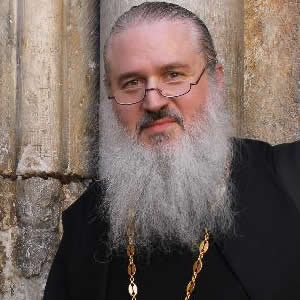 Fr. John Whiteford