Ms. Elissa Bjeletich: Welcome to Everyday Orthodox! It is Sunday, September 20, and we are live on Ancient Faith Radio. I’m Elissa Bjeletich; this is Everyday Orthodox. We get together here every Sunday night on Ancient Faith just to meet someone new, to meet a new, everyday Orthodox person. You know, I find that Orthodox people are fascinating. I love to go to coffee hours or different conferences. I meet people, and you just ask, “Where are you from? What do you do?” And it’s amazing the really fascinating stories that surround us. Of course, we have people from faraway lands and people who grew up in immigrant families, and a lot of converts who’ve come from all different diverse sort of areas and found the faith in different ways. I just think we’re an interesting crowd, so I’m always happy to meet someone else on a Sunday night.
We are live tonight. Bobby Maddex is right here in the studio, taking your calls, so you can call and join the conversation. The phone number is 1-855-AF-RADIO; that’s 1-855-237-2346. You can call us, or you can go in the chat room; it’s live: ancientfaith.com/radio/live. You are going to find the chat room, the phone calls. You’re welcome to join us at any point. We’d love to hear from you. I’m excited, because I’m thrilled to be introducing you to another exciting person tonight. Her name is Ginny Nieuwsma, and she is—I’m going to let her tell you the whole story, but she’s actually responsible for… She wrote a book; she put together a book after she converted, which is awesome. But she’s responsible for the antiochian.org website, and I know that so many of us Orthodox, when we are searching for information on different things, we go to the big jurisdictional sites. Antiochian.org is a great site and a great repository of resources and information. Right up front, Ginny, thank you for doing that; that’s a wonderful ministry. Let’s get started. Ginny, welcome to the program!
Ms. Ginny Nieuwsma: Thank you, Elissa. It’s nice to be here, and thank you for all that you do at Ancient Faith. I love everything that you guys are about: your podcasts, your blogs, which I love to pop into regularly. In fact, the thing that’s been keeping me during this COVID time is, of all things, I ordered the Journal of Thanksgiving, not knowing how useful it was going to be during this time. I started it in February and later looked back and thought, “Hah, that’s interesting that God had that right there for me.”
Ms. Bjeletich: Isn’t that remarkable!
Ms. Nieuwsma: A journal of gratitude in the midst of everything.
Ms. Bjeletich: That’s right., exactly. Nicole Roccas put that together, and she’s really a neat person. It’s kind of funny, because when it was coming out just at the end of 2019, I was like: “Oh, Nicole, that’s really neat!” and she was like: “I almost forgot that we ever did that, because I’m kind of on to the next project,” and it was literally just like God planted it at exactly the right moment so that at the beginning of 2020 we could all start journaling and thinking what did we have to be grateful for. It is good timing for it, yeah, absolutely. That’s right. That’s really a great journal. I need to… I have it, and I’m not doing it. Ginny, I think you’re right; this is the year for it.
Ms. Nieuwsma: [Laughter][ Tsk, tsk!
Ms. Bjeletich: Exactly. You know, it’s so funny. It was on my desk. I think I did it for a week. I’m bad with those things. I’ve got to get back to it. So, Ginny, tell me. I know that you’re on the West Coast now, but you’ve lived in a lot of different places. Where were you born? Did you start out in California?
Ms. Nieuwsma: I did. I was born in beautiful Santa Barbara, California, which I still consider my hometown. If you haven’t been there, go. [Laughter] It’s just beautiful Mediterranean enclave there, with the ocean on one side and the mountains on the other. My father was a professor at the time, at Westmont College, which is an Evangelical school in Santa Barbara. That’s how I started my life. I was there for the first four years, and then my dad, who had always had a call to missions—he had been raised as a missionary kid as well as a Methodist preacher kid—there he was in the middle of his life. He had tenure at Westmont College and just felt the call to the mission field. So when I was four, we moved to the Philippines.
I have some very early memories of landing at the dock, of seeing horse-drawn carriages that were still being used at the time to transport people around in old Manila. Sort of even then noticing as a child the different cultural things around me, and the drive to our new home there, which was at a radio station just outside of Manila. My dad took a job as the director of the classical radio station for the Far East Broadcasting Company, which was a Protestant outreach into Manila. We lived in a former military compound that had been turned into homes for missionaries, and that’s how I grew up.
I lived there. We owned a home in Santa Barbara; we would come back every couple of years, but primarily I grew up there in the Philippines until I was 17. So I was—I’m part Asian, I guess you could say.
Ms. Bjeletich: I’m absolutely— 13 years, those were some formative years that you spent there.
Ms. Nieuwsma: Very.
Ms. Bjeletich: So it was a military housing area. Was it like a little commune of… for lack of a better word, a community of all missionaries that all lived together in the same little place?
Ms. Nieuwsma: It was.
Ms. Bjeletich: Oh, that’s neat! What was that like?
Ms. Nieuwsma: A good way to express it. It was like having extended family all around with all the good and the bad that comes with that. [Laughter] But you know you felt very secure as a child, because your neighbors were all involved in the same work that your parents were involved in. We had a really strong international community there, because I grew up in the shadow of the Iron Curtain, as we called it, where the Communist repression that was going on in Russia and in other parts of Eastern Europe, and my father’s radio station broadcast the Gospel back into those countries.
So, see, I have a lot of radio in me. I used to walk over as a kid to the studio and see my dad in the studio doing his broadcasts. And I’m a third-culture kid. They’ve done a lot of studying on third-culture kids now, similar for a kid who’s in the military or whose dad is in business and they work overseas, so that the family goes with. You become something different, and they say that you’re most comfortable not in your home country, not in your other country that you grew up in, but on an airplane between two places! [Laughter]
Ms. Bjeletich: And it’s true. Really, that’s an experience really only shared by that little enclave of missionaries and international people. I have some friends; they’re ex-pats, because you call them ex-pats. They move around, and their kids are always at international schools, and this year they’re in Holland and next year they’re in Switzerland. It’s kind of the same, because you transport this interesting little ex-pat people who are sort of uprooted community, and you never really take root in the new place, but you’re also not at home either. That’s kind of amazing. Do you feel like…? I feel that’s interesting, the idea that you’re not comfortable at home or in the Philippines; either place is not really fully home. Do you feel like that, or is it now that you’ve been back for so long that you feel comfortable in the US, or is there like a lingering feeling?
Ms. Nieuwsma: Oh, yes. Not too much any more. I think it lingered into my 20s, but that was about it. You know, you do become acclimated, but I do remember as a young mom, being in the suburb in the Midwest and looking around and thinking, “What am I doing here?” It was just so different [from] my own childhood. But you adjust.
Ms. Bjeletich: Did it feel like, when you look at the difference between the two, like your childhood was more meaningful or maybe more adventurous? If you had to say what your kids missed out on by not having that upbringing, what would it be?
Ms. Nieuwsma: Oh, “adventurous” is a good word. I mean, by the time I was eight years old I had been through Europe, the Holy Land, several spots in Asia. At the time, you couldn’t fly from the Philippines directly back to the United States without stopping several places along the way. So we spent time in Japan, sort of hopscotched across back to California. We always spent some time in Hong Kong. We would stop in Hawaii in our trips back and forth. Then my parents took some money that had been in the family and took us all through Europe. So many, many memories.
I remember being in the third grade in my public school in Santa Barbara, and the teacher asking for a show of hands of who had been outside of California, and there were only a couple of us. Then she wanted to know who had been outside of the US, and maybe there were a few because of Canada and Mexico. And then who had been anywhere else outside of the continent, and I was the only hand up. I mean, it’s third grade, you know! [Laughter] Then she said, “Ginny, where have you been?” [Laughter] I started reciting the names of the countries.
I think it does. It shapes you in ways large and small. Sometimes it’s almost hard to put words to it, but I definitely sometimes would think with my kids, “Oh, I’m sorry that they haven’t had some of that.” On the other hand, everything that you do, every path that you take has strengths and weaknesses. I think in a way wanting my kids to have stability was more important to me, because I knew that, along with the adventure and the wonderful aspects of having that other cultural experience, there comes some struggle. So it wasn’t difficult for me to settle down in one town and have our kids there. We did make travel a priority, so we really tried, as the kids got older, to encourage them to travel and to take them on trips so that that heritage continued, of cross-culture into the next generation.
Ms. Bjeletich: Absolutely.
Ms. Nieuwsma: And then we became Orthodox, and that was a real cross-culture experience! [Laughter]
Ms. Bjeletich: No kidding! It’s actually funny, now that you mention it, because I wonder if the fact that you were a third-culture kid actually helped you adjust to Orthodoxy as being so different. It would be interesting to see if you adjusted more easily than somebody else, like, say, your husband. Do you feel like you adjusted easily maybe compared to somebody else, or was it harder because you had such a strong religious background?
Ms. Nieuwsma: Oh, yeah, good questions! My husband grew up in the Philippines, too.
Ms. Bjeletich: Oh! Wow, what are the odds?
Ms. Nieuwsma: We met at Faith Academy.
Ms. Bjeletich: That’s so cool!
Ms. Nieuwsma: There’s a really wonderful—strong academically and in every way, I would say—school, K through 12, outside of Manila called Faith Academy, and we both were students there. I went there from kindergarten all the way through with the exception of the couple years that we were in the US. Then I met Tim there when I was maybe second grade and he was third, something like that. So we had a very similar background, and then he went off to college, and then I went a year later, and we ended up both landing at Wheaton College in Illinois and reconnecting. It’s kind of an unusual story, but I would say that for both of us, I think that actually it really helped us to open our minds to the Orthodox Christian faith, because we were used to that jump across cultures. So, yeah, I think it probably worked in our favor.
I think the thing that was difficult was, as missionary kids, our lives were completely immersed in the Evangelical world. We didn’t grow up with mentors and the parents of our friends being in business and doctors and attorneys. They were all in Christian work. So that was our life, and when we approached the Orthodox faith, there were a lot of people that did not understand what we were doing. We left one world and entered another, essentially, so it was a challenging time in that way.
Ms. Bjeletich: I bet it was, absolutely. Let’s slow down a little bit before we get to that, because I do want to hear about sort of how that whole transformation happened for you guys. So you were in Wheaton. Did your family come home from the Philippines all together? Or was it time for you to go to college, so you came back and went to Wheaton?
Ms. Nieuwsma: Well, I came back. I actually started at Westmont College, because that was my family’s school in Santa Barbara. Then I went on a visiting program to Wheaton, and I just kind of fell in love with Wheaton. It’s such a Midwestern school in terms of values and the American culture. You know, they also joke—they used to joke—that Wheaton is the Evangelical Mecca, and C.S. Lewis is the patron saint! [Laughter] But I kind of fell for it, because it was something like what I pictured from the movies college should look like: these beautiful old stone buildings, and the seasons, which I had never experienced before. In the Philippines, there’s two seasons: the rainy season and the dry season. Santa Barbara, California, is basically one season with some subtleties, subtle changes. So I just loved everything. I loved the crunchy fall leaves and wearing thick sweaters, and the snow when it came. I really felt like I was on a movie set sometimes.
Incredible tradition there, actually, academically, and I was a lit major. Amazing literature department there. It left its mark on me. I still remember the things that I learned, both in the classroom and also at the chapels, which were beautiful. They had a beautiful chapel. They have a beautiful chapel there.
It was definitely California girl meets, I don’t know, Lake Michigan windchill or something!
Ms. Bjeletich: [Laughter] When you studied at Wheaton, your degree was in literature, so it’s not a religious degree. I always think of Wheaton degrees as always being religious degrees. Do you still study…? Are the actual studies imbued with a lot of religious content in a school like that, or are they… are you kind of doing like a regular literature degree that doesn’t look that different, but the community is religious?
Ms. Nieuwsma: That’s interesting. I would say, in a lit major… Maybe if you were a business major it wouldn’t be like this, but in a lit major it would be impossible for me to separate the Christian faith from the things we talked about and the way we approached literature. Part of what’s great about that is: How do you look at the old writers and not understand and discuss the Christian faith? How do you Dante’s Inferno? How do you actually look at those texts and not be able to talk about the Christian faith? And then that’s also where I got into some of the modern myth—not just C.S. Lewis, but Tolkien and George MacDonald and some of those other writers—and gained an appreciation for that. It definitely was woven into my studies.
At the time I was there, you had a biblical studies requirement. You didn’t get a minor in it or anything, but you just had to take a certain set number of classes. So they did include that, that Bible study part in the curriculum. But definitely studying literature there was rich. They have a real tradition of the C.S. Lewis kind of school, Oxford school, and real connections there.
Ms. Bjeletich: That’s neat. I bet that sounds like a great education, frankly, and hard to find these days. So you’re in Wheaton, you’re studying literature, and you reconnect with an old friend. Did the two of you start dating right away when you met back up in college, or was it one of those long, slow burn kind of situations?
Ms. Nieuwsma: So we knew each other in high school, and he was in love with my best friend. We got to know each other that way, actually. Then we dated a little bit in high school. He kind of took a break from pursuing my best friend, and the two of us went out for a little bit and then went our separate ways. So we had sort of this interesting history. When we saw each other again, I don’t think either of us really realized we were going to bump into each other. I remember exactly where I was standing and almost what I was wearing when he walked by, and I said, “Tim Nieuwsma!” So we gave each other a hug and started chatting. It was just a course of probably about six months.
He says I was like the girl next door. He’d known me since we were little. He was friends with my brothers in school, and our families knew each other. He didn’t think of me in that way. But we spent time reconnecting, and the interesting thing was we had years in the interim where we hadn’t seen each other, and we had both done a lot of growing and changing, obviously like you do between the ages of 18 and 22. So when we reconnected there was a very strong connection there, after a couple of months of breaking the ice and everything. So we started dating and dated through college and then got married a couple of months after we graduated.
Ms. Bjeletich: That’s neat. So what was the plan when you guys finished up? Did you consider, by the way, being missionaries like your parents had been?
Ms. Nieuwsma: You know, we did, we thought about it. The interesting thing is that Tim in the summers had gotten involved with a company called, at the time was called the Southwestern Book Company, and it’s a company that works with college students—only with college students—and trains them in sales, in door-to-door sales. He had stumbled into this and become a student manager and put his way through school, basically working summers with this job. They had amazing sales training that IBM and other companies used to send their people to, even though they just worked with college students. So he stumbled into business. It really wasn’t what he thought he was going to be heading towards. He thought he might be in ministry, maybe be a pastor or work for a Christian organization. After we graduated from Wheaton, he actually put out a couple applications in that direction, and nothing happened, and he ended up working in business and sales again. It’s kind of how God works. It wasn’t the way he started out with his thinking.
I, on the other hand, have had this straight line. I wanted to be a writer and editor from the time I was probably in the fourth grade. I was in an organization called Pioneer Girls, and somebody who grew up in the Protestant world would know what that is. It was like a girls’ club like Girl Scouts. My sponsor at the time gave me a book and said, “This is for writing. Write in this book.” I don’t know why she did that, but I started writing poetry, really bad poetry. [Laughter]
Ms. Bjeletich: I think everyone starts bad, to tell you the honest truth. I think you could get famous poets and put together all of their first 45 poems; it would all be horrible. I am confident.
Ms. Nieuwsma: I think mine are still… I don’t show my poems to people, but I love poetry. I love the spare words, just putting a lot of things into a few words. So I do it now just for myself, but that started very early. I had that straight line, and I knew I was going to major in lit and I did, and I edited the papers in school both in high school and college, and then I started freelancing when I got out of college, and here I am, right? Still doing similar work. That wasn’t a surprise. [Laughter]
Ms. Bjeletich: Well, there you go. Where did you guys end up heading? What happens next?
Ms. Nieuwsma: We got married, and I think because we were missionary kids and we didn’t necessarily have a natural hometown… At least Tim’s parents were still in the Philippines. Mine were on their way back at that point, because my dad was getting a little older, and he worked for the home office of the mission after he moved back to Santa Barbara. But Tim ended up taking a job that kept us in the Wheaton area for a couple of years, which was really nice, because we stayed around the college that had become home for us, and lived in the community. It’s a wonderful community, and we lived close enough to campus. I still remember as a young mom, you could hear: they have the chimes that go off every 15 minutes, so just keeping that toe in the door there. We still attended college church, which had been the church that we had gone to when we were students there. That was really a nice, stable start for us. Our first kid, two kids were born there in the greater Chicago area.
Then Tim got interested in commercial real estate and started talking about making a career change. We said, “You know what? Our family’s all out West, so if you’re going to change your career, maybe we should move back there,” because at that point we were parents, and we really wanted our kids to know their grandparents. That was not going to happen with them on the West Coast and us in Chicago area. It took a certain amount of pluck. We were in our mid-20s. I look back, and we were just babies! [Laughter] But we moved. He flew out and did some interviews up and down the coast of California, and that’s how we ended up in Silicon Valley, and he ended up going to work for a company, Saratoga Investment Company, and jumping into the commercial real estate world, so we ended up back in California.
Ms. Bjeletich: Well, it does take some pluck. It does take some pluck, because you guys really had so much stability at Wheaton, and you hadn’t had quite a home base other than that. It’s hard to pick up and go somewhere where you don’t have family, you don’t have the school, you don’t have the group of missionaries—you don’t have anybody; you’re just on your own.
Ms. Nieuwsma: Yeah. No, you’re right. It really was, looking back on it now, I think it was one of the biggest decisions that we made, because sometimes we say, “If we had stayed there, would we have discovered the Orthodox Christian faith?” Of course, you know. You look back at those forks in the road and you ask yourself those questions. But it was in Silicon Valley that we discovered the Orthodox Christian faith.
We love the Midwest, actually. I still think it’s a great place to raise a family. They’re just salt of the earth, you know?
Ms. Bjeletich: I completely agree. I love the Midwest. If I have to move somewhere, that’ll be my next stop. I don’t love the cold, though, so I’m a little torn. But I don’t hate it, but you know. It’s chilly, and the closer you get to the lakes, you get that wind going. It’s very cold!
We are going to take a short break. We’re going to take a little break and listen to a couple of announcements, and we’re going to be right back with Ginny Nieuwsma, and we’re going to find out how they came to find Orthodoxy and how Ginny came to be publishing an Orthodox book right away! We’ll be right back.
Ms. Bjeletich: And welcome back to Everyday Orthodox. We’re here tonight with Ginny Nieuwsma, and you’re welcome to call in. We’ve got Bobby Maddex in here answering your calls. It’s 1-855-AF-RADIO; that’s 1-855-237-2346.
But we’ve talked about [how] Ginny grew up a child of missionaries in the Philippines, came back, went to Wheaton, was a very nice Protestant girl, studying religious topics and completely unsullied by this weird Eastern faith. [Laughter] So the two of you are young and married… And you mentioned you were a young mom, hearing the bells of the school still. How many kids did you have in Illinois before the two of you—or I guess more of you—before your little family took the big leap and moved out to Silicon Valley?
Ms. Nieuwsma: We had our Annie Dawn, and then we had April Elizabeth, so we had two of our three daughters when we moved, and April was just a baby; she was about five months old.
Ms. Bjeletich: Excellent. Were you planning to have a big family at that point? When you got married, what were you envisioning, family-wise?
Ms. Nieuwsma: Oh my goodness! [Laughter] Not at all.
Ms. Bjeletich: I’m curious, because I know where you ended up! [Laughter]
Ms. Nieuwsma: And that’s so interesting to think about, but I was the youngest child. I have a sister and three brothers, and as the youngest you don’t get a lot of exposure to small children. I did not choose to babysit in high school. I think I can probably count on one hand the number of times I babysat, only when I was really desperate for money. So I think if you had asked me when we first got married, I would have said, “...two,” almost like it’s a stretch to think of that. [Laughter]
That’s one of the ways I think that life is so great, because we really grow into things. We change so much as we go along on the journey. We had the two girls, and it took—I don’t know—it took me a couple of years. I remember just thinking of myself as a mom and just giving myself over to that discipline. Of course, you have to do it and the job is there, but for me really internally to embrace it and to love it, it took a while. You know, it’s a big responsibility when you first start out.
[Laughter] I always say that there’s this progression in life. You think you’re a pretty nice person, and then you get married. And then you still basically think you’re a nice person, and then you have children! And then you still think you’re okay, and then you have teenagers. So it’s like all of this stuff causes your own weaknesses and things to bubble up.
After a couple years, by the time we moved to California, I had really embraced parenting and was really enjoying the girls. I loved those years with just the two. But then, you know, my husband—this is the way my husband tells it, and I guess this may be true—April got to be about four, and I kind of got this look in my eye and looked at my husband. Or maybe I was holding a baby, I don’t know. But we were young. We weren’t even 30, so we had plenty of time to have more children. So we had Allison, little Allison. Boy, when she was about one, my husband says I got that look in my eye anyway. Then we had our first boy. By the time I was about 32, 33, we had three girls and a boy. Then some more years went by, and then we had two more wonderful little guys, John Patrick and Andrew. By that time, I was almost 40, so then it was time to hang up the baby period.
Ms. Bjeletich: That’s great. That is wonderful. Okay, so you head over to Silicon Valley. Where were you guys, and was that kind of a culture shock for you? We were just talking about how beautiful the Midwest is and how wonderful the people are. Californians are great, too, but it’s different; it’s a very different culture.
Ms. Nieuwsma: Very different, and, yes, it was a culture shock. Yeah, very much so. I actually hadn’t thought about that for a while, but was like night and day. California, the weather’s so great and people are outdoors a lot, and all that’s really nice, but I found it a little harder to get to know people. In the Midwest, you’re inside for a portion of the year, and there’s a lot of gatherings and times when you’re sitting around the fire, getting to know people, that sort of thing. I also found that where we were in Silicon Valley is pretty unchurched, so there was no residual Christianity. Nobody in our neighborhood went to church. I didn’t meet Christians in casual encounters with people. That was something I was very used to in the Midwest. It was really a refining time for me in terms of my faith, and just at the same time as I’m really entering into motherhood and the hard questions that kids ask about God when they get to be three, four, and five years old.
So I went through a period of questioning and kind of going back to the basics with my own faith, recommitting myself and my mothering to being there for our kids spiritually. It was good, but it was hard. I’m sure a lot of people who listen to your podcasts… Who doesn’t have at least one or two experiences like that in life, where you’ve been thrust into something, and it’s just like a polar dip or something. You can look back later and see the grace of God was there, in the people that I was meeting, but it was; it was a very challenging transition for me.
Ms. Bjeletich: I’m sure it was; I’m absolutely sure that it was. I also had young kids in the same general vicinity, and it was. It’s very unchurched, I think surprisingly compared to the rest of the country. So you do end up deciding. You either decide to dedicate your household and kind of put your brain to it, or you kind of let go of it. I would imagine for you that’s especially hard, because you had grown up in this missionary community, where everyone was so faithful and everyone was on the same page, and then you were at Wheaton where everyone is Christian, I would assume, or at least the majority, and everyone is actively talking about their faith. You’ve been in all these communities where Christianity is intentionally nurtured and spoken and expressed, and all of a sudden you’re in a place where you’re not really meeting anyone who’s Christian. What did you guys do church-wise? Were you able to find a church community that worked for you, or what ended up happening?
Ms. Nieuwsma: Good question. I think actually now even just you framing it that way, it helps me to see that moving to California was really the beginning of us becoming Orthodox, because we said, “Oh, now we have to find a church.” So we started looking, and we got involved and joined small groups and everything. But what we were really asking was the bigger questions: What is the Church and where do you find it and what does it look like?
We were Presbyterians for a while, and I think the reason we ended up in the Presbyterian Church is really we were looking for depth. We were looking for something that wasn’t just invented last week. We had visited a few megachurches when we came out to Silicon Valley, and it just wasn’t our cup of tea, with the TV camera going up and down the aisles while people were singing praise songs; it was just very disorienting to us. I think that it was that dipping into a couple different traditions after we moved to California to try to discover what it was we were, because we had always been in a very inter-denominational situation, and in inter-denominational churches in the Evangelical world. That’s very common. So I didn’t know: Was I a Baptist? What was I? Was I a Methodist? I didn’t even know. I loved Christ, you know.
Ms. Bjeletich: I love how you said it put the onus on you to be in this culture that was not Christian. I like how you said it: There was no residual Christianity. There’s a post-Christianness to the culture out there. You kind of… It does. It puts an onus on you to decide and to figure it out and to do all the work. Whereas when you’re at Wheaton or if you’re in a community of missionaries, the work’s done for you.
Ms. Nieuwsma: Right. That’s right.
Ms. Bjeletich: The school or your parents or whoever, they’ve all decided what church is. They all know what worship is, and you can just follow along. But then, I do think in so many ways, it’s very interesting for a young couple, newly married, to move away, and probably for a single person, too, just because I didn’t do that. But to move away from your home culture and your home family. When you’re transplanted like that, there’s a real degree of intentionality for everything, and especially the faith, that you have to make those choices and you have to decide: What are you going to do?
It sounds like you were kind of navigating toward older and older, more and more liturgical traditions. What happened?
Ms. Nieuwsma: Wow, what happened was we were in this Presbyterian church, and we were in this small group of families that were really close. We were all homeschooling together, having our baby showers as the next baby would come along, and sharing our lives. It was actually really a wonderful chapter in the sense that we found a community in the midst of what was feeling a little bit like a desert spiritually. Within this group, there was a couple that had, through a series of circumstances, started attending a sort of Orthodox start-up church. We were concerned about them, don’t you know. [Laughter] What was this thing?
In fact, at the time, the strangest thing, Elissa, is that we lived around the corner from the biggest Orthodox church in Silicon Valley. It’s a big Greek Orthodox church.
Ms. Bjeletich: St. Nicholas?
Ms. Nieuwsma: Yes, and we were so ignorant that we would go on our family bike rides by there, and look. “Look, Tim, what do you think that is?” “I think it’s a branch of Catholicism or something.” [Laughter] That’s the thing that floors me now, just how ignorant we were. It’s nobody’s fault. It’s just we had no clue what Eastern Orthodoxy was. We really did think it was a branch of Catholicism.
Ms. Bjeletich: Absolutely, and Orthodoxy is kind of invisible in California. It’s there, but you don’t see it. I remember now, growing up, I had a friend who was Greek, and he had icons in his house, and I never thought about it. I always have friends who say, “Oh, you’re from California. You must have loved going to see St. John Maximovitch.” I’m like: I drove up and down Geary all the time, never had any idea that was there. I never thought twice about it. It is an interesting thing, because it’s like an underground community, and you don’t know that… You can literally walk right past and not know, whereas I think in the Midwest you get like a Serbian community and a Greek community, and they’re kind of more visible. But in California somehow it’s like everybody’s undercover.
Ms. Nieuwsma: That’s a really interesting observation, but true, I think.
Ms. Bjeletich: I assume you had never heard about, like, St. John being right there, his relics.
Ms. Nieuwsma: Oh, no.
Ms. Bjeletich: His relics were right around the corner, and all the Orthodox people are like: “Oh, San Francisco, Joy of All Who Sorrow,” and we’re all out there, living out there, going right by, going: “I don’t know what you’re talking about.”
Ms. Nieuwsma: No clue, yeah.
Ms. Bjeletich: So they’re going to a little mission start-up parish there.
Ms. Nieuwsma: They’re in this church, and it’s Antiochian, actually. They start talking about it, and the priest that was guiding the mission at the time, Fr. Jon Braun, who was out of the [EOC] movement that came into Orthodoxy years prior. He is just a dynamic teacher and leader. So our friends got the guys in the group—because we used to meet, the women would meet one week, and the guys would meet one week—the guys met with Fr. Jon. He said, “Hey, you guys, you’re asking me all these questions. I can’t answer them, but here’s a guy who can, so come and hear him.” So a bunch of them did, and Tim came home, and he had some kind of manuscript in his hand about somebody who had converted to Orthodoxy that he was going to read, and he stayed up till four in the morning reading it. I mean, I still had no idea what it even was, right? But he immediately—I don’t know what it was. I think he was just ready. And he was just immediately drawn.
So, of course, you know, I’m like: Oh, man! By this time we have four children, and so what are you doing here, dear? But I said, “Okay, I’ll visit.” So we all went. Oh, I can’t even describe my first service. Well, for one thing, they were meeting in an auditorium, a Protestant high school auditorium, so I didn’t really get a traditional first experience. But it was just… Everything was so different! Why is the priest…? Why are we looking at his back? And why are they singing all this stuff instead of reading it? And then they come around in the Great Entrance: well, why are they doing that? I had never seen anything like it, and I thought I had had a broad exposure to things.
We left, and Tim said, “Well, come on, sweetie. I didn’t like beer the first time I tried it, either.” [Laughter]
Ms. Bjeletich: That’s awesome!
Ms. Nieuwsma: But, you know, I’m a reader, and I saw what was going on with my husband. So I thought, “Okay, I’m going to read. I can do that.” And I just read everything. I just devoured all the usual books.
Ms. Bjeletich: Out of curiosity, which ones? Which ones stand out?
Ms. Nieuwsma: Timothy Ware and Fr. Peter Gillquist’s book, Becoming Orthodox. And then the Apostolic Fathers had a tremendous impact on me, because reading the original writings… You read the writings, and you say, “This is not the Evangelical Church here. It’s something else.” So I could see the continuity between that and this meeting on Sunday morning that seemed so strange, this liturgy that seemed so strange. I just read, and Fr. Jon was a wonderful mentor. We’d have him over, and we’d sit him on the couch, and we’d just throw all our questions at him! [Laughter]
He said, “Ginny Nieuwsma, when you die, I’m going to stand by your grave, and I’m going to throw in all the rest of these, and you can take them up to the Lord!” [Laughter] He’s got a great sense of humor.
Ms. Bjeletich: You can ask him all these questions! That was great.
Ms. Nieuwsma: But it was just over time, and I think participation in the liturgy… Really, when we went through Holy Week… What can you say about Holy Week? I realized I have never experienced anything like this as a Christian. So it was a combination of a year’s worth of attending and just the reading and having people that were very compassionate with us. I think it was pretty important that they came from the same background we did, because he knew what I was going to ask almost before I asked it, and the things that I would be negatively reacting to, whether it was the saints or the Theotokos or just the concept of liturgy itself.
Ms. Bjeletich: And he understood the vocabulary. When you said “salvation,” you meant something different than he meant, and he knew that and saw it coming and could adjust with you.
Ms. Nieuwsma: Yep.
Ms. Bjeletich: That is really a value. That’s a neat thing. But I agree. I think there’s something… Attending the liturgy… I remember, when I was converting, standing in the liturgy and hearing it in English for the first time and listening and thinking, “I really can’t object to any of this.” [Laughter] And then as you stand there, slowly it changes you and you begin to see that. That’s wonderful. So over the course of a year, is that what happened? You guys spent a nice year going through the liturgical year and studying, and then you were chrismated at the end, or maybe baptized?
Ms. Nieuwsma: Yeah, the kids were baptized, and we were chrismated. Oddly enough, Elissa, the date was September 11. That is when we joined the Church. That’s interesting.
Ms. Bjeletich: Back at that time, it was not a big deal, but now it just feels like that’s such a big day.
Ms. Nieuwsma: Such a weighty day, right?
Ms. Bjeletich: It’s written on our hearts now in a different way.
Ms. Nieuwsma: It’s interesting, because my parents and several family members came to our chrismation and the kids’ baptisms. It was a long service. I don’t know that it was that wise for me to invite them, but they were my family, and I know they love me and they’re Christians. I rode home with my dad—and it was just the two of us—whom I have enormous respect for. I said, “Dad, what’d you think?” He was kind of quiet. At this time, he was still serving on the leadership level at a Protestant church where he lived. He said, “You know, it’s very Christ-centered, honey. I read the Bible, and I don’t really see those things about Mary or about the saints, but I can tell that the important things are in place.” The other thing he said was, “If you lived in my area, I don’t know where I could tell you where to go. I could not recommend a church to you any more,” essentially.
That was meaningful to me, both that he recognized the Christ-centered nature of it, and also that he was putting his finger on something, which is that the church is changing so much that he doesn’t even recognize it. You know?
Ms. Bjeletich: Yes, and I think to say that phrase, like someone like your dad says that it’s Christ-centered, that is the ultimate compliment, frankly.
Ms. Nieuwsma: That’s right.
Ms. Bjeletich: I know if my mom were to say it’s Christ-centered, I’d be like Yes! Fantastic! She has not said that yet; she has not said that, but perhaps one day. I think that is a big compliment, and that’s probably a testament also to your priest who understood what it’s like to convert, and who got your parents a bit and was able to communicate that to them. That’s also a big blessing; that’s wonderful.
So you’ve converted, you have your kids, and then, what 15 minutes later you’re publishing a book with Conciliar Press, which is now Ancient Faith Publishing. What happened? How did that work out?
Ms. Nieuwsma: Another thread we haven’t talked about is that from the time I graduated Wheaton I started freelance writing. Even through having the children I had continued to write and edit. I had kind of a nice spot with a couple of Christian Evangelical publishers that I worked for: Tyndale House, David C. Cook, names that are familiar to people in the Evangelical world. I did book reviews for Christian Parenting Magazine, profiles and interviews. In fact, it’s very odd being interviewed, because I’m usually the one doing the interviewing!
Of course, a lot of the things I had read were from Conciliar Press, and we lived in Silicon Valley, and at the time Conciliar Press was located 45 minutes away. They had a wonderful bookstore at the press, and my husband was up there browsing through stuff. I guess somebody came out who worked for the press, and he said, “Oh! You need to talk to my wife!” He’s my salesman, you know. So through that I connected with Conciliar and ended up working on that book. Really, yeah, talk about soon. The stories of women who’ve come to the Orthodox faith. I think it was two years after our chrismation or something like that.
Ms. Bjeletich: But it’s a book about converts, right? It would be different if you had come in and a year or two later wrote a book about how to be Orthodox. But a book about women who convert, you were an expert at that point, because you were one of them.
Ms. Nieuwsma: It was actually fine for that very reason. You’re right; it was. It’s changed so much. I could not write that book now. I mean, Orthodoxy after 26 years sinks down in and is deeper and in some ways harder to express than those… Those were my initial responses to it, because my story’s in there, too. But it’s been a real blessing, I have to say, and you probably have this with being involved in this work. You go and you meet someone somewhere, and they say, “Oh, this or that thing was really helpful that you worked on,” and it’s totally the Holy Spirit. We have no control over that. We just put out the work or the thoughts or the writing, and then we just trust that God will have it watered and make fruitful in the places where it’s supposed to. It’s nothing that we can do in our own strength, but it’s really a blessing. To this day, all these years later, I will meet someone in a fellowship hall somewhere or something, and they’ll say, “Oh, your book…” Guys tell me, “Oh, that book was helpful for my wife,” which really means a lot to me when I hear that.
Ms. Bjeletich: Absolutely, and it’s true: God does wonderful things. You just sort of put out that stuff, and then God does stuff with it. That’s wonderful; that’s amazing.
Ms. Nieuwsma: Right? His grace.
Ms. Bjeletich: Absolutely. So how did you end up working with the website for the Antiochian jurisdiction? Because I should say, I mentioned earlier antiochian.org; that’s the official website of the Antiochian jurisdiction here in America, right?
Ms. Nieuwsma: Right. I started…
Ms. Bjeletich: How did they pull you in? [Laughter]
Ms. Nieuwsma: After I’d been with Conciliar for about ten years, we had a lot going on in our family. We were moving our in-laws closer to take care of them. Our daughter was getting married. I went ahead and resigned to have a period of time where I wasn’t trying to do work and other things, too. Then a former coworker contacted me and said, “There’s this opening at antiochian.org.” I said, “I don’t know anything…” I was picturing technical work. I said, “I don’t know anything about that!” And they said, “Oh, no, no. We’ll teach you.” It was just a very random kind of thing. Actually, in my work life, that has mostly happened. Things just kind of drop down. I mean, I have a resume, and I’ve occasionally used it, but it’s just been: Oh, here comes the next thing, and that’s the way that was.
I jumped in and I started learning how to manage a website, learning about content management systems and how to do postings and how the web is different, which it really is, than writing articles for magazines like what I had been doing. I had, again, the blessing of getting to know people within the Archdiocese in a different way, because we did a lot of interviews. We have done a lot of interviews. Then we went through the sorrowful loss of Metropolitan Philip and the joyful enthronement of Metropolitan Joseph. So now I’ve been in the role of editing there for over eleven years. I have to say, the Antiochian Archdiocese… Well, Ancient Faith is a department of the Antiochian Archdiocese. There’s a very strong evangelistic spirit there, in a lot of the priests and people, and it’s a real blessing to be able to work with them.
Ms. Bjeletich: It’s neat how each of our jurisdictions has kind of a different flavor?
Ms. Nieuwsma: Isn’t it? Yes.
Ms. Bjeletich: The Antiochian jurisdiction is so much about reaching out to Americans and trying to speak the language that Americans speak. It’s a beautiful thing. It’s wonderful. So, tell me now. Over the years, I know you’ve moved up to Oregon, life has changed a bit. Now you have… How many kids do you have? And tell me, I hear that one of your kids recently got married, and I want to find out what was the wedding like with coronavirus.
Ms. Nieuwsma: Oh, yes. This was quite a summer, because we moved here. We have a granddaughter that was born in June. Her parents are a priest and presvytera, and she’s child number seven in that family! And then, yes, then our son, on the heels of that, was married at Holy Trinity in Portland. Now we have another grandchild that we’re excitedly awaiting, who is going to be born in New Jersey at the end of October. We’ve had a very busy… When you have a big family, you have kind of these years where it feels like everything just happens at once, and this is one of those years.
Our son, they were allowed a certain small number in the church. They were allowed more outside. Fortunately they had just eased the restrictions so that there were more people who could come. But, you know, honestly, the sacrament is so beautiful, and you get inside the church, and the service starts, and you don’t think about it. You don’t think about COVID. You don’t think about who’s wearing a mask out there or who isn’t. You’re just entering in. I just think our Orthodox weddings are so beautiful and so amazing. And the reception: God was merciful. We had beautiful weather, and it was right on the river on this beautiful afternoon. It was great.
Ms. Bjeletich: That’s excellent. Fantastic! Ah, that’s beautiful. You’re right: the sacrament is so beautiful. I actually kind of wonder… Sometimes with weddings things get so big, and it’s so much about making everything just right that we miss the beauty of it, and we’re so busy with the details. Maybe in a way it’s a blessing to be getting married at a time when you’re not allowed to throw a really huge party. It’s just a small group of you gathered in the church. Sometimes that’s more beautiful.
Ms. Nieuwsma: Well, and the people in his wedding party [were] pretty sweet, because they said, “Oh, there’s so much joy in just being able to do something like this.” This has been a tough time for everyone. I mean, there’s so much stress right now, and no one knew we were going to have all this go on this long. I think for some people it was the first social event that they’d done, maybe since COVID started. Just full of joy. And you’re right; I think sometimes we lose the forest for the trees with the weddings, for sure. The people I know who’ve had COVID weddings have said it’s just very simple, but at the end of the day, they’re still married, right?
Ms. Bjeletich: That’s right; that’s absolutely right. And in the end, I think maybe we’re better off for it, as always. There are always silver linings, absolutely.
Ms. Nieuwsma: That’s right.
Ms. Bjeletich: So what are you up to these days? What are you doing? You’re in Portland. Where are you?
Ms. Nieuwsma: I am. We are on the western side of the river, if you know Portland. Across the street is the city of Beaverton, so that’s how close we are to the next town over. It’s really beautiful here.
Ms. Bjeletich: Oh, really? So you’re in kind of one of the prettiest spots in the country, aren’t you? It’s really beautiful.
Ms. Nieuwsma: It is stunningly beautiful, actually, and we are enjoying that. We live near some of our kids, anyway, which was our goal, and that’s a real joy. I’m working part-time for St. Vladimir’s Seminary. We didn’t touch on the fact that Tim and I lived there for a couple of years, and we’re big fans of St. Vladimir’s and I still work for them. I work full-time, between the Antiochian Archdiocese and St. Vladimir’s. I’m a gigi; I’m grandma. Hoping to do a garden in the spring and keep writing in my journal of thanksgiving.
Ms. Bjeletich: That’s right. Head down, keep walking.
Ms. Nieuwsma: Right! Exactly.
Ms. Bjeletich: Glory to God. That’s fantastic. Ginny, I’ve so enjoyed getting to know you tonight, getting a chance to talk to you. I know that you and I, our paths have almost crossed a couple of times, so I’m very grateful to get a chance to sit down and talk with you. And thank you to our audience for joining us. Thank you very much. We’ll be back next Sunday night with another everyday Orthodox person. Thanks, Ginny. Good night.
Ms. Nieuwsma: Thank you.
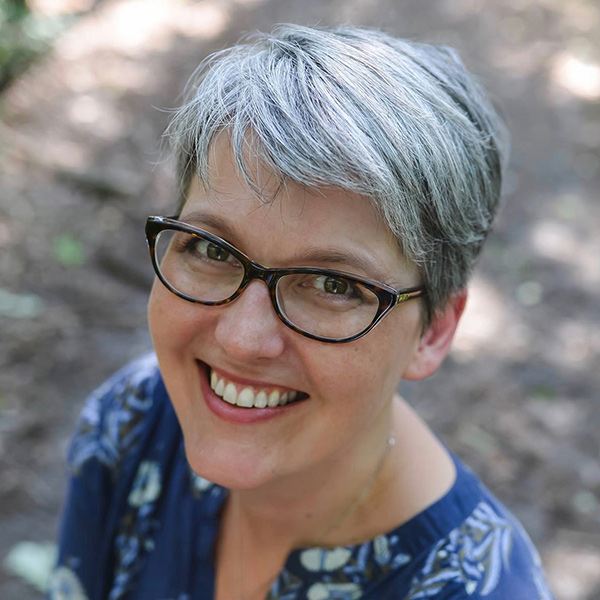 Elissa Bjeletich Davis