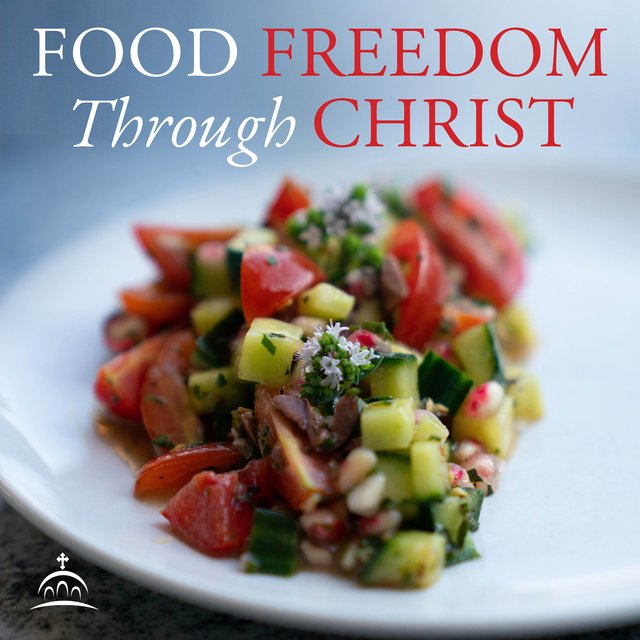
Krista Fedorchak helps you foster a peaceful relationship with food through the wisdom and practice of the Orthodox Church.
This is Food Freedom Through Christ.
Krista is a registered dietitian and private practice business owner who offers Christian-based insights into caring for body and soul alike. Here she is with today's episode.
Hello. Welcome to another episode of Food Freedom Through Christ.
I'm your host, Krista Fedorchak, and today we will be talking about good food and bad food, and my humble request to stop using these words when talking about food.
People use "good" and "bad" to describe food all the time. Right?
Good food is described sometimes as clean, correct, or right, and is usually talking about foods rich in nutrients, like lean proteins, vegetables and fruits, high fiber foods,
while bad foods might be described as wrong, off-limits, guilty pleasures, sinful, even.
These are foods like pizza, chips, ice cream, and foods high in fat or sugar.
Okay, so now we have a problem. We have these foods many of us may eat and enjoy, but they are labeled as "bad." And no one wants to be bad.
So how do we remedy this?
Well, go to the grocery store and you'll see all the ways in which we modify food to make it less "sinful."
We take the fat out of yogurt, we take the carbs out of bread, we inject protein into pancakes, all in search of a guilt-free eating experience.
Or, if we indulge in a "bad food," we justify it by calling it a cheat day, a splurge,
and it often comes with a heaping side of guilt.
But the problem with attaching morality to food in this way is that judgments about our own moral character may not be far behind. And this misses the mark.
St. Paul says, "Whether you eat or do not eat, do it for the glory of God."
One thing I work on with my clients is a mindset shift, one that says, food is not good or bad, but food is just food.
Now, I'm a dietician, so of course we do not ignore the nutritional value of food.
We know certain foods provide more physiological benefit to the body compared to others.
We know some foods have certain ingredients that aren't that nutritious for the body.
But having one choice lead to pride and another lead to guilt is not spiritually helpful.
Maybe one day we'll get into the weeds of morality in our food system,
and we will definitely one day talk about what the Church Fathers say about the link between eating and its effect on our efforts to be Christ-like.
But today we are trying to detangle the nutritional value of food and morality.
The big takeaway? Eating more nutritious food does not make you a good person,
and eating less nutritious food does not make you a bad person.
But for those of us who are stuck in that mindset, it can create a lot of anxiety around food,
and it may take some work to rewrite that internal dialogue.
One approach that may help: Broaden the definition of "good."
All food has the potential to be good food. Why? Because food is a gift from God, the source of goodness Himself.
St. Paul says, "For everything created by God is good." That's 1 Timothy 4:4.
And we know that this divine goodness spoken of here runs deeper than the flesh of a fruit.
But foods and the context in which they are eaten and enjoyed are little snapshots of some of God's most beautiful gifts to us.
So here are some ways I define good food.
Good food is fresh food: freshly picked, freshly sliced, freshly baked, freshly prepared.
When our food spends less time in transit, less time on grocery store shelves, and less time sitting in the kitchen cupboard, we can taste the difference.
Good food is local food. Whether picked out at the farmer's market or picked yourself, local produce and other farm products boast that undeniable attachment to the earth, of which we are called to be good stewards, and a recognition of doing good for your neighbor in support of local farmers.
Good food is tasty food: bursting flavors and kitchen table memories that stick with you long after the meal is complete.
Good food is family food. You know, the old family favorites preserved through worn-out recipe cards, or the family favorites that make an appearance at every feastday dinner table.
It's food that connects you to your family's history and the family meal.
Good food is food you didn't have to prepare: going out to a sit-down restaurant and selecting exactly what you want without having to consider the ingredients, steps, or time it would take to prepare it yourself. That's nice.
Good food is food offered in hospitality. When visiting with family or friends, or having somebody over in need, food is one way we can offer hospitality and love. Remember Abraham and Sarah?
Good foods are your favorite foods. We are emotional beings, and this means our attachments to certain comforting memories can come alive through food—and this is a good thing.
Good food is any food eaten in a hungry state. Everything tastes a little better when we're hungry.
We appreciate more what we have when we've gone without. Right?
We think about Pascha or Christmas, those meals after a fast. Everything tends to taste so good.
Ultimately, good food is food that God has blessed.
In the same breath, St. Paul continues, "For everything created by God is good, and nothing is to be rejected if it is received with thanksgiving. For then it is consecrated by the word of God and prayer."
So here we see the importance of the context: how we are receiving that food, how we invite God into that eating experience, and then what we do with the energy, the comfort, or the love that that food provided us.
We don't look to the nutrition label to find its inherent goodness. We look to it to find useful information about nutrition, but not the moral character of the food or the person about to eat it.
Ultimately, all food has the potential to be good food.
When we recognize this, our hearts and our bellies can receive this life-sustaining gift in a way that keeps us humble and thankful.
Can you think of any more examples of good food? Let me know by sending an email to foodfreedom at ancientfaith.com.
And may we be open to recognizing and receiving this goodness the next time we eat. Enjoy!
Food Freedom Through Christ. Fostering a peaceful relationship with food through the wisdom and practice of the Orthodox Church.
You can email your questions and comments to Krista at foodfreedom at ancientfaith.com.
This has been a listener-supported presentation of Ancient Faith Radio.
 Krista Fedorchak