St. Basil the Great, in a homily that he preached during a famine in fourth-century Cappadocia, said something that one imagines would have been pretty hard to hear during a famine.
And that is that he told them, "The bread in your cupboard belongs to the hungry. The cloak in your wardrobe belongs to the naked. The shoes that you let rot belong to the barefoot.
The money in your vault belongs to the destitute. You do wrong to everyone you could help, but fail to help."
Now, a lot of time has passed between now and then, and yet these are still very uncomfortable words for us to hear today.
This is not the way that most of us think about our possessions, especially in this country. I'm speaking mostly to my fellow Americans here, because that's the context in which I serve as a catechist.
We tend to think about the things that we have as being our own, things that we earned, things that we budgeted for, things that we saved up for, maybe just things that we bought on credit, most of the time, if we're being honest.
And then giving is something extra that we do with whatever is left over, after we have taken care of ourselves.
But what St. Basil says here is that this is exactly backwards, that what you have beyond what you need isn't yours; it actually belongs to your brother, especially to your fellow Christian.
So you're not actually being generous when you give; you're just being just. You are, in some sense, maybe even returning stolen property.
[Music]
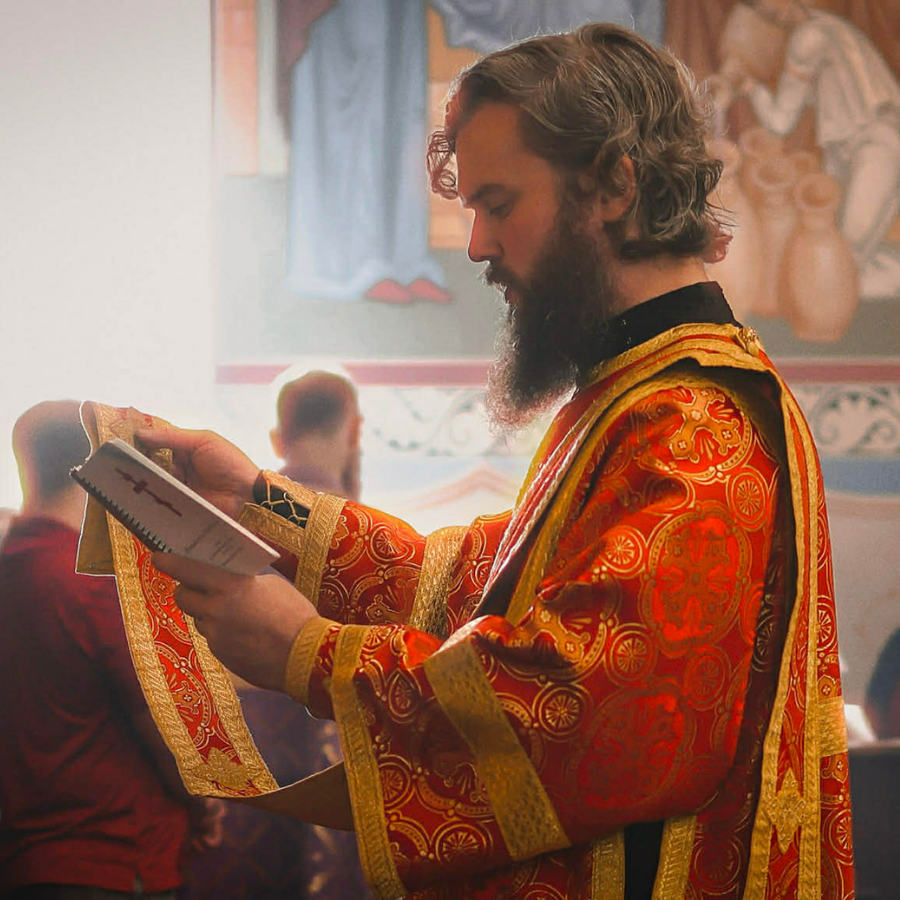
Hello, beloved. My name is Dn. Seraphim Rohlin, and this is How to Be an Orthodox Christian.
In our last two episodes, we talked about prayer and fasting, which are the first two of the three disciplines that Christ teaches his followers on the Sermon on the Mount.
Actually, we've been addressing them a little bit out of order for reasons that we talked about in the last couple of episodes,
but today we're going to come to the third, and in some ways the most overlooked, of the three spiritual disciplines which Christ teaches, which is, of course, almsgiving.
So if prayer is the discipline that turns us toward God, fasting is the discipline that teaches us mastery of ourselves,
then almsgiving, which is what I'm talking about today, is the discipline that will teach us to love our neighbor as ourselves, which is the second commandment, the second great commandment.
This is the practice by which we learn very slowly, very imperfectly, and very often reluctantly to stop hoarding what we have, to stop hoarding what God has given us, and instead to bless those around us.
The Fathers of the Church are nearly unanimous in teaching that when we do this, we are doing the most God-like thing a human being can do, because God, in his very nature, is the one who gives.
There's a line in the Divine Liturgy that the first time I ever heard it really began to change the way that I thought about everything that I have in my life and everything that I do in worship.
And it is the moment at the offering, the anaphora, when the priest—or if a deacon is serving, and usually when I'm in church there is a deacon serving—
when the deacon lifts the bread and the wine that are on the altar, and the priest or the bishop says, "Thine own of thine own we offer unto thee on behalf of all and for all."
What I want to pose to you today is that the theological foundation of almsgiving, and in fact the theological foundation of the way that you should relate to all the things in your life that you think are yours, that you think you own, should begin in this phrase: "Thine own of thine own."
That is everything that we have—every dollar, every meal, every breath—it all comes from God.
So when we give—let's say when we give money to the Church—we are not parting with something that belongs to us, like: "Oh, look at me, I'm this great benefactor, I've given up something that belongs to me."
No, you're actually returning to God— either maybe through a gift to your church or through your neighbor who is the image of God. You are rendering to the image of God something which is always his.
The psalmist says very plainly, "The earth is the Lord's and the fullness thereof, the world and all those that dwell therein."
So David makes the same kind of point later on in the books of the Kingdoms when he gathers the materials for the temple, he prays—
which he's not going to be allowed to build; his son is going to build it, but he gathers the materials—
and he prays, "All things come from you, and of your own we have given them to you."
So this offering, this line in the liturgy, like all the language in the liturgy, is echoing the holy Scriptures here, and in this case it's specifically echoing David.
So it means that the question is not, "How much should I give?" as though giving is an occasional withdrawal from an account that is fundamentally ours,
but the question is rather, "How much am I keeping?" and whether or not it's something I should be keeping.
And this is the question that St. Basil kind of presses in his homily.
And we have to keep in mind that he gave that homily in the time— the context was a time of great need—not great abundance, great need—
when people could have very easily made an argument for why they should hold on to what they have, to save up, to prepare for the future rather than attending to the needs of their fellow Christians.
And this is the question that Christ presses in the gospels again and again and again.
Before we get to what Christ himself says about almsgiving—he says a lot about it—we need to understand something about the God who commands it, because the command to give doesn't just come out of nowhere. This isn't just an arbitrary action we take.
So I mentioned earlier, just a moment ago, that the Church Fathers saw the act of almsgiving as a God-like action, a God-like undertaking.
And that is because this is something that comes, as all the commandments do, from the very nature of God himself.
The Scriptures reveal a God whose most fundamental action, the most fundamental way that we know him, is through his gift of himself to us.
We experience this in a general way. For instance, through creation: God doesn't create because he needs anything.
The Holy Trinity, the Father, the Son, and the Holy Spirit have one another for all eternity. Their shared life is a shared life of perfect communion, of perfect love, of perfect fullness—and yet, God creates.
He brings forth a world, not out of necessity, but out of this sheer self-giving love.
And in doing so, he creates beings who can receive his goodness and participate in his life.
And this is how you should think about the spiritual disciplines.
Prayer allows us to participate in the life of God because it invites us into that communion of the Trinity;
fasting allows us to participate in the life of God because it frees us from our attachment to our animal passions, and we become more and more like God;
and, of course, almsgiving also allows us to participate in the life of God because it allows us to participate in his self-giving for the salvation of the world.
So, to those beings that he creates out of his self-giving, out of his generosity, he continues to give.
He gives us the commandments. He gives us the law. He gives us the prophets.
He gave us our forefathers' manna in the wilderness. He gave us water from a rock. He gave us a land flowing with milk and honey.
And when his people turn away from him—not once, but over and over and over again, century after century—finally, he gives them his only Son.
And this is the shape of the whole anaphora, the whole prayer that we pray at the offering, when we worship God together on a Sunday morning— is thanking God for all these different gifts he's given us,
including, of course, this liturgy.
"This liturgy, which you have vouchsafed to accept from our hands, even though there stand beside you thousands of archangels, ten thousands of angels, etc."
So, God is all abundance. Even if you wanted created beings to worship him, he doesn't need us: he's got the angels.
So, why do we get to be a part of any of this? Well, that is because of his generosity.
And, of course, the most famous verse in the Bible, probably, John 3.16: "For God so loved the world that he gave his only-begotten Son." Right?
You've probably heard or seen online maybe that the Orthodox understanding of salvation is theosis.
This is a nice Orthodox word, "theosis," which usually is described as becoming by grace what God is by nature.
A lot of us don't have a good sense of what that looks like.
Does it mean like you get superpowers? Well, actually, sometimes it does.
We'll talk about miracles. We'll talk about saints. We'll talk about all those things over the course of this.
But it begins by taking on aspects through grace of what God is by nature.
So, if God by nature is love, is self-giving love, then we become like him by giving, by emptying ourselves, not just our money, not just when it's convenient. We become like God by giving of ourselves in a more deep, self-sacrificial way.
So, the Christian life is not, at its root, a matter of believing all the right things or following all the right rules.
I said back in the church tour video a few weeks ago that actually in the Orthodox Church there are no rules.
Obviously, there are certain rules. There are things you can't do and remain in the Church. And obviously, there are certain guidelines around fasting such as: when you fast, don't make a show of it; don't tell people that you're fasting. When you pray, don't pray, you know, on the corner or the housetop.
These are rules that Christ gave us for how we're supposed to practice these spiritual disciplines.
But what I mean when I say it's not really about rules or there are no rules in the Church, what I mean is that the Christian life is not a matter of just believing the right things or following the right rules.
Obviously, the things that we believe are important. Obviously, being obedient to the law of God is a very important part of the Christian life, as we're going to discuss in the next few episodes,
but all of these things are just a means to an end; they're all just a means to the goal.
The Christian life always has as its goal the transformation into the image and likeness of God.
This is the God who gives everything away and never runs out. He is the Bread that is eaten yet never consumed and who sanctifies all those who partake thereof.
All right. So let's turn now to what Christ says about giving on the Sermon on the Mount.
If you've been following along with our series, you know that the Sermon on the Mount has kind of been our anchor text for this whole early section on praxis in which we're focused on the initial ascetic disciplines of the Christian life: prayer, fasting, and almsgiving.
In the last two episodes, we looked at Christ's teaching on prayer and fasting in Matthew 6, but almsgiving actually comes first in the passage.
This is the first of the three disciplines which Christ gives to us. It's the first one he addresses.
And this is what he says. He says: "Take heed that you do not do your charitable deeds," that is, your almsgiving or your charitable deeds, your works of mercy—different ways to translate this word—"before men to be seen by them.
Otherwise, you have no reward from your Father in heaven. Therefore, when you do a charitable deed, do not sound a trumpet before you, as the hypocrites do in the synagogues and in the streets, that they may have glory from men. Assuredly, I say to you, they have their reward.
But when you do a charitable deed, do not let your left hand know what your right hand is doing, that your charitable deed may be in secret, and that your Father who sees in secret will himself reward you openly."
Now, notice, what Christ does not do here.
He does not say, "If you do a charitable deed," in the same way that he did not say, "If you pray" or "If you fast." He says when.
He assumes you're going to do these things. He assumes that his followers will fast and pray. He assumes that also they're going to give alms. So the question is not whether you do this as a Christian but how. I hope that's very clear to you.
And the how matters enormously, because giving can be an act of self-emptying love, but it can also be an act of self-aggrandizement.
He says, "Don't sound a trumpet before you," that is: "Don't make this big public display."
You think about maybe the named building or the social media post about the charitable donation.
All of these kind of turn the gift into a transaction: You're no longer just giving to the person in need; you're buying admiration, you're buying reputation, you're buying just the comfortable feeling of being a good person.
Christ says that that kind of giver has already received their reward. They got what they were actually after, which was the applause, and that's all they're going to get, both now and in the hereafter.
The idea, by the way, is that all three of these things—prayer, fasting, almsgiving—that you can either have your reward in this life or you can have it in the next, but you're probably not going to get both.
So the real life, Christ says, is one— Sorry, the real gift, Christ says, is the one that the left hand does not even know the right hand is giving.
So this is kind of hyperbole, but the idea is that your— is about the orientation of the heart.
True almsgiving is so unconcerned with the self that it forgets itself in the act of giving.
It doesn't keep a ledger. It doesn't keep an account. It doesn't congratulate itself. It just gives—and moves on.
This is extraordinarily difficult to do. If you're anything like me, you have a little voice that tells you after you've done something kind to someone, "Oh, that was really good of me! I'm being a good person. I'm being a kind person."
Or you get the impulse to mention sort of casually, maybe, that you helped someone or you donated to something or you volunteered somewhere.
Christ is not forbidding us from ever talking about charitable work. Obviously, I'm here doing it for you today.
Your parish probably organizes some kind of charitable effort publicly. Most Orthodox parishes do.
And that's good and necessary, because to do these things at scale, you need a little bit of organization.
What he is targeting, rather, is the inner posture of our hearts: the heart that gives in order to be seen giving as opposed to the heart that gives in order to honor the image of God in my brother.
Now, there's something very old behind Christ's teaching here, and it takes us back to the Old Testament, and this takes us back to a book of the Old Testament that you, if you are coming from
a Protestant background, may not have encountered before, and this is the book of Tobit.
So the book of Tobit is one of the deuterocanonical books of the Old Testament, the second canon.
These are books that are included in the— were part of the Old Testament Scriptures or part of the
Scriptures of many of the Jewish communities before Christianity, and then were also brought into the Church and accepted by the Church.
For various reasons later on, they're removed from the Protestant canon. I'm not really here to talk about that today, but if you haven't read the book of Tobit, I would just encourage you to do it with an open heart and say:
"I'm going to just take this as a helpful instructional teaching," which for instance is how St. Athanasius says you should use it. He recommends it for the reading, you know, for catechumens specifically to read.
"I'm going to take this as just a helpful instructional teaching" and see how it opens your heart to God.
So Tobit is the story of a devout Israelite who's living in exile in Nineveh after the Assyrian conquest. And he's a righteous man who does two things consistently, and he does them both at great personal cost.
The first is that he buries the dead. And this might not sound like a big deal to modern ears, but in the ancient world and hopefully for Orthodox Christians today—at least it should be this way—this is one of the most important things that you can do for someone, is to give them a proper burial and then to offer prayers for them.
In Tobit's time in exile, many of these observances from the old Jewish religion had been lost as the people, you know, in exile they're losing their faith, they're turning away from God, and the burial of the dead was being neglected.
And of course obviously the pagans don't care about you, so they're not going to bury you.
And so Tobit takes it upon himself on behalf of his own brothers and sisters, his Israelite brothers and sisters, to bury them, which is itself a form of almsgiving, I would argue. It's a way of showing love and charity to the weakest among us, that is those who can do nothing for themselves.
You can extend this today to care for and advocacy for the very young, the very small, the very weak, including, I would say, children in the womb, and then also the very old people towards the end of their lives, right?
It's not enough as an Orthodox Christian to be pro-life. We're something more than that, right? That is that we protect and defend the image of God everywhere that we meet it.
So this is what Tobit does. He buries the dead and then he gives alms.
And at one point Tobit tells his son Tobias, as he's giving him kind of some life advice before he goes out into the world on his own, tells his son Tobias,
"Do not turn your face away from any poor man, and the face of God will not be turned away from you.
If you have many possessions, make your gift from them in proportion. If few, do not be afraid to give according to the little that you have.
So you will be laying up a good treasure for yourself against the day of necessity, for almsgiving delivers from death and keeps you from going into the darkness."
It's not hard to hear echoes of Christ saying, "For where your treasure is, there will your heart be also."
There are two remarkable things about this passage. First, that Tobit directly connects almsgiving with deliverance from death.
In the context of the story, this is not even hyperbole. God will send the Archangel Raphael to heal Tobit and to deliver his family precisely because of his righteousness, which is expressed primarily through these acts of almsgiving and care for the dead.
And then second, Tobit tells us the size of the gift doesn't so much matter; what matters is the proportion. You give from what you have, whether that is much or little.
Christ picks up exactly this teaching in the story of the widow's mite.
You probably remember this maybe from Sunday school growing up or maybe heard it preached about in a sermon on the Sunday where they preach about tithing.
Christ sees a poor widow put two small coins into the temple treasury, and he tells his disciples,
"Assuredly I say to you that this poor widow was put in more than all those who have given to the treasury, for they all put in out of their abundance. But she, out of her poverty, put in all that she had, her whole livelihood."
So the widow gave everything. The rich gave from their surplus, and Christ says that the widow gave more.
Christ is here revealing something about the nature of giving itself, that the gift that costs you nothing also changes nothing.
Now maybe the recipient still benefits materially—that could still be fine, and that might be great for them—but it changes nothing in you, the giver.
The gift that costs you something, that actually requires you to go without or to trust God for what you need, the gift that reshapes you, this gift is what is capable of loosening the grip of your possessions upon your heart.
It teaches you that the most concrete— in the most concrete and physical way possible, that your life is not simply tied up with the things that you own.
And this connects directly to what the prophets have been saying for centuries before Christ.
In Amos 2, the Prophet Amos thunders against Israel for oppressing the poor.
He says, "They sell the righteous for silver and the poor for a pair of sandals."
The Prophet Micah said, "He has shown you, O man, what is good. And what does the Lord require of you but to do justly, to love mercy (that is almsgiving), and to walk humbly with your God."
Isaiah 58, which we discussed in our last episode on fasting, he connects fasting directly to almsgiving. By the way, these two things always go together.
"Is this not the fast that I have chosen? To loose the bonds of wickedness, to undo the heavy burdens, to let the oppressed go free, and that you may break every yoke?
Is it not to share your bread with the hungry, and that you bring to your house the poor who are cast out? When you see the naked, that you cover him?"
So for the prophets, fasting that does not lead to almsgiving is empty. This is what God says.
Hunger that does not make you seek your brother's hunger has missed the point entirely.
And this is why I've chosen in the structure of the series to put almsgiving right after fasting, because
in some ways it's the most important, and it's the one that we talk about the least.
The point I'm trying to get across here is that these disciplines are not just separate programs. They are one life approached from three different angles.
You pray, and prayer opens your eyes to God. You fast, and fasting teaches you that you are not actually the center of the world. And then you give, and giving makes you like God, makes you like the generous One to whom you have been praying.
Now all of this sounds very lovely, but Christ goes even further.
He tells us that the extent to which we are generous with others, the extent to which we recognize him, in other words, in others, will be the metric by which we ourselves are judged.
So in the 25th chapter of Matthew, Christ describes the last judgment. This is the separation of the sheep from the goats, the moment when the whole human race is going to come and stand before the throne of the Son of Man as he comes, as we say in the Creed— comes with glory to judge the living
and the dead.
And the criterion of his judgment is very surprising, especially compared to modern approaches to Christianity.
He doesn't say, "Did you believe in a certain version of the plan of salvation? Did you say a certain prayer when you were a young person?"
Rather he says, "Then the king will say to those on his right hand, 'Come, you blessed of my Father; inherit the kingdom prepared for you from the foundation of the world, for I was hungry and you gave me food.
I was thirsty and you gave me drink. I was a stranger and you took me in. I was naked and you clothed me. I was sick and you visited me. I was in prison and you came to me."
And then the righteous ask, bewildered, "Lord, when did we see you hungry and feed you?"
And Christ answers them, "Inasmuch as you did it to one of the least of these my brethren, you did it unto me."
And then of course the reverse happens. The wicked are those— who go into eternal darkness prepared for them—are those who did not see Christ in their brother.
By the way, this account of the Last Judgment is the one that in the Orthodox Church we read on the Sunday before the beginning of Great Lent.
In other words, as we are about to start the Great Fast, this period in our lives, this great tithe of the year where we try to take the Christian life more seriously than at other times, we set before ourselves
the standard by which Christ himself has said we will be judged. And then at least for a few weeks we try to really live that way.
So Christ is describing what is going to happen at the day of judgment. And he makes an identification here—and it's not a comparison; it's not a metaphor; it's an actual identification between himself and the hungry, himself and the thirsty, himself and the stranger, the naked, the sick, the imprisoned.
When you feed a hungry person, you are feeding Christ. When you visit someone in prison, you are visiting Christ. And when you walk past someone in need and you do nothing, you are walking past Christ.
St. John Chrysostom, preaching on this passage, is relentless. He says, "Do you wish to honor the body of Christ?" talking about the Eucharist, "Do not ignore him when he is naked. Don't pay him homage in the temple clad in silk, only then to neglect him outside where he is cold and ill-clad.
He who said, "This is my Body," is the same who said, "You saw me hungry and you gave me no food."
So this kind of goes back to what I was trying to do at the beginning of this episode, which is that St. John is making the connection between the Eucharist and almsgiving that the liturgy itself encourages us to make.
"You cannot venerate or worship Christ on the altar and then ignore him on the street. The Lord who gives himself to you in bread and wine has told you that he is present in the person who has nothing.
If your communion with him does not lead you to compassion for your brother, something has gone
wrong."
We get another example of this in the parable of the rich man and Lazarus in Luke 16.
So here we have the rich man. He's not named in the text although traditionally he's named Dives. Rich man, Dives.
He's feasting while the poor man, Lazarus, is at his gate.
And by the way, the idea here is he's not abusing Lazarus. He's not kicking him or stealing from him, not as far as we can tell in the parable. He just simply doesn't see him.
He walks past him every day. He's dressed in purple and fine linen, draped in silk, as Chrysostom describes, feasting sumptuously—while Lazarus lies at his gate, covered in sores, longing just for the scraps that fall from the rich man's table.
In other words, the things that are fed to the dogs, those are the things Lazarus— just like, his mouth waters when he thinks of them.
And then when both men die, Lazarus is carried by the angels into the bosom of Abraham, and the rich man is in torment in hell.
The sin of the rich man here is not cruelty; it's indifference.
He had everything he needed—and the idea is, again, you can pick your paradise. You can have paradise in this life now or you can have it in the age to come.
It's the same kind of an idea here.
He had everything that he needed and he could have used it to help Lazarus. He could have used it to
store up for himself treasures in heaven, so to speak.
But he simply doesn't bother. And in the economy of the kingdom, that is enough to damn you.
Because to see a person in need and to do nothing is to see Christ—and not recognize him.
So the Fathers of the Church take this parable and the other warnings to the rich in the Scripture—and, by the way, there are no warnings to the poor in the Scriptures—
but they take this parable, and they develop it in a way that should make us, hopefully, all a little uncomfortable.
So we've already heard from Basil's declaration that your surplus belongs to the poor, but he goes a little bit further.
In a homily that he gives on the parable of the rich fool—this is the man in Luke 12 who says, "I will pull down my barns and build greater"—Basil asks his congregation; he says, "Tell me, what is yours? Where did you get it and bring it into the world?
It is as if someone were to take a seat in a theater, and then drive everyone out, drive out everyone who comes in after, thinking that what is there for everyone's use"—in Basil's time, remember, theaters are like public benefits. "—what is there for everyone's use is his alone.
That is what the rich are like. They seize what belongs to everyone, and they claim it as their own."
St. Gregory the Theologian, another one of the Cappadocian Fathers, in one of his orations On Love for the Poor,
he describes visiting the sick and the lepers outside of the city—these are people who are cast out of human society—and describes their suffering in vivid physical detail, not just to shock his audience, but to force them to see.
And then he says, "Recognize in them your own nature. Remember your own weakness.
You once enjoyed good health; you will not always be so fortunate. Place yourself in the position of the one who suffers and give to the one in need."
So St. Gregory here insists that we are bound to the poor, not by charity but by the fact that we share our very nature with them. We have the same flesh. We have the same vulnerability, the same mortality.
The person who is sick and destitute today could be you tomorrow, and the person who is comfortable today was, not long ago, a helpless infant who could do nothing for themselves.
We have this illusion, especially as Americans today, of self-sufficiency, that what we've earned is just what we have, is what we deserve.
And all of this is exactly an illusion, because everything that we have comes to us by grace.
Clement of Alexandria, writing in the second century, addresses a question that wealthy Christians in every generation have asked, which is,
"Does Christ command the rich young ruler to 'sell what you have and give it to the poor'? Does this mean that all Christians must divest themselves of everything that they own?" Oh boy, that's a scary question!
Clement gives his answer in a treatise called, Who is the Rich Man That Shall Be Saved?
And he argues that Christ does not command to every single person the literal renunciation of all ownership of all property, although some people, for instance, monastics, are called exactly to that,
but rather what Christ commands is the renunciation of the passions that attach us to our property:
It's not the money that damns you, but it's the love of money. It's not possessions, but possessiveness that is the problem.
This is an important distinction, because almsgiving is not just about a transfer of material goods.
Remember that if you give things away but you do it for the wrong reasons—you're doing it to be seen to men and so on—actually it doesn't benefit you at all. So it's actually not about just giving the thing away.
Almsgiving is about the transformation of the human heart.
When I give away something I'm attached to, the thing that changes is not just my bank balance, but rather it's me.
Every act of generosity is meant to loosen the grip of acquisitiveness, the grip of fear of the future, the grip of the lie that says, "If I do not hold onto this, I will not be safe," as though holding onto it could really, in the end, make you anything more than a little bit more comfortable for a little bit longer.
You're going to die, and when you die, you will not be able to take any of your wealth with you.
So almsgiving is an ascetical practice in the same way that fasting is an ascetical practice.
Fasting trains the body; almsgiving trains the will. Both are aimed at the same thing, which is imitating the freedom which God has, in this case, being free to freely give.
So all of this brings us to the practical question: What does almsgiving actually look like in your life, as an Orthodox Christian, particularly if you don't have, maybe, a lot of money?
—as many people coming to our churches, you know, a lot of them are young, they're not well established in life, the economy is rough, etc., etc. So they may not actually have a lot of money to give.
So what does this look like? What can you do?
Well, the first thing to say is that the Church has always taught tithing. This is giving a portion of your income to God.
Some people get hung up on this word, "tithe," you know, technically meaning 10%, but it's a practice that has deep roots in Scripture.
Abraham tithed to Melchizedek before the institution of the Law.
The law of Moses commanded a tithe for the support of the Levites in the Temple. Think about your parish, your clergy.
Well, in America, and this is sometimes difficult for people who maybe were Orthodox, but in the old world where there is essentially state funding that's taken through a tithe, through a mandatory tax to pay for churches and their maintenance, and to pay a salary for clergy and so on—we have nothing like that in America.
So if you think about your temple, like your parish and your clergy, their work—I mean, it doesn't just happen magically—their work is supported by the gifts of the community.
So, by the way, if you want to see your church grow or you feel like, hey, we need more priests or we need more help or we need a bigger temple—all of those things, you have to begin thinking about: What can I do to help with that?
By the way, the tithe under the law of Moses was actually much higher than 10%. The Prophet Malachi, in one of the most striking passages in the Old Testament says,
"Bring all the tithes into the storehouse that there may be food in my house and try me now in this, says the Lord of Hosts, if I will not open for you the windows of heaven and pour out for you such a blessing that there will not be room enough to receive it."
So God is saying, "Try me, test me. Give and see what I will do."
And this doesn't mean if I give money to the church, I will then, you know, have a massive financial blessing. The blessing may come in other ways. Ultimately, we should value eternal things more than temporal things.
But, all of this to say, the Fathers of the Church take the idea of the tithe further than the Old Testament.
St. John Chrysostom in his commentary on St. Matthew's Gospel says that the tithe was the standard under the Law, and that those who live under grace therefore should exceed it. If the law said, for instance, 10%, grace says everything.
This doesn't mean that every every Christian has to give away everything that they own.
I have many children, and I have a responsibility to provide to God for them. St. Paul says that the man— I have a responsibility before God to provide for my family.
St. Paul says that the man who does not provide for his own household is actually worse than an unbeliever, in 1 Timothy 5, I think.
My almsgiving has to begin, in a certain way, with my own family, with my own children.
But what it does mean is that 10% might be a good starting place, but it is not where you end.
And by the way, I would just say most of us are not in danger of reading these passages and coming away and saying, "Oh, I guess I have to give up everything," you know, like St. Anthony the Great did.
Most of us are trying to just justify and rationalize: "Oh, well, this doesn't mean I have to give everything," and then instead of not giving everything we only give a little bit or we only give some or sometimes we give nothing.
So, usually the emphasis— This is why Scripture, again, no warnings to the poor. It is not that poor people don't have problems and don't have sins and passions they need to repent of, etc., etc., but everybody knows being poor is not fun. Everybody knows that.
But we have been tricked into thinking wealth is going to solve our problems in a way that it really won't most of the time, and that is why the Scripture has to focus there.
So the second thing to say here is that almsgiving need not only be about money.
Money is a good place to start, and in the culture that we live in today, especially for the very wealthy,
it is where you should begin,
but in this day and age where we—I wouldn't say we are beyond all material need certainly, but we are much more materially wealthy, even in our poverty than sometimes rich people were in the ancient world, and we have things like social safety nets and so on.
Anything that you have— The point I am trying to make is that anything that you have that someone else needs could be the object of almsgiving.
So your time, for instance, is a gift. Your attention is a gift.
If you don't have a lot of money to give, but you have time that you can give, if you have attention that you can give—and I mean real attention, not the sort of distracted half-listening, but the ability to really sit down with somebody as a friend and listen to them, really listen to them, and to share their grief and suffer with them a little or to take some of that burden on yourself—that is a gift!
A meal cooked for someone who is grieving or has just had a child, that is a way, a form of almsgiving.
An hour you spend visiting somebody in a nursing home is a way of almsgiving.
Helping your neighbor fix a leaky pipe or mowing their lawn when they are sick, that is a way of almsgiving.
So the tradition of the Church identifies both corporal and spiritual works of mercy.
There is feeding the hungry, giving drink to the thirsty, clothing the naked, sheltering the homeless, visiting the sick, visiting the imprisoned, burying the dead.
That is kind of like a baseline, but then also: instructing the ignorant, counseling the doubtful, admonishing sinners, bearing wrongs patiently, forgiving offenses, comforting the afflicted, praying for the living and the dead—these are also ways of giving alms.
The point is that there is never any circumstance where you have nothing to give, even if you have no money at all, even if you are barely putting groceries on the table, maybe you have a little time. Even if you have no time, you still have your prayer.
And even if you are bedridden and you can do nothing else, you can pray for the people in your life and in your parish, the people you know who are suffering.
Some of the greatest, to use a good old evangelical term, some of the greatest prayer warriors I have ever known were specifically those bed-ridden people who had nothing else to give, nothing left to give to their brothers and sisters, to the Church, but their prayers.
This is a genuine act of mercy, and it is one that the Church has always recognized as such.
The third thing to say is that almsgiving should not be something we do alone.
So it needs to be done privately, or let's say humbly, but it has always been something the Church does together.
In the book of Acts, the early Church in Jerusalem we're told had all things in common. They sold their possessions and goods, and they divided them among all as anyone had need.
Later on it also says, "The multitude of those who believed were of one heart and one soul. Neither did anyone say of the things that he possessed that it was his own, but they had all things in common.
Nor was there anyone among them who lacked, for all who were possessors of land or houses sold them and brought the proceeds of the things that they had sold, and they laid them at the apostles' feet, and they distributed to each as anyone had need."
Whenever this verse comes up in an American context—I know already where some of your minds are going—it usually comes up as either an attempt to endorse a particular political program—let's say socialism—
or in the context of attacking the same and saying, "Oh, they weren't really socialists; they were, you know— Don't you know how many people capitalism has fed?" That's not what this lesson is about.
The early Christians here are not implementing an economic theory, certainly not one that was imposed from the top down by the state. Rather, they were living out the consequences of what they had received.
They had been given everything—forgiveness, the Holy Spirit, the Body and Blood of Christ— and their natural response was to give back everything in return.
Their generosity was eucharistic. It flowed from the altar out into the streets,
and especially, as St. Paul says, "to those who are of the household of faith," which St. Paul says in Galatians 6, that they should always be the first priority of your almsgiving: it's your fellow Orthodox Christians. The Christians took care of their own poor and their own sick and their own needy first.
Every Orthodox parish has some form of organized charitable life. There are benevolence funds for parishioners in need. There are food pantries, clothing drives, partnerships with local shelters and charitable organizations, and there is, of course, the practice of a collection.
I want to encourage you not to grumble when the plate gets passed around. It's not because the priest is greedy. I promise you, if you knew what the priest was being paid, in most cases, you would be deeply embarrassed and ashamed.
St. Paul was organizing collections among the Gentile churches for the Christian poor in Jerusalem all the way back in the first century.
By the way, his language in those chapters, 2 Corinthians 8 and 9, is really extraordinary. He calls the act of giving a charism, a grace, same word that's used for the grace of God or for the gifts of the Holy Spirit.
He says that the Macedonian Christians gave "beyond their ability and begged us with much urgency that we would receive the gift and the fellowship of the ministering to the saints." So they begged for the privilege to be able to give.
So if you're new to an Orthodox parish, one of the first things you can do if you just want to get involved and be part of the ministry, the life of that community, simply ask, "How do I start giving? Where does the money go? Is there a box in the back? Does the parish have a way to give online?"
I will confess that I do the online thing, which my parish has available. Because it's more convenient, I'm less likely to forget if it's automatic.
But I will say that there is something really beautiful and probably spiritually significant about the practice of actually coming with a check in hand or even just a little bit of money and having actually something to offer at the time of the offering, that is to join your gift to the Gifts which are being presented on the altar. So maybe think about that a little bit in your approach.
And even if you can't do 10%, do 1%. If you can't do 1%, just bring a few dollars, bring your loose change, bring your time, bring yourself.
Another way that you can put this into practice is just to ask, "What are the organizations that the parish supports? How are parishioners in need being cared for? Is there a list of shut-ins? Are there people you could go visit?"
And then start to look beyond the parish. Is there a food bank nearby that maybe needs volunteers? Maybe you can organize a time to go down with some of your fellow catechumens or your fellow parishioners.
Maybe there's a crisis pregnancy center you could get involved in supporting. People always need diapers.
Almsgiving is not only or even primarily about writing checks. Very often it's about showing up.
And I will tell you from my own experience that the more steps that are removed between you and the person that you're giving to, the less beneficial it will be for your own heart.
So it's very easy to just round up at the grocery store and feel good about that, and there's nothing wrong with doing that, but there are reasons you might want to reconsider it.
First of all, you don't actually know where that money is going. There's no chain of accountability or at least none that you can check on.
But second, you're being deprived. If that's your only form of giving, you're being deprived of the opportunity of looking another human being in the eye.
And by the way, I'm not running down the idea. I think actually one of the best things about the internet, to be totally honest with you, is that when there's somebody in your community in need and somebody sets up like a GoFundMe page for them, I think that's actually lovely. It's wonderful.
It's one of the best uses for this technology because it makes almsgiving kind of a communal-based thing.
It's not as good as actually going to the person and giving them a gift and looking them in the eye, but it may be as good as many of us can do sometimes. So I'm not running those kinds of things down. Don't let the perfect be the enemy of the good.
But as much as possible, try to look your fellow human beings in the eye and see them as icons of Christ.
Almsgiving should be for us, as all our life should be, as embodied an experience as possible, and it should begin, as all our life should begin, at the altar.
At every Divine Liturgy, the faithful bring their offering, bread and wine.
And in our Church, remember that bread is typically something actually baked by a member of the parish. We don't send off to a factory for prosphora loaves, but rather the bread and the wine are things made by our fellow Orthodox Christians, usually by somebody in the community.
And why? Because the bread itself is meant to be an offering for God.
When we take things like bread and wine—it's less common nowadays for us to make our own wine, but I'm not going to talk about the whole process of what kind of wine can be used in the Eucharist and so on and so forth. There are, as you might guess, some guidelines.
But in any case, when we take bread and wine, which stand for everything that we have, which really stand for the arts of civilization and the idea of food itself—you know, you notice we're not giving grapes and wheat berries; we're giving bread and wine—
we take all of these things, the arts of civilization, the idea of food itself, all of these things, which are, of course, a gift of God, and we offer them back to God on the altar,
and we say, "Thine own of thine own"—this offering, but also ourselves—"we offer unto thee on behalf of all and for all."
And in return, God gives us something infinitely greater. He gives us himself. He gives us his body and his blood, which was shed for the life of the world.
The whole movement of the liturgy is one great school of giving. We give bread; God gives us his body. We give wine; God gives us his blood. We give our prayers, our attention; God gives us his Holy Spirit.
And then, as we say, we depart in peace, because the idea is that we should go out to continue the offering, to give to the poor, to feed the hungry, to visit the sick, to comfort the grieving.
And in doing so, we now offer Christ—that same Christ that we have received from the altar—to the world.
I offer Christ to my brother, and Christ in my brother receives the offering.
This is why we should never separate the Eucharist from the action of almsgiving and why the Fathers of the Church simply would not let you do it.
St. John Chrysostom doesn't want you to decorate the altar with gold while ignoring the poor outside. St. Basil will not let you thank God for your abundance while your neighbor is going hungry. St. Gregory would not let you worship a God of mercy while showing none yourself.
The liturgy forms us for a life of thanksgiving, a life of giving, and that life of giving and thanksgiving must extend to the whole world.
So here's what I would like to leave you with today. If you're watching this as somebody who is exploring orthodoxy or as a catechumen preparing for baptism, or even as somebody who has been Orthodox for a few years, but has maybe not thought very much about these things in a while, some practical takeaways.
The first thing I would say is: Give away something... Give away something. Give something away.
Not just something you don't need—not that old coat you're going to throw in the trash anyway, but I'll donate it instead. Okay, that's good, because it's less wasteful for one thing, but give something that really costs you something.
It doesn't have to be money. It doesn't have to be large, but make it— let it be real.
Sometimes for many of us, our time is more valuable to us than our money, so maybe think about spending some of that time visiting someone who is lonely or encouraging someone who is discouraged. Maybe cook a meal for somebody who is struggling.
Maybe we put a $20 bill in the hand of the person standing at the intersection with a cardboard sign and do not judge them for what they might go and do with it afterwards.
And then very importantly, this is the rule: Do not tell anyone you did it, or at least let's not let the whole world know about it. Do not let your left hand know what your right hand is doing. Let the gift just be between you and God and the person who received it.
You can always ask the person who receives the gift to pray for you. By the way, it's a very traditional Orthodox thing to do is say, "Here's a little money. Please pray for me or please pray for my grandmother. She's sick in the hospital," and so on.
St. John Chrysostom says in another place that the rich man needs the poor man's prayers more than the poor man's needs the rich man's wealth, because it is very hard for the rich man to be saved.
So give something away and see what happens. See whether this act of giving even one small step does not loosen something up inside of you a little bit, some fear, some tightness, some grip on your own life that you didn't even know was there.
Now, I always have to say there are such things as abusive relationships, people who will take advantage of your generosity. I am going to leave that for another time.
Most of us— because most of us err too much on the other side. We are suspicious. We are overly retentive of the things that we have. And so first we need to practice having our grip loosened a little bit before we can know how much to tighten it up again. So we'll talk about that another day.
Almsgiving— very importantly, if you don't take anything else away, please take this. Almsgiving is not about being a good person.
Being a good Orthodox Christian is not about simply being a good person. I am not here to tell you how to be a good person. I am interested in becoming like God.
And God, who made the whole world out of nothing, who gave his Son for your salvation, who gives his own Body and Blood every time you stand before the holy altar, every time that you receive the chalice, God has never stopped giving to you.
The whole of creation is sustained by his generosity, and now he is inviting you to participate in his work in the world—not because he needs your help, but because that participation is what it means to be his Son.
So we're going to continue our look at some practical aspects of Orthodoxy next week in our next episode, when we turn to the question of how Orthodox Christians read the holy Scriptures, what the Bible is, how we've received it, how it functions in the life of the Church,
but we're going to be mostly focused on the practical aspects of this, like: How should you read the Scriptures? How do you create a regular discipline of reading and meditating upon Scripture? So we're going to talk about those things in the next episode.
But the reason that I've begun here with a life that you're supposed to live as an Orthodox Christian, a life of prayer, fasting, and almsgiving, is that without these things, as we will see next week, you have no business trying to read and interpret Scriptures.
We'll talk more about that next time.
Until then, beloved, pray, fast, give. These are the foundations. Everything else in the Orthodox Christian life as we live will be built upon them. So this is where we begin.
May God bless you all.
Announcer: You have been listening to How to Be an Orthodox Christian with Dn. Seraphim Richard Rohlin. This has been a listener-supported presentation of Ancient Faith Radio.
 Dcn. Seraphim Richard Rohlin