
Fr. Harry Linsinbigler: Greetings, everyone! Welcome to Made to Be a Kingdom: How God Forms Us as a Sacred, Royal Family. Today we’re going to be discussing culture in the kingdom, and who’s going to be discussing that? Well, Fr. Anthony and myself; I’m Fr. Harry Linsinbigler, and he is Fr. Anthony Perkins, and we are going to be discussing this, and hopefully you will gain quite a bit. This will be two parts, and so we will begin in the first part. And this is tied into our previous episodes where we’re talking about how the kingdom’s incorporated into our lives, and so how do we as the royal priesthood deal with our jobs? How does it manifest in our homes? How does it manifest on vacation? And here it will be: How does it manifest in the culture? How should it, how could it, how should it not manifest in the culture also, we will be looking at among other things.
Fr. Anthony Perkins: Yeah, and most of the time we’re just trying to act virtuously, be peaceful, be beautiful, do beautiful things, be graceful. But sometimes there are issues that come up, and I know you say, well, this is a podcast where we think biblically. Okay, that doesn’t solve every problem. Come to find out, there are different sources of authority and so on. So I’m really looking forward to this so we can get some discernment on discernment; so we can get some meta understanding here on how we’re supposed to approach the things in the world. Yeah, because that’s a mess right now. I’ve got to tell you, it’s frustrating.
Fr. Harry: Yeah. So we tend to think of culture right now in the United States as culture wars, unfortunately, which is not a healthy thing. No wars are beyond spiritual warfare is without… And the spiritual warfare, again, even we have to be careful there. But the cultural war we can’t confuse with spiritual warfare, and I think this is what I’m seeing way too often. And so we’re going to be talking today about how do we tackle this kind of concept of culture. Biblically, there are things that the BIble informs us of, but we are going to be discussing various other points of tradition and of the collective learning that we’ve done as a Church.
With regard to Christ and culture, we can go back to… There’s a few Orthodox books that remark on this, but ultimately they go back to [Richard] Niebuhr’s Christ and Culture. There he… Niebuhr relates five different basic approaches to Christ and culture, the relation. And one he terms “Christ against culture,” another is the “Christ of culture,” “Christ above culture,” “Christ and culture in paradox,” and “Christ the transformer of culture.” So these typologies, typically known as Niebuhr’s typologies, are the approaches or relations, various relationships that Christendom and that there [are] several articles and a book by Orthodox writers who show how even modern jurisdictions have taken—different ones have taken one of five or several of the five approaches, but all five different approaches have been utilized within the Orthodox Church, even in our modern time, but also throughout history as well. These can basically be demonstrated.
You know, when Niebuhr basically constructed these typologies, Christendom had not entirely collapsed. So I think this is a pretty important distinction that we’re now at a different place; we’re now at a different place. And we have to be cognizant of the fact that the way we approach culture is going to be different because we are at a place where, yes, Christendom, the concept of Christendom, or Christian civilization, is pretty much gone; Christian culture, as it were, is pretty much gone.
I often have said that I criticize the term “Western civilization,” because… and we often use that phrase, but I actually told a person last week—I said, “Stop defending Western civilization. Stop it!” I said it’s the secular replacement for Christendom. I said Marxism was born in the West. Its godless democracies were born in the West. Dictatorships under the title of democracy, all born in the West, and they’re all part of Western civilization. Christendom, Christian civilization, was what it is, and Western civilization, devoid of Christ, is not worth anything.
But is it even accurate? As one fellow canon lawyer [friend] of mine said, “There is no such thing as West and East anymore.” I asked him to explain himself, but he said there’s… this globalization, and especially through the internet, but through wide travel, has largely integrated cultures. Now, I would argue with that that we still have in some countries sort of authentic enculturation, but it is to some degree true that they’ve been affected by this sort of Christless Western civilization. Fr. Anthony, I don’t know if you want to chime in here, because…
Fr. Anthony: Oh, yeah, this is…
Fr. Harry: This is your battlefield, here.
Fr. Anthony: Right, yeah, and I love the West. I think it has a lot of potential, and I think, when leavened by Christianity, it has some real value added in the institutional arrangements and so forth; but devoid of it, you’re right: we’re just… [Laughter] It can’t forestall tyranny, and it can make tyranny when it comes even worse than it would be under another sort of arrangement.
But I would like to bring us into the world that I live in, which is… I don’t live in a global world. I live in a local community that is affected by its relationship to other communities. And the community that I live in is still at least Christ-haunted, as Flannery O’Connor called it. Most of the people, if they aren’t Christian, their parents were, in the part of the South that I live in, which is a different situation than you would have if you went to, say, the Netherlands. One of my professors who is really a clear thinker, he is a third-generation atheist. Third-generation atheist.
Fr. Harry: Wow.
Fr. Anthony: And so when you talk about post-Christian, this is what we’re talking about as evangelists. You can’t take anything for granted. Yeah, so when we talk about bringing leaven to this, we have to be aware that there is no single Western culture. There’s not even a single American culture, Georgian culture, or Southern culture. There is our environment and having the discernment to act within it. Of course, the way most people now, most of the people who are listening perhaps, engage with the culture is through the internet. That’s where they get their data, that’s where they’re interacting, and that’s a whole ‘nother animal there. I think it’s missing many of the aspects of civilization that allow for effective evangelization. It turns Christianity into an idea rather than a relationship.
But I still have a question for you. So we’re going through all of these kind of quick changes, one after the other, and it seems like you can’t really find a place that’s the center. We have this idea of the center and the edges. In the center, the icon of the center in the modern world might be a monastery. And then the edges are the places where everything is in flux, so academia, the social media, and things like this, where everything, even definitions, are continually being adjusted. The conversation about what is a woman—that’s in the news right now—you can’t escape that if you are plugged into the internet or if you’re engaging with other people who are.
So, Fr. Harry, when we have all of this confusion, redefinition, and stuff going on, there are a lot of voices and a lot of voices with—that associate themselves with Orthodoxy, and they’re saying different things. And some of that may be responding to their local circumstances, which is what I would expect, but the fact is that they are all competing, as it were, for our attention as we try to find a way of discernment, a clear path, in this mess. And some of them have the imprimatur—they have clerical authority—some of them have academic authority; some of them claim a special revelatory authority, some kind of spiritual authority; and some of them, they’re more like the shaman, so they have this kind of charisma, that they’ve been red-pilled, as it were, and so they’re sharing this way with you.
I can generally tell in a discussion within two or three back-and-forths where it is that someone is getting their information, who it is that they’ve turned to as their source of discernment. And everyone, of course, thinks that they’ve found the right website, the right subcommunity, subculture, within Orthodoxy that tells the truth. And, Fr. Harry, I want you to help either tell me what website I should read or give me a sort of a guide on how to figure out whom to trust in this.
Fr. Harry: [Laughter] Well, flee netodoxy! I will not give you a website. AFR is a good website. But in terms of how to deal with the culture issues that we’re having, I think this… And again, I am… The internet is very helpful on many fronts, but it’s also very destructive. It can be. And it’s the same thing as… If I’m cold and I swing an axe at a tree, that’s pretty good; if I miss the tree and it hits my leg, that’s pretty bad. So the internet is one such tool, where we could be warming ourselves or we could be cutting off our own leg, our ability to walk. So I think that we have to be highly discerning with regard to websites. In fact, we need to be really—without sounding like I’m cynical, we have to be hyper-skeptical about things that we read from and analyses that we read from various sources on the internet.
Now, of course, the broader topic that we first opened up to is the matter of whom we go to for authority in general. Is there such a thing as prophets in our day, and if so how much weight should we put on them? And how would we discern if one’s a true prophet or one is not? And so on. So I think we do have to go back to the fact that authority in the Church is— We do certainly have the various roles of spiritual communities. So we would have… You know, monasteries are certainly—we would consider them spiritual centers. Sometimes people conflate that, that spiritual authority that we would find there, authentic spiritual centrism, as it were, a centering, with particular personalities.
Again and again, from beginning to end, Scripture is clear on one thing: God is not a respecter of persons. We are not to reduce ourselves to a cult of personality. We’re not “of Paul but not of Cephas”; we’re not a disciple of James but not of Mark, and so on. So we would not go— Christianity is not a cult of personality, and it can’t be reduced to that. We saw the disastrousness of this even in the early Church, in the period of the first-century early Church, where we have the doctrine of the Nicolaitans already, so there’s this person who sets himself up as this great seer, Nicolas, who was reputed to be one of the 70, first called out, and then he was replaced later. We have people who were given legitimate authority, and then abused that, in the case of—this particular case of the Nicolaitans. And then we have others who just start off and might be false prophets such as Simon Magus, Simon the Magician, who set himself up, as it were, as a seer, as a prophet, and he was a false prophet.
So we do have to return back to the fact that Christ set up apostolic authority within the Church. It can be abused, but this is our first and foremost anchor. Fr. Anthony, I don’t know if you had any comment on that.
Fr. Anthony: No, that’s perfect. Right, yes. So this is not a new problem. But you haven’t helped me out yet. So now what you’ve said is that clerical authority isn’t enough, so I can’t just look and see whether someone is a priest or a bishop or a deacon to know if I can relax into what they’re saying. I still have to have this skepticism that you told me to be primed with. What can I relax into?
Fr. Harry: Well, we’re called to constantly be vigilant, so I’m not sure if we can relax into anything. We’re not— To be vigilant— But we can rely on certain things. So what can we rely on? For that, I want to go to Acts 15, in the first verse: “And certain men came down from Judea and taught the brethren: Unless you are circumcised according to the custom of Moses, you cannot be saved.” These were very convincing, right? They were convincing a lot of people, so much so that it was causing, in our very young Church, our very young New Testament phase of the Church, controversy already on this. They were very certain: Unless you were circumcised according to the custom of Moses, you cannot be saved—quite a great statement. “Therefore, when Paul and Barnabas had no small dissension and dispute with them, they determined that Paul and Barnabas and certain others of them”—so in other words, Paul and Barnabas were arguing with them, so they were sending both Paul and Barnabas and the others—“up to Jerusalem, to the apostles and elders”—notice it doesn’t say to St. Peter, to St. James; it says to the apostles and elders, apostles and presbyters, literally—“about this question. So, being sent on their way by the Church, they passed by Phoenicia in Samaria, describing the conversion of the Gentiles, and they caused great joy to all the brethren.”
So on their way to Jerusalem, they’re not talking about these controversies. What are they talking about? The conversion of the Gentiles! So they’re having a big argument: Paul and Barnabas against these certain other brethren have this huge argument. They have to go up to Jerusalem about it, and they have to go through Phoenicia in Samaria. And are they talking at all about that? Nope. Instead, what are they talking about? The good news, the miraculous good news of the things going on with the Holy Spirit through Christ, the conversion of the Gentiles. And it caused great joy to all the brethren.
So this is a message to us, is are we to be spreading those things that we find on the internet, that this archbishop did this, and the Church is falling apart, and the Church blah-blah-blah and divided and this and that. No! We’re to do exactly what Paul and Barnabas and Paul and Barnabas’s adversaries—but still brethren within the Church—did, and pass on the good news of the conversion of the Gentiles, the good things that were happening in the Church.
“And so when they had come to Jerusalem, they were received by the Church and the apostles and the elders.” Notice there it says, “by the Church and the apostles and the elders.” “And they reported all things that God had done with them. But some of the sect of the Pharisees who believed arose up, saying, ‘It is necessary to circumcise them, and we command them to keep the law of Moses.’ ” So these are some who came from the sect of the Pharisees, that were members, that were leaders in the Church. What did they do?
The apostles and elders came together to consider this matter. And when there had been much dispute, Peter rose up and said, “Men and brethren, you know that a good while ago God chose among us, that by my mouth the Gentiles should hear the word of my mouth of the Gospel and believe, so God knows the heart, acknowledging them by giving them the Spirit just as he did to us, and made no distinction between them and us, purifying their hearts by faith.”
Which, by the way, doesn’t that a little bit contradict the way we do today, within our jurisdictions, with certain levels of purity, of mainlanders versus islanders, or within certain ethnicities, or, “well, they’re not the primary ethnicity that we were founded on in our jurisdiction,” or whatever, or, frankly, the cradle and convert thing, which, again, is not legitimate after 40 days, according to the canonical Tradition of the Orthodox Church. Now, here:
“It made no distinction between them and us, purifying their hearts by faith. Now therefore, why do you test God by putting a yoke on the neck of the disciples, which neither our fathers nor we were able to bear? But we believe that through the grace of our Lord Jesus Christ, we shall be saved in the same manner as they.” Then all the multitude kept silent and listened to Barnabas and Paul, declaring how many miracles and wonders that God had worked through them among the Gentiles.
And after they had become silent, James answered, saying, “Men and brethren, listen to me. Simon has declared how God at the first visited the Gentiles to take out of them people for his name. And with this the words of the prophets agreed, just as it is written: After this I will return, and I will rebuild the tabernacle of David, which is fallen down; I will rebuild its ruins, and I will set it up so that the rest of mankind may seek the Lord, even all the Gentiles, who are called by my name, says the Lord who does all these things. Known to God from eternity are all his works. Therefore I judge that we should not trouble those from among the Gentiles who are turning to God, but that we write to them to abstain from things polluted by idols, from sexual immorality, from things strangled, and from blood. For Moses has had throughout many generations those who preach him in every city being read in the synagogues every sabbath.”
Then it pleased the apostles and elders, with the whole Church, to send certain men of their own company to Antioch with Paul and Barnabas, and with Judas who is called Barsabas, and Silas, who wrote the letter with the decision.
I won’t continue beyond then, but what does this tell us we can sit back and relax on? This tells us that we can sit back and relax on the synodical decisions of the Church on the things that the Church has already taught us. And it also tells us that we can relax about the things that before we’re able to get to Jerusalem for a council, that are still in dispute, that are not clear violations of this or that, that we can relax. We don’t have to be tangled up in all this drama. People call them politics, but let’s face it: it’s drama. It’s created drama, and we should not be entertaining it very long. We shouldn’t be going back and forth between websites, and: “Oh, this one says this, but that one says that.” You know, how much is it our business to be concentrated on that? We see what happened here. What were they mostly concentrated on? Even with the report, even with the apostolic council? They were reporting of all the great miracles and all the great things done in the Church at this council, even though the council was called for pretty much the singular purpose of resolving this great dispute that arose amongst the Church.
So that is what we can rely on: the Church with the apostles and presbyters at the lead, who together come together in the Holy Spirit, speaks with them and through them and has many times in our day. And singular personalities were not involved. Peter [doesn’t say], “Well, forget this. I’m a leader among the apostles.” And St. James doesn’t say, “I’m the bishop of Jerusalem.” He says, “This is what I think; listen to me.” And then it pleased the apostles and elders with the whole Church to agree and to form a letter on the decision of the council in this consensus. And that is what we can relax…
Fr. Anthony: So, Fr. Harry, if I find my perfect website and perfect podcast, and it fires me up about someone else’s mistakes, about someone else’s alleged heresy, that walls them out and says how they’re not really Orthodox, I think what you’re saying is that that is not something I can relax into. I can’t relax into that antipathy, self-assurance. Instead, what I need to relax into is the evangelical impulse, the desire for harmony and beauty, and a recognition that in the short-to-medium term we might not have an answer on some of the things that people are disputing, and that that’s okay. It’s okay, because there are souls being saved in the meantime, and that really is our business, not figuring out how to tithe cumin correctly. Sorry, just gave away my dog in this fight. That harmony really is the thing that we are supposed to be experiencing.
And, Fr. Harry, I just want to— Another thing that we don’t have to take up today, but one of the things that I encourage people to do is not just an attitude of skepticism, but an attitude of discernment. So if someone wants to ask me, as their spiritual father, what they should do in a certain situation, I’ll never tell them, unless it’s an emergency and they don’t have time to work through it themselves. Instead, I’ll help them figure out how to think clearly about the issue. What are the aspects that are relevant to making a good decision? And I think that’s one of the things that’s missing. What I see a lot of are these quasi-dogmatic pronouncements on whatever the cultural issue of the day is. It descends quickly into tribalism, and we lose this spirit of harmony, of unity, that we are to share.
And I wonder, Fr. Harry, if part of the problem isn’t the medium that much of this discussion takes place in, because foundational to our faith is our anthropology, and our anthropology sees people as—we’re to pastor them; we’re to love them—rather than as pawns in some kind of cosmic game, or avatars of this position or another. And when we engage online, the humanity is stripped, so there’s— It’s missing that vital dimension, so it becomes just purely informational. In Orthodoxy, there is no pure information; everything is connected. Everything is connected. It gets its importance from God and the love that we share with one another.
So a little bit—I’ll step off my soap-box now. [Laughter] Fr. Harry, is it possible for us to come to discernment using just social media?
Fr. Harry: No, not at all. And so, going back to the fact that one of the main things that makes a monastery one of our centering forms is not particular sage-monks; it’s the fact that the community is formed around Christ liturgically in a maximalist way, that we are not able to in the world. So the form a function for us; they have a vocation within the Church that we respect, of continual prayer and also a level of hesychia that we don’t experience in the world. And again, a lot of this is— With our relationship to culture, we have to remember Christ’s words, that we are in the world but not of the world. I think that we cannot— I mean, it’s dangerous to go just to the internet, and, frankly, to rely on the internet at all.
I’ll just tell you this. Going back to really the first part or the first point that you made on that was— Look, we cannot be judges of heresy—of heretics, I should say, of whether a person is guilty of heresy. I think that there is a prevalent heresy—I’m not going to mention it right now—going around in pop-Orthodoxy, like I call it, including academically. And it will have its day in court, but in the meantime, I can’t label anyone who promotes that a heretic, because it has not been dealt with by the Church synodically. Yes, I am a theologian; I’ve been trained in dogmatics and canon law. I am very attuned with these things, but guess what I am not? The arbiter. Only a council can be an arbiter of these things.
So this is one of the key things. One of the things that it really pains me to see are these accusations of heresy all around, like these laypeople just—no offense, but it’s a grave sin to be doing that just ad hoc. And I know you’re following your favorite cult—you’re developing your favorite cult of personality; you’re following this or that sage person on the internet, who may be an ecclesiastical figure, and may be a large one—but, guess what? They don’t have the ability to do this by themselves either. A heretic can only be condemned by a synod.
Fr. Anthony: Sorry to interrupt you, but: even if they act like they do?
Fr. Harry: Yes.
Fr. Anthony: Even if they’re claiming and speaking as if they had that authority. They’re speaking de facto as if it existed, and they skipped a step. They’re proclaiming judgment without having— Just forget about discernment for a second—without having the authority to do that.
Fr. Harry: Yeah, and often charismatic people will do that. They’ll speak with authority. I hear people that get upset with certain other priests or, you know, podcasters even, that they said something with such authority but they were so wrong about it. And I said, well, some people just do that; they just speak that way, but it doesn’t mean that they’re pronouncing dogma. But it upset one person in particular— But they’re like: But some people will take it that way, that it’s an absolute teaching of the Church. I said, well, I mean, we do have to work through these things, but I would say, if you are one of those people who might take it as gospel, as it were, that they have authority just because they’re presuming it in their underlying presentation and method of delivery, then stop doing that! I mean, start looking for the fact that just because people are speaking with confidence does not mean that they have the authority, that they have authority and that we should follow them.
Fr. Anthony: Yeah, and in defense of people who speak with confidence, to be charitable, they’re also… It’s not necessarily the case that they’re not willing to admit that they were wrong.
Fr. Harry: Oh, right!
Fr. Anthony: And so they are assuming that kind of goodwill on the part of the listeners, that they will hear with discernment what they’re saying and not just act as the old injection model of manipulation, where what you hear from a charismatic person is like a serum being injected straight into your body. They’re probably assuming on the part of listeners that they can… they recognize that when they’re speaking with confidence, that they’re offering the best that they have at the time and that it’s an important subject, not necessarily that this is the only way to see it.
Fr. Harry: Correct.
Fr. Anthony: And one of the challenges is we do have important issues that matter. There are souls at stake. And so the urgency lends a certain sense of false satisfaction with opinion, when we haven’t really done the math; we haven’t done the hard work of discernment yet. What we’re really hearing when somebody is screeching like that is this is important and we need to pay attention; it’s important we get it right. And I love what you’re saying is that, yes, but we’re not going to get it right right now, because some of these things require a longer period of discernment, punctuated by a council. In the meantime, we’ve got enough to work with; we’ve got enough to guide people to salvation.
Fr. Harry: Yeah, absolutely! We have what’s essential to salvation. And again, if we have misbehaving people within the Church, be they bishops or clerics or theologians or anything else, there usually is a call to action that sort of rises up, at a lot of times from the grassroots, from the laity, sometimes from the hierarchy. And so this often does happen. With some other things, though, it takes time to pan out. And again, with something that is… Frankly, the question is: Who is the schismatic? That’s another question here where people pronounce these absolute things. And I’m a person who speaks with confidence on occasion, and so that is… So normally, I’m not going to say, “It is my opinion that… It is my opinion that…” Rather, when I’m saying something that the Church has definitely said, I preface it with that as, “The Fifth Ecumenical Council said…” and I read what it said. That is where I try to—everybody’s different, but that is where you know where I’m coming from. I’m not pronouncing dogma, even if it’s with confidence, unless I strictly say it’s dogma. [Laughter] Like: this is it.
And that’s what I was trying to get this person to understand about the other person whom they were fixated on, was they were speaking with confidence, but they’re not going to say, “It’s my opinion,” every time. They’re just speaking with confidence, and they could be wrong, but that doesn’t make it heresy. [Laughter]
Fr. Anthony: And they—the speaker—assumes people know that “this is my opinion” is built in unless they claim some other authority. The problem is psychologically it all combines in a way that works against discernment, because you have the effect of authority. People tend to naturally defer to authority. Conviction: people defer to conviction. So that’s where the concern comes from. But, man, we all just need to chill out a little bit.
Fr. Harry: Yep, I agree. So next time we’ll pick up on this same topic, because it is a very big, important topic. But in the meantime, we can relax in the fact that the things that we need for salvation are here. They’re with us and in us, and, again, just as that monastery, the same with the parish. What does the parish remind us of? What does the fact that traditionally the parish was in the center of the town remind us of? That there’s some things that we can rely on and relax on, and that is the fact that these important things for our salvation are already provided for, and that they’re already there, and these other matters will be taken care of in the course of time, but there’s nothing that detracts from our salvation, unless we’re putting our weight into it, unless we’re weighing it into our thought processes.
And I’ll tell you something that’s on the internet—be discerning! I mean, be skeptical of everything, because there’s going to be a lot of claims, and we see it on social media, where we have this quote supposedly from a Church Father; half of them are fake, that are floating around. You can’t actually find it. They don’t come from a Church Father; they’re someone’s thoughts and then they put a Church Father’s name onto it or something like that. Don’t put weight into that; put weight into the stuff we already know is unto salvation.
Seek ye first the kingdom of God and his righteousness and his rightness, and the rest of the things shall be ours as well. And I think that this is the rest of the things that are good shall be ours as well. Lets not mix in spiders with our cereal.
Fr. Anthony: [Laughter] Yeah, and it’s a beautiful and glorious thing, and this is— I believe God understands us and what we need, and he set it up this way, that the things that are necessary for our salvation don’t require the presence of some kind of a holy ascetic priest. You and I celebrate the sacraments that are the medicine of our salvation regardless of our state of holiness, the correctness of our political opinions, and so on. So that really is— There’s a reason for that. There’s a reason that God set up the Church around these, if I can use the word, institutions, reliable rather than around shamans.
Fr. Harry: Yes, absolutely.
Fr. Anthony: So we’ll talk more about that next time. Until then, God speed!
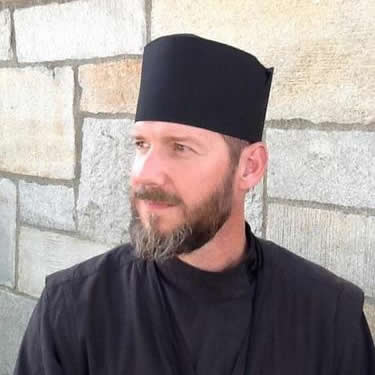 Fr. Anthony Perkins
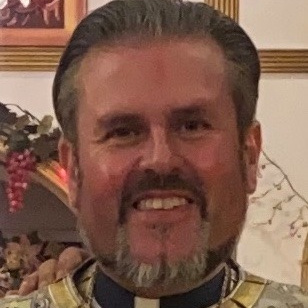 Fr. Harry Linsinbigler