
Fr. Harry Linsinbigler: Greetings, everyone! Welcome to Made to Be a Kingdom: How God Forms Us as a Sacred, Royal Family. I’m Fr. Harry Linsinbigler, together here with Fr. Anthony Perkins. Fr. Anthony, wonderful to see and talk to you.
Fr. Anthony Perkins: Hey, you, too. Glory to Jesus Christ!
Fr. Harry: Glory forever! We are once again glad to be able to connect with all of our listeners as members of the royal priesthood or as potential members or upcoming members of the royal priesthood of Christ which is Christ’s Church. Fr. Anthony and I were both discussing how I have been preparing catechumens. Some will be received by baptism, and some by chrismation. That actually happened earlier in the year, too. I had several different groups of people and families coming in, including adult baptisms. This is something a little bit new to—shall we say, new to the scene. Thirty years ago, most baptisms… When we thought about receiving adults into the Church, a lot of times we were receiving other Christians into Orthodoxy, and now we’re making people Christians, adults into Christians, and receiving them by baptism, who have never been baptized.
Fr. Anthony: Yeah, a lot of unchurched people out there. That changes not just the logistics of conversion for many of us, but also the way that we catechize. With people coming from all these different situations and backgrounds, you’ve got some overlapping in groups… We’re not going to get into it completely this time, because we want to talk more about the service, how we bring people in and what we’re committing to… But how is it in general that you personally prepare them for entrance into the Church? Is it a set of “these are the things you have to know”? Is it a mix of that and personalized instruction? How do you do that?
Fr. Harry: No, we should definitely start at the beginning, and that is the beginning, certainly; would be the catechesis. For the baptism of a child, [it] would be the catechesis of his parents and godparents, which we fail to do a lot of times, to catechize them. Obviously, they’re members of the Church already, but you need to catechize them again in certainly their responsibilities, and remind them of things that they might have forgotten or are central to it. But when we’re talking teenagers or adults, then all of a sudden we are—yeah, we’re discussing preparation. I actually have a whole sheet of preparation.
Basically, it’s been modified by practice from what it used to be, because it’s very hard for people— Well, first of all, my parish is very spread out geographically. We’re kind of out in the middle of nowhere geographically. We’re centrally located, but I’ve had to make sure to get all those things in. One of the things that I did as director of religious education for our archdiocese was I created a catechetical website—that is OrthodoxChristianEd.org—so that people had the resources to do that. There’s actually several different paths. Some people are readers, so we have links to the online version of Fr. Thomas Hopko’s “Rainbow” series; we have catechetical articles that I’ve written, posted on different aspects of the faith—and videos: two different sets of catechetical videos, and a link to a third set, two of which were done by me, distinct different things. Different strokes for different folks, as it were. One was produced by a foundation from faithful from the Greek Archdiocese.
They have all these things, but I have three in-person, face-to-face classes with them that they must come to. One of them is entirely immersing them in the church, as it were; it’s a church tour, but it’s catechism as we’re moving around the church and pointing them out. The second two are sessions. The second one is significant dogmatic things, why they’re important to us, as well as general principles of the commandments of God, how they relate to us, why they’re important, things like that. Then the third one is actually what we’re going to do here, is actually going through the text. This last group of people I went through the chrismation affirmations before chrismation texts from the Great Trebnik, the Book of Needs. There are several different forms of that, but we went through that and I explained why those are there, why those things are core and why we have that. So I went over that even with the baptismal—the people who are going through baptism, even though they’re instead doing, of course, the pre-baptismal rites, which are distinct.
Although— Well, I don’t want to get too far off track. I just want to mention… Fr. Anthony, you had mentioned for first confession in a wonderful series of talks that you did at our sobor, which is, for those of you who don’t know what that is, it’s like the clergy-laity council on a national scale. Fr. Anthony mentioned that, for first confession, having to make the affirmations of Christ from their baptism again. So I almost wonder if that wouldn’t be good also for the chrismation service, but it’s something that I’m noodling, and now I’m just talking out loud. Hopefully I didn’t scandalize anyone by thinking out loud. [Laughter] It literally just popped into my head! As my wife knows, that’s… She had to learn to live with me for thinking out loud, expressing my thoughts.
So they go through all that, and then they go through one of the series of videos or one of the series of readings. We see where everybody is, and then we get them ready for reception of course. Another part of it is them coming to services regularly. If you show up once a month, you’re going to have a very long catechesis, very, very long, because, you know, remember: the 40-day catechesis was people who were coming at least three to four days a week during Great Lent. The 40-day catechesis period assumed you were having at least that many services and assuming at least six Sundays: six Sundays and then the Presanctifieds [on] Wednesdays, Fridays; and Saturday Liturgy and vespers, vespers for the departed and so on, and maybe other days even.
I don’t know. I’ve said a lot, but…
Fr. Anthony: Yeah, so you’ve got a set of things to make sure that everybody has a certain level of knowledge. And also, all of these videos, or if they’re readers the “Rainbow” series and so on, those are also grist for the mill for conversation, to get them talking about what they read, because you’re not going to take an exam: you’re going to be living this life. As Americans, we can tend to think of “I need to learn this so I can pass some kind of test, so then I can be baptized, I can be Orthodox.” That’s not what we’re doing! We need a mindset. Learning these things is part of that process of repentance, changing our minds, changing the way we think about things. That requires that you really do more than just chew on the information. You really have to work with it. I find that the conversations that result from somebody watching a video or somebody reading a book are awesome.
You know, Fr. Harry, I’ve started something new. Again, I hope I don’t scandalize anybody. I offer to my—even to my inquirers, if they’re serious, if they’ve been coming for a while… A couple of the challenges that they have—one is trust, trust of the priest, trust of the process. You don’t know what you don’t know. They can pretend like they see what communion looks like, and I know it’s a big deal, and they’re growing in understanding of that, but confession is just this “oh, what’s going to happen there? I don’t get to do it till afterwards? What if there’s a pig in the poke there?” So what I started doing is I invite them to come up and—of course, I don’t say the prayer of absolution over them or anything—but it gets them used to this idea of intimate conversation about sin, about brokenness, about repentance. It allows us to build a rapport so they can kind of figure out: What’s this about? What is this relationship going to be about with the Church, with this priest as spiritual father? What does this mean? Because that’s a big deal.
Fr. Harry: Yeah, that’s good, because a lot of times we think of just the lifetime confession, the lifetime confession before. And now catechumens can go several times. You don’t get the prayer of reception if they’re being received by chrismation until right beforehand, as part of the chrismation service for that. But, yeah, for them to feel comfortable to come up for— Again, there’s more than just full sacramental confession. As we know, people go to unordained monks. We wouldn’t call that non-confession even though it’s not full sacramental confession.
I think this is a very healthy idea. I even, for the one first confession class— Now I know this is switching topics a little bit, but it’s related. I had the youth who were coming up and I had them stand where I do. I went and I gave an example of myself as giving a confession and how to do it so that they saw it.
Fr. Anthony: Wow. Yeah!
Fr. Harry: And that made them comfortable with this. “Oh, okay.” And then, of course, the one question: “Oh, you go to confession, too?” I said, “Yep, I go to confession, too!”
Fr. Anthony: Yeah.
Fr. Harry: “I go to other priests for confession.”
Fr. Anthony: Yeah, we talked about that a little bit last time, about how it is nice when your people can see you going to confession, and it’s okay to mention it. I’m always very careful. I don’t talk too much about my spiritual life, but I’m leading by example as well as I can, and part of that is being accountable to other people for my spiritual state and for my activity. And it helps that they know that, especially when you’re saying, “Hey, we need to be accountable to each other, and I want you to come to confession,” because some people, they might experience that as a power thing.
That’s why rapport and community are so important. If you just impose sacraments on the community without formation—and here I don’t mean informational formation; I mean that spiritual formation, that unity that we’re supposed to grow into with one another, that pastoral sensitivity and pastoral acceptance—it can go sidewise. You won’t even know. As a priest, you’ll be like: “That conversation was odd.” And it’s because there’s baggage sometimes about power. There’s baggage about fathers and stuff. So if we can deal with some of this stuff on the front end, I think it really helps. I think it really helps.
Fr. Harry: I agree.
Fr. Anthony: I’m also very thankful that I serve two communities that are used to going go to confession. Most of the confessions happen during orthros, or matins, which we celebrate in both the parishes, which means that people are there to see it. They also have it at vespers, well, at least in the parish I serve vespers at. That’s not seen as much, but it’s neat, because it’s just a natural thing. For the kids, you were saying you’ve brought in people recently for their first confession. You’re getting ready to… The fact that they’ve seen their parents and everybody in the community go up for that, it’s just very natural; it’s very wholesome in a way that it wouldn’t be if that were not the case.
It’s very tough, very tough to convince people of the need for confession. What often happens in communities is you’ll have this preparation for first confession, they have their first confession, and then you won’t see them again, except for around Pascha.
Fr. Harry: That’s true, yeah. That’s true. We have a lot of other interesting beliefs in whom you should go to—should you only go to your parish priest—you have a lot of these beliefs of actual people who hold to that. Should you wait and go to your spiritual father even though your spiritual father’s in Alaska and you live in the Bahamas, or something like that, and you don’t see him much? You have all these sort of questions, and I get them. I don’t want to get too far off track here, but some of those things are also important. They come up, and people will hear stuff from other people, which, you know… Brother and sister to brother sister, learning in the parish is important, but sometimes the information given isn’t exactly right.
Fr. Anthony: Especially when it’s coming from outside your community, because there are different standards. There are different answers for that. In general, the culture within our Ukrainian Orthodox Church of the USA is that we encourage people to go to confession, period. When we have a sobor or we have a convention or something, we make priests available. It used to be a big tradition within our parishes to have what are called “missions” during Great Lent, where you invite priests to come in and serve Presanctified with you, and then those other priests would be available to hear confessions. In some cultures, that’s not scandalous, but it’s odd. They’re like: “What are y’all doing?” So be careful when you’re describing what’s “right” to another Orthodox Christian. Don’t take your Typika to another monastery, or whatever that rule is. There are lots of good ways to do this, and you can have your preferences, that’s fine, but grow where you’re planted. Grow where you’re planted.
I also feel that way about catechesis. There’s so much information out there, and a lot of it is very, very, very good. I know that the videos and the podcasts that I do, they’re not as entertaining. I’m just not as interesting, and I get that, completely get it. But if I’m going to be your priest, it kind of behooves you not to prepare yourself as some kind of a general Orthodox Christian who happens to be going to this parish. No, you’re being planted within a community.
So having that understanding between the priest and the people about how they approach issues and so on is very important, even if you don’t agree with it. That’s not the point. The point is that you’re part of a family, and the family kind of is what it is. It’s not a perfect analogy, but if we’re continually saying, “Man, I wish my priest were like So-and-so,” you’re kind of like somebody who likes marriage so much that they prefer another wife. We have to be very careful with that and be generous towards our priests, and priests toward our people, that we really are together.
And if I can just throw a footnote up—and we really are going to get to the subject of baptism and chrismation and conversion!—but one of the things we talked about last time is about the standard has changed about growing where you’re planted. Now it’s kind of: “Go where you want.” I get it: I’m an American, I’m a consumer by nature, I like to go places that I prefer, and so on. But we’re missing something, and it goes both ways.
If we suddenly—if our bishop suddenly said, “Okay, y’all have to go to the parish that’s closest to you,” and every bishop in America says that. For a while, that’s going to be so uncomfortable, both for the people who have to go to the parishes they’ve been driving by intentionally for the last few years, because there’s a reason they’ve been driving by, because they weren’t comfortable there or whatever. And at the same time, the people who are at that parish they’ve been driving by, they are used to seeing others as outsiders.
We’ve lost that ability to really be family with people that are different from us, and it’s so important. We joke about Thanksgiving with our families, about how awkward it can be and so on. It doesn’t have to be awkward. If we had Thanksgiving every Sunday, then we would learn how to be together with people whom we love but don’t necessarily like yet. [Laughter] That’s a skill that I think is necessary for our sanctification, for our holiness, because God calls us to be one as he is one. We can’t take a shortcut by just hanging out with people who think like us and who like to study theology like we do and who prefer this instead of that.
Okay, Father, I’m off my soap-box now! [Laughter]
Fr. Harry: Yeah, so we… Looking at what are called the pre-baptismal rites, we have what’s called the reception into the catechumenate. This a lot of times is done the same day as the baptism, which a lot of times makes baptisms rather… sometimes rather difficult, especially when you’re dealing with really young children, but the reason why it came to be that way—it originally was supposed to be done long before. Again, at one point, it was done at the beginning of Great Lent, and the baptism was done on Holy Saturday, and then later in some places Lazarus Saturday. The catechumenate took place in between those, going to church every other day, doing your learnings, which a lot of times was hearing Scripture read and things like this, and the Lives of the saints and things of this nature.
This is a very important thing I have come back to when I’m able to, to do the one before the other on distinct days. Now, the reason why practically they all got put on the same day was why? When all of a sudden we were having people coming as godparents from other places, so it had to be all done on the same day, because they have to be there not just for the baptism, but they have to be there to make all these affirmations for the baby, because the baby can’t speak for themselves, so the godparents needed to. So it was all put on one day. Again, it’s rather challenging at times, even for adults, frankly, to have that all. But it’s important to understand the history of it, and that actually it is distinct from the baptism itself.
Fr. Anthony: Just one question for you, on handling this culturally. It’s wonderful that we’re going back to an older tradition, but we don’t have the culture yet that sustains it. One of the things that can happen is—because I’ve seen it—you’ve got floating catechumens. You’ve got people who have been “made catechumens,” and then they move or something like that, and next thing you know, you’re like, “Oh, you’re a catechumen? How long have you been a catechumen?” “Oh, two years.” “Oh my goodness. We need to do something about that.” “Yeah, well…” Uh-uh, no. It’s like with a betrothal. We can move them to different times, but we’re not going to have people betrothed who aren’t going to be married at a definite time.
What do you do to…? What can we do to prevent that from happening? Do you set a date, or do you just say, “Okay, you’re ready to take the next step”?
Fr. Harry: Nope, I set a date. There’s a schedule, absolutely. It’s a date and a schedule, so much so that if they’re not able to make one of the classes, they will still be—we need to still fill in those blanks in between the next class and so forth. It does require some patience on the priest’s part, and actually a little bit of— I’m not terribly good by nature, by temperament, personality type, at getting on people, like “Did you do the dishes? It’s Saturday, you know. Did you do this, did you do that?” but I had to discipline myself to it, because I’m their spiritual father. [Laughter] “Did you do your readings? Have you been praying every day? Okay, so this week we need to get back on track there.” I actually sort of guide them through this process. It hasn’t been a problem with adults, the floating catechumens.
Fr. Anthony: So you do set it. Yeah, I think that’s the way to deal with it, is just to set a date. And you are going to have some people who balk at the last minute. You’re going to have to figure out what your policy’s going to be, because you can’t baptize someone, you can’t bring somebody in who isn’t willing! [Laughter] You can’t drag them in.
Fr. Harry: Normally I remind them that the service of the catechumen is already the first commitment, and this canonically is also how it’s set up. You make them a Christian first, you make them a catechumen, then you go forth and baptize them. So there’s this protocol of order, and they’re making that commitment on that day. That’s the difference between an inquirer and a catechumen. No matter how long that period of being an inquirer is, which can be shorter or longer, I let them know: “This period now is commitment time, so you’re already doing it here.”
Fr. Anthony: I suspect that that means that all the ducks have to be in a row. If there are things that they are doing in their life that are not consistent with the Orthodox life, that needs to be dealt with before they become a catechumen, not like “We’ll make you a catechumen and we’ll work it out.”
Fr. Harry: Well, they have to have the commitment at least to correct it before baptism.
Fr. Anthony: Correct specific things.
Fr. Harry: Specific things, right.
Fr. Anthony: Okay, I’ll buy that.
Fr. Harry: Yes. That is definitely another part of it. Again, we’ve kind of gotten into a culture sometimes where the priest is like, well, maybe a little more lax on the topic, but no. You have to get them there.
Fr. Anthony: Yeah, it’s not healthy. You’ve got to talk about these things. They’re expecting you to talk about them, and here often it’s sex and gravitation. You’ve got to talk about it. You have to.
Fr. Harry: Absolutely. Nope, yep, absolutely, so much so that weddings, for example, a wedding—can you baptize someone who’s shacking up without having a wedding also being prepared for, and so on? This already has to be in the woodwork. Or if there is none, to correct the living situation. And then you have the problem of financially how they’re going to do it. This is a lot of difficult topics that are still…
Fr. Anthony: And just so y’all know, priests aren’t just making stuff up. We talk to our bishops when there are complicated situations; we talk to each other. We don’t give up confidences or anything. We talk to each other and we talk to our bishops to figure out what are the range of acceptable ways of handling this; what’s the most useful pastoral situation that… And that includes, by the way, we don’t put “pastoral” in opposition to canons and things. No, being pastoral means doing things the right way. What is the right way for these people? Yeah, very important.
We’re already at 30 minutes. We haven’t even started the reception service! [Laughter]
Fr. Harry: Well, that’s okay. That’s a good place to pick up next time, with the actual text itself.
Fr. Anthony: Okay, wonderful. I look forward to that, because, you know, we’re going to have to talk about exorcisms. What’s going on there? What kind of vestigial remnant of medievalism is that, Father? No, I’m kidding. Some of you, maybe this is the first time you’ve listened to us: that was not a serious comment. The exorcism is a huge and vital part of this. We’re going to talk about why, and how the priest needs to prepare, just like the people need to prepare.
Fr. Harry: Absolutely. We’ll be talking about all these things in the next episode and episodes following. We’re continuing our topic of lived ecclesiology, but, again, maybe people don’t know things like exorcisms are part of lived ecclesiology, and the exorcism especially before baptism is one that we see over and over and over again. It’s very important, and we’ll talk about that among other things next time.
Fr. Anthony: Okay! I’ll look forward to that. Until then, don’t forget to give us a five-star rating, right? Godspeed.
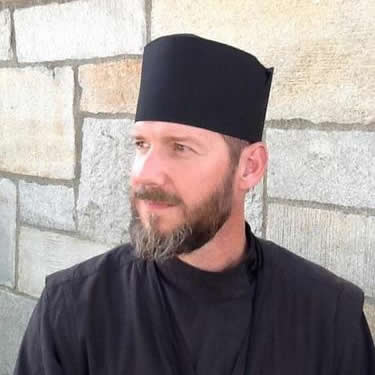 Fr. Anthony Perkins
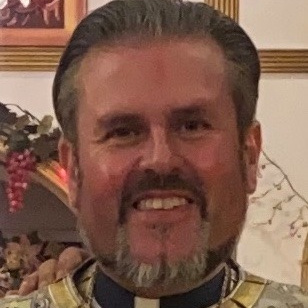 Fr. Harry Linsinbigler