Fr. Harry Linsinbigler Greetings, everyone. Welcome to Made to Be a Kingdom: How God Forms Us as His Sacred Royal Family. I am Fr. Harry Linsinbigler, and with me is Fr. Anthony Perkins. Fr. Anthony, hello!
Fr. Anthony Perkins: Yep, how’re you doing?
Fr. Harry Doing well. We’re starting our series here of talking about, as we’ve now come to the end of Great Lent, approaching Holy Week, and we are about to enter upon the Feast of the King of kings’ triumphal entry into the city of the King, Jerusalem, and what that means for us, and what it means for us on a greater spiritual scale as well, and how Palm Sunday really fits in with the whole plan. A lot of people don’t really quite grasp how Palm Sunday fits in with Pascha, and so we are going to get into that as well, but this series overall will be about kingdoms and particularly about two enemy kingdoms, one being the kingdom of God and his kingdom of heaven, and the other as being the kingdom of hell, or Hades, and how that gets conquered in the week following. We’ll be talking about that and Scriptures relating to it, and also our liturgical services and how all that ties together.
Fr. Anthony: I’m really looking forward to this, Fr. Harry. I’ve been chomping at the bit.
Fr. Harry Yeah. So we wound up with the last episodes talking about things pertaining to Great Lent and the stairway or ladder to heaven, ladder of ascent, divine ascent, and about salvation. A lot of people lump together Holy Week and Great Lent, but they’re two distinct things. So Great Lent, its purpose is to prepare us for Holy Week. So we’re working on ourselves—we are given 40 days to work on ourselves in repentance, so that we’re properly prepared for Holy Week and Bright Week, the Bright Week following, and, frankly, the festal 40 days following, of Paschaltide. And so we can turn our focus solely on Christ himself. So I actually do not hear confessions the last… after Lazarus Saturday, and actually the eve of Lazarus Saturday; the last day of Great Lent, that is it for confessions. The time for confessions is before that.
Fr. Anthony: Father, let me throw a footnote on that. Do you do the Unction on Wednesday?
Fr. Harry So I do, but this year I am moving it to Bright Wednesday. So Unction doesn’t properly belong to Holy Week; it’s just become popular to put it there. So instead I will do the Matins proper with an anointing, but I will not be doing Holy Unction until the Wednesday following, because Bright Week is so neglected, and canonically we’re supposed to be rejoicing with church, but everyone kind of… Pascha comes and then that’s it. Maybe they’ll come to Agape Vespers or something, but that’s it, right? And then everyone forgets about it. So this year I am granted—it is through a drawing card—I am moving Holy Unction to Bright Wednesday, so that we can rejoice in this mystery of healing in Bright Week, after Christ accomplished the great salvation and eternal healing in his resurrection for us.
The last week of Great Lent, approaching Lazarus Saturday, has Lazarus being mentioned every day in the services. We are progressing with Lazarus and with the people around Lazarus, with Christ, as it were, and this is his death, and then his first day of death, second day of death, third day of death—and we reach his fourth day of death. So we’re really brought into this encounter and experience of Lazarus’s death and the shock at it, but also the… We’re able to feel his sisters’ human side and their reaction to Christ on this whole thing, of: “Couldn’t you just have prevented this?” And it’s naturally something… In our day, when we have these tensions in the world, and great worries that we might have that question of: Why couldn’t God have prevented this?” So we have the sisters’ question; we have Mary and Martha’s question to God on that.
And because God’s plan is different from ours, and recently out came the Man of God movie. It aired on Monday, and people might come out of there with the question: “Why…?” Basically an existential question of: “Why didn’t God allow St. Nektarios to be pope of Alexandria? Wouldn’t he have cleaned things up? He would’ve been a good guy to clean things up.” Maybe, or else maybe he would have been destroyed, and the community of Aegina would not have benefited from him. We don’t see the “what if"s; God alone knows those. So that’s why we have to put him back in charge and stop with the excessive existential “what if” questions, and start putting our trust back in God, who knows what’s best for us and wants what’s best for us. We think we know what’s best for us [Laughter], but he knows what’s best for us.
And so we reach the resurrection of Lazarus, and with Christ’s—and St. John makes it clear that Christ’s human side is very much involved, that Christ weeps at Lazarus’s death. He calls him forth. On the day before, he goes into Jerusalem. So a lot of people might wonder about the timing there, like: “Hmm. Why did Jesus wait for then, right before he’s about to go into Jerusalem?” He couldn’t have waited until after then, for one thing, but another thing was to show us the general resurrection, that God can even resurrect a decaying corpse—because the Sadducees said it couldn’t be done! “It can’t be done! This whole doctrine that there’s going to be a general resurrection is nonsense! It can’t be done! Look, we’re all going to be decayed!” So Christ waits beyond the three days after which there’s definitely decay setting in, and God can put it all back together again. The Lord Jesus Christ, the Son of God, the eternal Son of God, can put it all back together again for us.
And that is the reason for that timing, but also the fact that it’s before his entrance into Jerusalem is very important because Palm Sunday happened on the tenth of Nisan, or tenth of the Hebrew month of Aviv, and for those who don’t know, in the Old Testament, the preparation of the pure lamb for the Paschal sacrifice, the lamb who would be the Pascha, would be the Passover—we need to remember that the word “passover” refers first and foremost to the lamb itself, not to the day, per se, but to the sacrificial lamb itself. So the pure lamb is set aside, always on the tenth of Nisan for the sacrifice to happen on the Passover itself. So Christ was set aside on that day, on the same day that he entered as King of kings into Jerusalem. So think of that contrast!
He has this triumphal entrance where all the people are recognizing him as the son of David, the actual heir to the throne, which Herod didn’t like because he was not the actual heir, descendant of David. He was a pretender, so no wonder why the Herods felt threatened, the whole Herodian clan. And so he is being welcomed as King of kings, so at that same time that he’s entering in, claiming the city of the king as the King, as the recognized King, he is setting himself at that same time, entering in as the pure sacrifice for the world, for the eternal Passover, the Pascha that will save the world.
So here we have these two things where we have the kingdom—even in the Bible we have the phrase “the children of the kingdom will be cast out,” meaning the children of the earthly kingdom that are not of God, that have not adhered to the heavenly kingdom under the King of kings who is the Messiah. So he is setting himself aside under the rules of that… ultimately of that old kingdom, as it were, to ultimately fulfill and build the new and everlasting kingdom that was foretold.
So, Fr. Anthony, I didn’t know if you wanted to jump in here with any thoughts on Palm Sunday.
Fr. Anthony: You’re doing great. Yeah, and the connection with the tenth of Nisan, that’s really profound. And the Lord knew it; he offered himself like a lamb to the slaughter. This is all in accordance with the prophecies. Lots of layers that the hymnography put together for us in a special way. It’s not just through podcasts that we learn about these things; going to services really puts things into its proper perspective.
Fr. Harry So we look at even the troparion… This is the one instance where… So we even think of forefeast and feast have different troparia, but in this case both Lazarus Saturday and Palm Sunday share the same exact apolytikion and the same troparion:
By raising Lazarus from the dead before your Passion, you confirmed the universal resurrection, O Christ our God. Like the children with the palms of victory, therefore, we cry out unto you: Hosanna in the highest! Blessed is he that comes in the name of the Lord!
Or as we read elsewhere: “...crying out: Blessed is the king who comes in the name of the Lord,” which is the same thing. We’re not just talking about any general person—“Blessed is he who comes in the name of the Lord.” The “he who comes in the name of the Lord” is the Messiah; it refers distinctly to the Messiah, the King of kings, the anointed priestly King who fulfills all priesthood and all kingship.
And so, “like the children with the palms of victory”: here we have that connection of they’re rejoicing not just that they found the Messiah, but it’s the same Messiah that’s going to resurrect them. A lot of people were probably confused about whether the Sadducees or the Pharisees were right about the resurrection, and they didn’t know which way to go, one way or another. And the Messiah comes and says, “No, there will be one, and here’s Lazarus. Here’s a man, four days dead, decayed—decayed and was four days dead—and was resurrected.” So they’re rejoicing that he is the one who is not just coming to do— but that he is the one who is going to resurrect them on the last day.
So they are recognizing that this is a different sort of kingdom. They’re accepting Christ for who he is. Different—everybody knows now that Christ is not the other anticipated messiah, the one who’s supposed to come and slaughter all the heathens outside, the Gentiles, and so on, and establish this sort of barbaric superior kingdom, Israel: restore Israel as this barbaric superior kingdom. He has quite a different kingdom in mind that he is establishing, and they see it, they know it, and they’re rejoicing in it: “Hosanna in the highest! Blessed is the King who comes in the name of the Lord! Blessed is he who comes in the name of the Lord!”
And then that says, “like the children with the palms of victory, we cry out unto, O Giver-of-life: Hosanna in the highest!” So we’re participating. Like the other liturgical services, we are participating in that event, which did happen at a point in time, but it is also an eternal event, where eternity reached into time, and so therefore we can participate in it now, here and now, because the same Christ who entered as the King of kings is also present among us: sacramentally, prayerfully, liturgically, in our presence.
In our parish we actually have palms that get laid down for the great entrance, but we also have the longer great entrance, and down before the priests and so on.
Fr. Anthony: Yeah, that’s a beautiful combination, because one of the ways of looking at the Divine Liturgy is of seeing that great entrance as being a combination of the triumphal entry into Jerusalem and events of Holy Week. So, yeah, that’s really special there.
But you’re setting us up to talk about two kingdoms, so you’ve got the Lord arriving to his Temple, the King arriving at the top of the mountain. And you said this was obviously fitting, and people felt that and they celebrated it—but not everyone. What’s going on with the development of this other kingdom?
Fr. Harry Yes, what is the other kingdom? We kind of see this unfolding, some aspects of it, not until Great Friday, where we have Bar-abbas, the false father, as it were. And Satan is building his kingdom, too, at this same time. So when we read “anti-Christ” in the Bible, some people are thinking Damien Thorn, right? But “the spirit of anti-Christ is alive even now,” St. John says. So, yes, there is to come a beast, as it were, -like figure, but the spirit of anti-Christ is alive even now. And the anti-Christ was alive even then. The enemy kingdom was assembling in Jerusalem at that same time, and: “He’s not the real messiah that we’re looking for. He’s not leading us into victory! He should be leading us against the Romans if he was the real Messiah!” So the enemy kingdom was building on that, and that anti-Christ—that instead-of Christ, the alternate Christ—is who the devil is backing, and it’s being built right there. At the same time that the kingdom of God is being built up, the kingdom of Satan, the enemy kingdom, is being built up at that same time.
And, again, Barabbas himself… “Yeah, we’re going to let him go, because he’s closer to the messiah that we want, even though he’s a robber and a thief, at least he has a chance to lead us on a revolt against the Romans, and to overcome and slaughter all these Gentiles.” So this is the vision of the kingdom of Satan that’s being pronounced right from the same place, and in the midst of… So we start to think here of the wheat and the tares, in Jerusalem assembled, because there’s tares and there’s wheat, in and amongst each other. In that very same crowd, some who were for the kingdom of God, being built for the Messiah, by the Messiah; and some that are for the kingdom of Satan, the anti-Christ kingdom, that is being built up at that same time, opposing Christ, trying to kill him, thinking that they’re going to kill him, to defeat him for all time. And instead, quite the opposite happens of what these children who have espoused themselves to the enemy kingdom are expecting; the opposite happens.
So we look at the enemy kingdoms as… We remember back to Matthew 12: “Every kingdom divided against itself is brought to desolation, and every city or house divided against itself will not stand,” and of course we remember that second part because of Abraham Lincoln, but Abraham Lincoln got it from the Bible. So “if I cast out demons by the spirit of God, surely the kingdom of God has come upon you, or how can one enter a strong man’s house and plunder his goods unless he first binds the strong man?” These words—we shouldn’t… Everyone’s like: “What is this talking about?” Well, we see it in the icon of the resurrection, where Satan is bound in Tartarus, in the lowest part of Hades. Christ came and bound the strong man, the strong man being Satan; and he plundered his house: the harrowing of Hades.
So we go over to Luke which expands even further on this: “When a strong man, fully armed, guards his own palace, his goods are in peace; but when one stronger than he comes upon him and overcomes him, he takes from him all his armor in which he trusted, and divides his spoils.” So Satan thinks that he has gotten everyone to voluntarily make themselves slaves and they’re pieces of his property; quite the opposite. Christ has come to regain them and give them their freedom. So this is what is all encountering and going on all through this week starting Sunday and going through—starting Palm Sunday and going through Great Saturday.
Fr. Anthony: Yeah, and I look forward to going through these services with you, to talk about that journey within the framework, looking at the two kingdoms. That’s really useful.
Fr. Harry So we have the terms “kingdom of God” and “kingdom of heaven.” St. Matthew prefers “kingdom of heaven”; St. Mark “kingdom of God”; Luke has a mixture. These are used far more than the word “church” is. We talked about that in a previous episode, but when we get to Matthew 16, where Christ says the famous—Matthew 16:18 and the verses following: “On this rock I will build my Church, and the gates of hell shall not prevail against it. And I will give to you the keys to the kingdom of heaven. On earth, in heaven.” So there we go: this contrast between the two enemy kingdoms, that of heaven and that of Hades, both of which, interestingly here, have gates!
In this passage, it’s clear that the gates of Hades are immediately contrasted with the gates of the kingdom of heaven, and the keys are given—will be given to Peter. A lot of people think they’re given then; they’re not. They will be given to Peter later, and will be given to all the Twelve, consequently.
And so we have to go back to the Old Testament to understand this, where the gates of Hades and the gates of heaven are contrasted, back even in the psalms. So in the Septuagint ninth psalm, we have:
Have mercy on me, O Lord; look upon my affliction from my enemies,
You who lift me up from the gates of death (ton pylon tou thanatou),
That I may declare all your praises
In the gates of the daughter of Zion.
I will exalt in your salvation.
And here we have salvation as a person, of course, himself, so Christ himself. So of course we know that “the daughter of Zion” refers to the Church, from Hebrews 12:22. If we go to Matthew 7 in conjunction with the passages in Matthew 16, there are two buildings: the house of Christ on the rock and the house of death and Hades which is bound for destruction, one built on solid foundation, one built on a non-solid foundation.
An important thing that we have to remember when we look at Matthew 16, which is very key to understanding this whole thing—what’s going on in all of Holy Week—that we understand that the gates of hell will not prevail against it. “On this rock I will build my Church, and the gates of Hades, the gates of hell, will not prevail against it.” That we are not talking about that the gates of hell are somehow pressing upon the Church; it’s quite the opposite. The Church is pressing against the gates of hell! It’s going down there, and the gates of hell will not hold against the Church as it charges into hell. So this is the image that’s given there, and this is what happened on Great and Holy Saturday. The gates of hell did not prevail against it. Christ, as King of kings and High Priest, the Head of the Church, plows into Hades. The gates of hell did not prevail against him, and he goes back out. They might have tried to shut, but as we see in the resurrection icon, those gates are plundered, and they’re fallen down. You see them almost in a cross-fashion, in an X-fashion, in a lot of ways, but those gates of hell are plundered. So that’s the fulfillment here, that the gates of hell will not prevail against the Church.
This enemy kingdom is about to be plundered by the King who took his place, in a way that just was not seen by most, and not by violence, as some thought, an earthly violence, but quite the opposite: by becoming— entering in as the King of kings, also as a Lamb led to the slaughter, and to do so by self-sacrifice, for the sake of the world: that’s how he would plunder the kingdom of hell. Everyone thought that Christ was defeated, he’s out of the way. And, of course, the sons of… From the perspective of the sons of the kingdom of hell, Christ was a false Messiah, because they were looking for another one. But they were deceived. He was the true Messiah, and they were deceived by, as Scripture says, their father the devil, whom they voluntarily took on to believe, which I won’t go into how today. We have to be vigilant, but I won’t go too much into today how we need to be vigilant against the kingdom of Satan using or manipulating us through emotionally driven articles or videos, even, to try and get us to believe things that aren’t so, or to try and get us to go in a directoin that is not in accordance with righteousness and with God’s commandments. So we have to be careful there.
Fr. Anthony: Yeah, right, and another thing that we’re going to talk about as we continue this conversation in future episodes is we are talking about kingdoms and our calling—that’s the theme of this podcast—and so how do we fit into the harrowing of hell? How is our participation prefigured in Scripture? And how is it that we realize it? And also, what does it mean that the devil is bound in lowest Tartarus? You just told me that I still have to be on guard. I thought the war was over! [Laughter]
So I’m really looking forward to continuing this conversation. There’s so much to…
Fr. Harry Yep, and we’ll go into also—we’ll look at the services on that, too, as to what they say, because this is all very rich, meaningful stuff.
Fr. Anthony: Yeah, many, many layers.
Fr. Harry Many layers, absolutely.
Fr. Anthony: All right, and you’ve gotten us started on it really well, and we appreciate that. I look forward to continuing this in the next episode.
Fr. Harry Sounds good, Father.
Fr. Anthony: Until then, Godspeed.
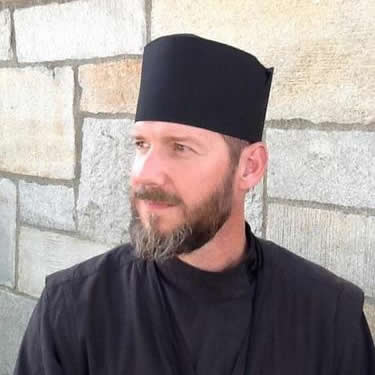 Fr. Anthony Perkins
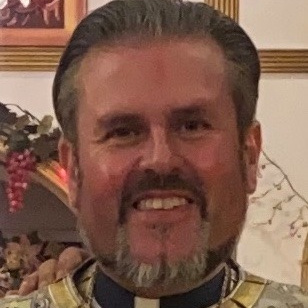 Fr. Harry Linsinbigler