Announcer: Ancient Faith Radio presents the Orthodixie podcast with Fr. Joseph Huneycutt, author of the Orthodixie blog site and One Flew Over the Onion Dome, a book published by Regina Orthodox Press.
Here's Fr. Joseph.
Fr. Joseph Huneycutt: When I'm in my car, I usually listen to National Public Radio. That's quite a transformation for a man who once saw Kiss, Willie Nelson, and Prince all in the same year, but those without sin cast the first 8-track.
Honestly, over the years I've found that listening to classical music is not only the best way to control road rage, but it's actually enjoyable. Therefore, I listen to NPR stations a lot.
And if you're accustomed to the same, you know that sometimes you might tune in and they're playing the most fabulous hits of the classical music world, like the greatest hits of Mozart, Bach, and—oh, I don't know—Garrison Keillor.
You know, for some reason, their programming sometimes just seems extra heavenly, and then it occurs to you, especially when you hear the voice asking for money, donations, "That's right, it's that time of year again": fundraising.
No, this podcast is not about money, but it could be.
In fact money is a little less painful topic than the subject of this week's Orthodixie podcast. Are you ready? Forgiveness.
Forgiveness.
Also—come closer; I don't want to upset anyone here—I'm also going to talk about a man who was part of a gang, a murderer, and he was Black!
And no, I don't mean he was African American. This was long before there was a country called America. And essentially, I'm not even talking about skin color.
But first, back to the fundraising.
I once heard someone say during one of those NPR pleas for money that you don't mind the begging once you've given.
You don't mind the begging once you've given.
In other words, after you've made your donation, the request for money is directed toward others. You're in the clear!
It's much the same with forgiveness.
For instance, a couple Sundays back, many church-goers heard a familiar gospel reading which goes like this:
"Peter came to our Lord and he said, 'Lord, how often shall my brother sin against me and I forgive him? Up to seven times?'
"Jesus said to him, 'I do not say to you up to seven times, but up to 70 times seven.
"'Therefore, the kingdom of heaven is like a certain king who wanted to settle accounts with his servants.
"'And when he had begun to settle accounts, one was brought to him who owed him 10,000 talents.
"'But as he was not able to pay, his master commanded that he be sold, his wife and his children as well, and him thrown into prison until all payment was made.
"'The servant therefore fell down before him saying, "Master, have patience with me and I will pay you all."
"'Then the master of that servant was moved with compassion, released him and forgave him debt.
"'But that servant went out and found one of his fellow servants who owed him 100 denarii.
"'And he laid hands on him, took him by the throat saying, "Pay me what you owe."
"'So his fellow servant fell down at his feet and begged him saying, "Have patience with me and I will pay you all."
"'And he would not, but went and threw him into prison till he could pay the debt.
"'So when his fellow servants saw what had been done, they were grieved and came to their master and told him.
"'And the master, after he had called him, said to him, "You wicked servant, I forgave you all that debt because you begged me.
"'"Should you not also have compassion on your fellow servant just as I have pity on you?"
"'And his master was angry and delivered him to the torturers until he should pay all that was due to him.'"
"So my heavenly Father also will do to each of you who from his heart does not forgive his brother his trespasses."
Matthew 18:21-35.
You see, this is a model of the Church, the safe ship on a stormy sea.
It's in the Church that we find forgiveness from God; we're brought into the family of God, the Church of Christ.
Yet the unfaithful servant, after gaining the grace of God's forgiveness, lost it when he failed to forgive in return.
We, too, can lose everything that we've been given and forgiven by God in that terrible moment when we refuse to forgive our debtors.
We receive forgiveness in the sacrament of confession. We receive grace in the sacrament of holy communion.
And in one moment, that moment when we turn our back, walk out on God and demand of our debtors that which we have been forgiven, we lose all.
In the Orthodox tradition, the Church is called the kingdom of God on earth. Thus, when our Lord speaks of the kingdom of heaven, we should also see therein a model for the Church.
Now to this week's subject, St. Moses the Black. Moses was a former gang leader, murderer, and thief in ancient Africa.
However, he became a model of transformation. His is one of the most inspiring stories among the African saints.
Moses lived in the fourth century. He was an escaped slave and the leader of a group of 75 robbers.
He was a large and powerful man who, with his gang, terrorized the entire region.
Moses was transformed after they had stolen some sheep and wished to seek asylum in a monastery.
The abbot greeted Moses with open arms and such a warm welcome that it had a life-changing impact
on Moses the Ethiopian.
The peaceful welcome and warm manner of the monks overwhelmed him.
He immediately felt remorse for all his past sins, sincerely repented and begged to remain at the monastery.
He soon gave up his old way of life, became a Christian, and he and his fellow gang members were baptized.
Yet Moses, even after becoming a Christian, was tortured by his past and for years was tempted to return to his old ways.
The devil fought him intensively with his old habits of excessive eating, drinking, and fornication.
Moses also had a rather difficult time adjusting to the regular monastic discipline. His flair for adventure remained with him.
Attacked by a group of robbers in his desert cell, Moses fought back, overpowered the intruders, and dragged them into the chapel where the other monks were praying.
He told the brothers he didn't think it Christian to hurt the robbers and asked what he should do with them.
The overwhelmed robbers repented, were converted, and themselves joined the community.
Yet much of Moses' temptations to his former way of life became transformed one day when he had a vision while he was confessing his sins to St. Macarius.
It is said that Moses saw a vision of an angel who appeared with a tablet full of his sins.
As he confessed each sin, the angel began wiping the tablet clean. The more he confessed, the more the angel wiped, until by the end, after a full confession, the tablet was completely clean.
After meeting St. Macarius and St. Isidore, he completely left his old ways behind him and became a monk.
Moses was zealous in all that he did, [but] became discouraged, however, when he concluded he was not perfect enough.
Early one morning, St. Isidore, abbot of the monastery, took Moses to the roof, and together they watched the first rays of dawn come over the horizon.
Isidore told Moses, "Only slowly do the rays of the sun drive away the night and usher in a new day, and thus only slowly does one become a perfect contemplative."
A favorite incident of many is the story of the hospitality of a certain Arsenius toward a visiting monk.
Arsenius received the monk in absolute silence. Moses, however, greeted the visitor with joy.
When someone asked for an explanation, the answer was given in the form of two visions.
One was Arsenius in a boat, with angels, in silence. Another saw Moses in the boat, with the angels, eating sweetmeats.
Later, St. Moses was ordained to the priesthood.
Now here's a story. It might shock you, but listen carefully.
The blessing of the Lord came upon Moses. After a while, he became the father and the spiritual guide of 500 brothers, who elected him to be ordained a priest.
When he came before the patriarch to be ordained, the patriarch wanted to test him by asking the elders, "Who brought this black here? Cast him out."
He obeyed (Moses), and leaving, said to himself, "It is good what they have done to you, O black-colored one."
The patriarch, however, called him back and ordained him a priest and said to him, "Moses, all of you now has become white."
You see, brothers and sisters, Moses was put to the test, not of his ethnicity, his skin color, but of humility.
He became known for his wisdom, humility, love, and non-judgment of others.
A certain wealthy, high-ranking official once came to the monastery with a large caravan.
He bestowed upon the monks gifts and inquired where he might locate the elder Moses. After receiving directions, the official set out to visit the Ethiopian monk.
Moses, perceiving in the spirit the approach of the official, went out to meet him in disguise, in the guise of a traveler.
Encountering the dusty elder along the way, the official asked him if he knew the whereabouts of Moses.
"What do you want with that troublemaker?" the elder asked him. "Stay away from him. He will do you no good."
The official, stunned and scandalized, returned to the monastery and told the monks of his conversation en route.
They could not believe that anyone would speak about Moses this way and asked the official to describe the man he had encountered.
The official described him as being tall, white-haired, and black, with ragged and dusty clothing.
Hearing this, the relieved monks informed the official that the monk he had conversed with was none other than Moses himself.
The official was somewhat chagrined and realized that Moses wished to avoid the praise and recognition of men, and, so edified, he returned to his home.
Once, when a brother had been caught in a particular sin, and the abbot asked St. Moses to come to the church to render judgment, he refused, once, twice, but on the third time, reluctantly, he came.
But he came carrying on his back a leaking bag of sand. The bag had a hole in it, and it dribbled a path of sand behind him all the way to the church. When he arrived, the brothers asked him why he was carrying such a thing
He simply said, "This sand is my sins which are trailing out behind me which I don't see. And yet, you asked me to judge the sins of my brother before me?"
At that reply, the brothers forgave the offender and returned to focusing on their own salvation rather than the sins of their brother.
In 405 AD, at age 75, St. Moses suffered a martyr's death. When his monastery was attacked by a group of barbarians, they wanted to stay and fight. The brothers wanted to defend themselves, but Moses forbade it. He told them to retreat rather than take up weapons.
He and seven brothers remained behind and greeted the invaders with open arms, the same as they had once received in the welcome of the abbot.
But, similar to the ungrateful servant who'd been forgiven so much in the Gospel, all eight were slain by the invaders, martyred by the bandits.
St. Moses the Black is remembered on the 28th of August.
You see, when you realize you've been forgiven much, when you are grateful, you are naturally inclined to give—to give even more.
Forgiveness is forgiving, and today, St. Moses the Black is not only considered the patron saint of African Americans, but a model—a model for us all.
St. Moses is a model of Christian humility, love, and forgiveness.
Brothers and sisters, let us open our arms each week in our churches and our homes to those who are seeking, no matter the color of their sins—nor especially their skin—for in so doing, we may be welcoming future saints unaware.
St. Moses the Black, pray to God for us!
For Ancient Faith Radio, this is Fr. Joseph Huneycutt.
Announcer: Fr. Joseph Huneycutt and the Orthodixie podcast. You can link to the Orthodixie blogsite by going to ancientfaithradio.com and clicking on "Orthodixie."
Fr. Joseph is a priest at St. George Orthodox Church in Houston, Texas, and author of One Flew Over the Onion Dome, published by Regina Orthodox Press.
This has been a presentation of Ancient Faith Radio.
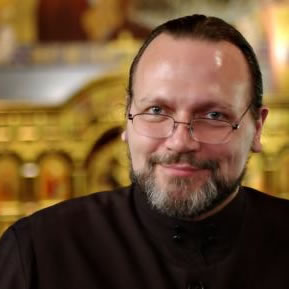 Fr. Joseph Huneycutt