
The following story is actually something that’s happened to me personally, that I hesitatingly share with everyone.
When I was an assistant priest at St. Andrew’s in Chicago, our closest neighboring parish was St. Demetrios. At the time, Fr. Nikitas Lulias was the proistamenos there. Fr. Nikitas had a favor that he asked me to do for him, and it was going to take the entire day. So to sweeten the pot, to make me more inclined to say yes to it, he said to me, “If you do this for me, I’ll give you a portion of a relic of St. Andrew.” I was serving in the church of St. Andrew. I had been ordained as a deacon and a priest on the feast of St. Andrew, on the feastday of St. Andrew. So this was a very good enticement.
I did the favor for him, didn’t say anything else to him, and some time passed. Then I ended up changing metropolises, entering into the Metropolis of Pittsburgh, and my reassignment to the Church of Holy Cross in Stroudsburg. And as I was getting ready to come, I went to my brother, Fr. Nikitas then, and asked him if he still was able to give me a portion of a relic of St. Andrew, and he said, “Yes. Here, take this little reliquary,” and he explained the history of the relics. He said, “This is a reliquary that has a relic of St. Andrew, St. John Chrysostom, and St. Arsenios of Cappadocia, and it was given to me by Fr. Paisios when I had visited him on the Holy Mountain. Take it with you to your parish. Take off a portion of each of the saints, a small portion of the relics, and return the rest of the reliquary to me.”
I was overwhelmed. I had never had on my possession holy relics of saints before, and now I had three. I carried the relics in my pocket, right over my heart, all the way on the drive from Chicago to Stroudsburg. I placed them right away on the altar table.
A little time passed, and I needed to change the covers on the altar table, so I took everything off of the altar table: I took off the altar cover, and there, right below where I had placed the relics down, I was surprised to see that there was a picture of now-Saint Paisios, Elder Paisios. It’s one of the more well-known pictures: he’s kind of walking down a trail. And I thought: How unusual. That’s practically miraculous, that these relics started with him, and I had put them on the altar table, and right underneath, a picture.
When I had the chance some time later, and I asked the priest who was sometime servicing the parish before me for almost a year—Fr. Evangelos Pepps—why he would have put a picture of St. Paisios under the altar table, Fr. Evangelos said to me he didn’t know what I was talking about, that he had not placed a picture of Fr. St. Paisios under, on top of the altar table, under the glass and under the covers. Obviously, he’d have to have changed the more than once.
So then I thought: Now, this is really quite remarkable. It was almost as if the saint knew. I had had a chance to meet him a few times earlier in my life. It’s almost as if he knew and arranged it all somehow to happen.
I remember the last thing that he said to us when a group of us had spoken to him, back in 1988, and he had asked us to come back the next day to see and talk with him a little bit more, that he had said to us—and we had thought he was just joking—he had said, “Well, maybe I’ll see you next year, or maybe I’ll see you when I come to America,” and we laughed at the time, knowing that that was very unlikely. But he came. He came, and he came right into my church.
About six months later, the news came out that then-Fr. Nikitas who was going to become Metropolitan Nikitas, who is now the Archbishop of Great Britain in the Church in England, and I realized, boy, that really shows the insight, and that’s another miracle, that Fr. Paisios, St. Paisios, had given these relics, out of so many thousands of pilgrims that he would see on a regular basis, to Fr. Nikitas, as if he could discern that one day he would become a metropolitan, one day he would have a greater need and be in a position of responsibility to care for these relics.
If we read the story of the life of St. Arsenios that was written by St. Paisios, St. Paisios mentions that the prized possession of St. Arsenios was his relics: of St. Andrew and of St. John Chrysostom, and that he even risked his life to go back to his little hermitage in Farasa after all the Greek Orthodox had been driven out in the exchange of populations. He risked his life to go back just to be able to bring the relics with him as they left their home for good, and as refugees made their way to Greece. So it’s all the more remarkable that somehow, in the midst of all of that, our little parish in Holy Cross in Stroudsburg and Father, now-Metropolitan Archbishop Nikitas and I would still be blessed in such a wondrous manner.
This little miracle was shared on Ancient Faith Radio, that you may believe that Jesus is the Christ, and that, believing, you may have life in his name.
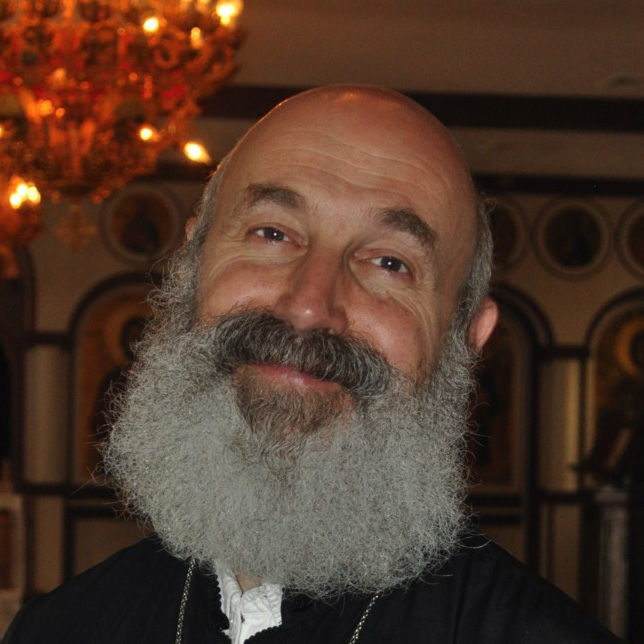 Fr. Theodore Petrides