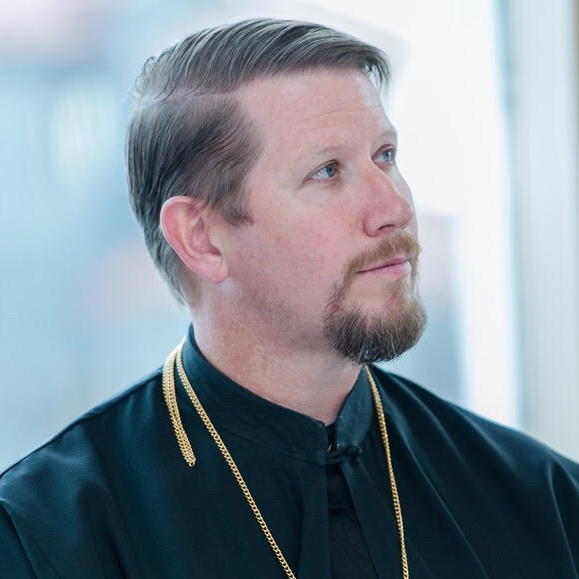
Matushka Liz Gauvain: Hello, everyone. Welcome to The Spirit of Saint Tikhon’s here at Ancient Faith Radio. My name is Matushka Liz. We are here at St. Tikhon’s Seminary in South Canaan, Pennsylvania. We’re here today with Deacon Sampson Nash. He is from the OCA, Diocese of the Midwest. He’s attached to St. Gregory of Nyssa Parish in Columbus, Ohio. He is a physician. He also holds an endowed chair in medical ethics and professionalism at The Ohio State University, where he is the director of the Center for Bioethics and Medical Humanities. He’s also married. He has a lovely wife, four daughters; and they all live on a farm north of Columbus, Ohio.
In addition, he’s here at the seminary this summer, newly teaching a Christians ethics course here at the seminary, and he’s here today to talk a little bit about that course. Welcome!
Deacon Sampson Nash: Thank you for having me. It’s a joy.
Mka. Liz: To get started, tell us a little bit about this course. What’s it about?
Dn. Sampson: Well, most seminaries will have a Christian ethics course, and St. Tikhon’s has had Christian ethics as part of its curriculum for as long as I know. I’ve met several of the priests and bishop and archbishop who have taught it recently. [Laughter] I’ve learned a great deal from them. The unique experience I have is not the unique experience of an archbishop or bishop or priest. So I’ve learned from them and tried to incorporate some of the things they would share in their experience.
There are many ways you can teach ethics. Thankfully, Christian ethics is a required course at St. Tikhon’s. Other places, it may be elective, but I think dealing with the dilemmas of life is what a priest does, so I’m glad that it’s required.
It was exciting to teach this. So I’m teaching it intensively. I don’t live here at St. Tikhon’s; I live in Ohio. My focus is really trying to give pastoral care ethics, I think; not pastoral care formally or pastoral ethics, how to be an ethical pastor, although all that’s wrapped in. [Laughter]
How to teach Christian ethics— I’ll tell you there are many different potential approaches. What I want the students to grapple with and what we have grappled with, I think fairly successfully, was there are many different systems of ethics. First, I guess, we could ask the question: Does Orthodoxy have an ethics? And that kind of begs the question, “What is ethics?” Fr. Georges Florovsky and others have said that Orthodoxy does not have an ethics. And I agree with that if you mean a systematic approach based on secular reasoning or just using the faculty of reason to come to a very clear, precise, binary of good and evil. That kind of definition of ethics, of course, we wouldn’t think that we have that capability, nor are things that simple.
Some may make a distinction between ethics and morality, or ethics and ethos. All of them just beg the same question. So I think we can say we are concerned about living, being people of the way, the way to Christ. How do we orient our souls to Christ? How do we live according to his law? How do we guide souls to do so, to have joy, health, and gladness within the unity with Christ in his energies? How do we pursue the path of purification, illumination, and deification, as much as we’re able, and guide others to do that?
So what is sin, what is not sin, and what are—? How do we grapple—? We learn from the Church Fathers that we have a gnomic will. We don’t know automatically; we don’t perceive what we’re to do. Faced with a crisis or faced with a dilemma, we don’t automatically perceive exactly what would be the godly and best choice. And sometimes we’re faced with choices that seemingly don’t have really great options. [Laughter]
So my goal was to try to get to a point where we’re grappling with the hard things, that we can sharpen each other, gain wisdom. And we did that through going through some basic framework discussion, but then going through a lot of types of cases and dilemmas and wrestling together.
Mka. Liz: That’s wonderful. That’s something that they’ll all need in the future, just on the daily basis, on a pastoral basis. As you start the course, is that the first thing that you’ll start with?
Dn. Sampson: Yeah, I actually start with the question: “Is there an Orthodox ethics?” but then [at] the beginning of the course, we started with considering secular ethics and what we— So in a few days, or in several hours, we go through very quickly, and skipping a hundred or two hundred years here and there, a history of Western moral philosophy, the basic systems, painted with very broad brushstrokes, the different systems of ethics that most would know, whether it be Plato, Aristotle, Kant, deontology, consequentialist theories, kind of social justice and Marxist movements, and all the above. We quickly put those on the board and talk through them.
Then we shift to Christian but not Orthodox approaches, whether it be liberation theology, social gospel, prooftexting, fundamentalist rigorism, and other kind of Christian humanisms, and natural law theory and Scholasticism—it’s not exclusive to Roman Catholicism, but it was codified there.
My approach there—which if I taught this five years ago or ten years ago, I would have taught it a little different. I would have made sure to tear down those strongholds. [Laughter] That would have been my real focus. My focus now has changed a bit. I think this is consistent— Oddly enough, in illustrating the point, it’s consistent with the dialogues in Plato and how Socrates brings wisdom out of and with his interlocutor.
Mka. Liz: Oh, interesting.
Dn. Sampson: Often the person he’s trying to help will say things that are completely wrong, but then he’ll say one thing that’s good, and he’ll grab that one thing and bring it out. I’m calling upon that non-Christian source, but this is— There are many wise Church Fathers and contemporaries— I was having a wonderful conversation with the Fords. Mary Ford was sharing this is the approach that Metropolitan Anthony used in evangelism. He would find the good in someone and say, “This is good that you have this,” and try to build on that.
So if you take something like virtue ethics—this is good that you long for virtue, but how do you define virtue? This is hard. We hold a virtue ethics, but our virtue is known through the Theanthropos, the God-man. It’s good if you are concerned about the consequences that if you think something is ethical because of the consequences that come out, but how—where do we end that consequence? Especially when we have a view that’s beyond the horizon of the finite and the immanent, if we’re thinking into the gloriousness of eternity—if you take eternal consequences seriously, then consequentialism… Think about: “Well, this would be good right now, but in eternity, this would be really bad.” Or vice versa. We have an eternity. What’s better than being united to Christ, being united in the joy and ecstacy of the energies of God?
So these systems, often they have a point of contact with the Christian, even the non-Christian systems. If someone’s a social gospel person: “Well, it’s good to care for the poor, but there’s even more food that they need.” [Laughter] So we often can say, “Yes, this is good; this is a good intent.” You take a popular term now, “social justice”: if I ask my undergraduate students—I still teach undergraduates occasionally, but not as much as I used to—social justice is their rallying cry; that and equity and a few other things. So if I ask them, “What do you mean by social justice?” most of them are giving me a definition of charity and love. I can build upon that, and then point out to them in time: “Well, you know, ‘social justice’ proper as a term often has roots in John Rawls or Marx or some other philosophical thinkers that are fairly recent. And they and their theories of social justice further this notion that in order to have peace and real social justice, you have to have this direct relationship between the state and the atomized individual, that they mistrust intermediate institutions like family and church or civic society. And is that what you mean by “social justice”? No, they’re unaware of that.
Mka. Liz: Interesting.
Dn. Sampson: So I’ve found that that methodology of having civil discussion, caring for the person in front of you who may have ideas that differ [from] yours is more effective. So we practice through some of that, and we went to Christian but not Orthodox as well. I think you can do the same kinds of things, realizing that showing how Orthodoxy, with the right orthophronema, with the right orientation, it would build upon the good that they’re going after and give so much more, and correct their error. Here I’m not trying to say, “Don’t correct the error.” Correct the error, but if you start by just correcting the error, then you’re probably going to lose that relationship, and you’re going to actually emulate something that’s not Christian.
This is one— We went through secular ethical approaches, Christian, non-Orthodox. We took a brief pause before we went into Orthodox approaches and talked about unfortunately a really common lens for all of us Americans—actually throughout the world and very common in the Church as well—and that’s the ethical lens of the culture war. I’m not saying there’s not a culture war; there is. I’ve been engaged in the culture war and even have probably been a culture warrior, as I think about it, at times in the past. I’m increasingly convinced, and I think we saw a lot of this in the anger and fear on all sides with COVID, that the culture war itself, though we may be able to ally on certain topics, on certain issues, with people that are fully engaged in the culture war, I don’t think we should view ourselves as having a side.
The culture war itself defines itself by the enemy. It builds— Its weapons to do that are to build fear and anger towards the other. Christ tells us to love our enemies, but in this he’s— What I understand from the Fathers is it’s those who call us enemy, those who call God enemy, not those we call enemy.
Mka. Liz: Oh, wow.
Dn. Sampson: If we want to— If you disagree with me, take it up with St. Silouan the Athonite, who says if you call your brother “enemy,” you have the devil as your friend.
Mka. Liz: Wow.
Dn. Sampson: I think the culture war encourages the fighting spirit, and this fighting spirit, it puts all aspects of the soul in motion and enflames the passions in such a way that you can’t further the orientation to Christ. You may be able to win a debate or political election or pass a policy or humiliate someone or get a few thumbs up on social media or something, but if our goal is to direct people towards Christ, I think the culture war spirit, the culture war lens, is very, very dangerous. So in the culture war, I think the place for the Orthodox Church to view itself is kind of like the Red Cross, that we’re here for all the wounded, and knowing that all the combatants and all those who are caught in the crossfire are wounded. All of us are wounded.
To elaborate on this, Fr. John Romanides said that Orthodoxy is not a culture. We’re not trying to further Orthodox culture.
Mka. Liz: Interesting.
Dn. Sampson: Instead, he said that Orthodoxy is a medical science. It’s about the healing of souls, wounds. This is why the Red Cross—this is why that metaphor, I think, works. Now, he also said that everything culture needs to be a thriving and good culture exists within Orthodoxy, but it’s an outflowing of that healed soul. If we focus on the culture and not on the healing of souls, what we’ll get is a cheap imitation and will actually probably do damage to souls, and we won’t realize the cultural potential, because the culture has to be an outpouring of the heart of those who are rightly oriented.
Now, I’m not saying that we can’t— that we have to divorce ourselves from politics and other concerns. I’ve worked with pro-life organizations my whole career. I’ve written religious liberty laws that are on the books for several states. I’ve been politically engaged. I think that lens— one, it does damage to us. If you’re out there afraid of the other and calling others enemy, St. Silouan the Athonite, St. Sophrony of Essex, and others will say that that is the test of the faith. If you are saying, “That is an enemy, I’m afraid of them, I hate them,” you’re not a Christian.
Mka. Liz: Wow.
Dn. Sampson: But the test of a true Orthodox faith is loving your enemy. Now, love doesn’t mean affirmation and saying, “Oh, happy, happy, peace, peace,” when there is no peace.
Mka. Liz: Of course.
Dn. Sampson: Love is caring for the soul, praying for the soul before you, and directing them to Christ as best you can.
I challenge the students here at St. Tikhon’s Seminary, named by St. Tikhon of Moscow but for St. Tikhon of Zadonsk, and in one of St. Tikhon of Zadonsk’s writings, it talks about the duties for Christians. I asked them to compare and contrast his words with the kind of culture war era that we’re in.
Mka. Liz: Oh, fascinating!
Dn. Sampson: Where he says, “Offend no one,” where “offend,” especially on social media and in media and… If you’re a public persona now, you have to offend. This is equal opportunity. I’m not attacking one party or one media source. This is across the board, it seems. “Offend no one,” because you’re doing damage. When you offend someone, you’re putting their soul in motion, and if you’re not able to orient them to Christ, you’re doing harm.
He says for those in leadership, to pray for them, love them, and show them honor, to avoid gossip and slander. And generally, when someone is in authority, thank God for that, that you’re given the leaders that God has provided. Thank God and generally do what they say. Now, this doesn’t mean that you have to be completely passive or again that we can’t try to make our towns, villages, cities, states, country, and world a better place, but I think when you read the Fathers, when you read someone like St. Tikhon of Zadonsk and square that— And he was writing at a different time, of course. There’s lots of qualifications, but I think we can’t qualify a way the Christian spirit in which he’s writing in, and contrast it to one that we often, even people that are claiming to do things in the name of Christ, you just look at it, and, like: This is just not Christian.
Mka. Liz: It’s counter-productive.
Dn. Sampson: Yes.
Mka. Liz: All of that is quite powerful to compare and contrast those. Now, when we were talking before this talk, you had mentioned the notion of authority and proper authority and how that plays in. Could you go into a little bit of that as well?
Dn. Sampson: Yeah, this moves from kind of the apophatic—defining something by what it’s not—which is not just a rational process—it’s experiential as well—but to use it in that more rational sense, saying that Orthodox ethics is not, though we can have these touchstones to try to have further dialogue, and since priests are guides in dialogue—that’s the reason we went through secular and Christian-but-not-Orthodox approaches and talked about the culture war—moving into an Orthodox ethics, I further four basic loose principles.
These aren’t principles in the sense that going down them is going to get you to an exact rational answer. [Laughter] This is not a systematic philosophy; it’s just guiding metaphors to help us think about the dilemma ahead of us. Here we’re not talking about dilemmas that are very clear. I mean, some things are very, very clear: “This is right. This is wrong.” If someone wants to apostatize, that’s wrong. Most priests aren’t going to wrestle with that kind of dilemma.
Mka. Liz: What’s the right way to apostatize? [Laughter]
Dn. Sampson: Exactly! So we’re talking about the things that really it’s not clear… And the framework I give—again, it’s not a systematic framework—it’s just a loose metaphor, and metaphors all have limits. One is authority, who’s in authority, and what is authority. My mentor, Reader Herman, or Tristram Engelhardt, talks about this aspect quite a bit. So what is an authority? Someone who has—or something— If you want to learn about nutrition, reading the Hilandar Collection may be very interesting for historical purposes, and I’m sure they probably, in all that past writing, probably have something on herbs and diet and other things, but even if they had something, a treatise on medicine and nutrition, the kind of Galenic ideas that they may be furthering may not be the best nutritional science, although that’s a very hard science to… It’s not a hard science; it’s a difficult science to find truth in, because it’s so hard to study nutrition. But that’s a long aside! [Laughter] It may not— Even though this is a holy place, [and] many holy priests and deacons and monks were there—we have much to gain from their writings—it’s not necessarily so that you’re going to get the answer for nutrition.
Or if you’re wanting to study physics and energy, reading St. John Damascene may not help you get an A on your physics exam.
Mka. Liz: [Laughter] It’s not in his wheelhouse.
Dn. Sampson: Right. We hold that holy people… I mean, the way to know ethics is through purification, illumination, and deification. It is the holy perception of true nature, not fallen nature, but true nature, that is, nature in the eschaton, nature without the fall. Even more than Edenic, probably, but the nature in the eschaton. For us, miracles should be not supernatural but true nature. It’s nature obeying God perfectly; it’s not something that’s contra or supra nature, unless you’re saying supra, that it’s above: that it’s above because it’s conforming to God so much more perfectly. But we sometimes think of “supernatural” defined a different way.
So this is where we would differ with natural law theory, which would think you can use the natural—“natural”: all these terms have to be unpacked— So when the Church Fathers talk about “natural,” sometimes they’re talking about the nature that we should have, not the one we have. So if we think of ourselves as icons—we’re icons of the Icon of the Father; we’re made in the image of God—and we are made in his likeness, but we are besmirched, smeared icons. So our true nature is that icon, and we’re to grow into God’s likeness by his grace and his energies.
But when we have a smeared icon, it’s hard for us to see nature as it ought be. Mixing metaphors here is hard, but it’s seeing through a glass darkly is the idea.
Mka. Liz: Right. It makes sense.
Dn. Sampson: So when we try to discern ethics just by using nature, in this natural world that we see, we see glimpses of true nature, but it’s through a glass darkly in many ways. So the way to see true nature is through theosis, through this path of purification, illumination, deification.
Mka. Liz: As it ought to be.
Dn. Sampson: As it ought to be. Now, those who’ve reached this pinnacle may have perception. They can see nature in a more true way, and they may have perception of the ethical good and right. We don’t hold that any are infallible, and even in the writings of the Fathers, sometimes you’ll get something that: “Oh, that’s interesting, but I don’t read that in any other Father.”
Mka. Liz: Oh, sure.
Dn. Sampson: One holy Father—who’s a saint—said that Christ lived to be 54, because he had to go through all the stages of life, of course. We don’t hold that to be true, because it’s nowhere else to be found. So even the holy Fathers are put to the test of what the Church Tradition—the other writings of the Fathers, the holy Scriptures, the experience of those who were in that path of purification, deification, illumination now. So we don’t— Just because you have someone who may have lived before who was holy, it doesn’t necessarily mean that they’re omnicompetent. If you… I may not… To make it more mundane… Well, I’ll finish that thought. And even if they have perception, it doesn’t mean that they have omniscience. They’re not given perception of all things. They’re usually given perception on things about dogmatic belief and how to guide souls.
That said, to make it more hopefully clear on authority—we’re still on authority, if we’ve got lost. I always had to assign a student. I would point at someone that would have to be the fisher, the fisherman who had to reel me back in and find the place where we went off on a tangent. [Laughter]
But I’m a physician. I know a lot about medicine. I’ve taught ethics for 20 years. I’ve led healthcare systems. I am broadly read in philosophy and fairly well read in theology. You could ask me a lot of questions, but if you ask me— I just had a wonderful conversation with Fr. Paul here at the monastery on iconography and different pigments. If you ask me even to recite what we just talked about, I’d have a hard time, because I’m definitely not an authority in pigments and iconography: I’m not omnicompetent. But if you ask me about mechanisms about certain drugs or certain medical ethics dilemmas, well, that is my expertise, and I’m more of an authority—which is distinguished from who’s in authority.
So, who’s in authority, if you’re— Mothers are in authority over their children, fathers as well. A husband and wife are in authority over each other. There may be a headship of the husband over the wife in some ways, but it’s really mutual martyrdom. That’s a different podcast that I asked someone else to do. [Laughter] But as Orthodox Christians, we are under authority of our priest. Here I’m not trying to further that every layperson needs a strict monastic obedience to a spiritual father that’s going to have them move rocks from one place to another and say, “Move them back.” [Laughter] If you’re not a monk, what that authority means is usually loving guidance in the faith. And paradoxically, that can be loving guidance but is more of a monastic obedience, and I don’t know much about monasticism, because I am not one, so I won’t further that metaphor.
So priests are in authority in their parish. They’re in authority over the liturgics. Parish council shouldn’t be commenting on liturgics. [Laughter] The priest is not— is also under authority: under the authority of the bishop. Generally, if your bishop is giving guidance, as long as it doesn’t violate dogmatic belief, they’re in authority, which doesn’t just— We’re not talking, even though we say, “Eis polla eti, Despota,” we’re not saying that they’re tyrannical despots. [Laughter] They’re loving shepherds; they’re loving fathers.
It’s important to realize that for them to be in authority, this is something they’ll answer for. A bishop will not only answer for his own sins but also for the care of all the souls that were under him; same with the priest. One of the most powerful experiences I’ve had is being at the— shortly after my ordination, helping with the vesting of a priest after his repose and the increase in prayers. It was striking. My motive, of course, being there was because I loved him and I wanted to give him honor. I was thinking in my mind, “Oh, the reason we do this Divine Liturgy and the reason we do this vesting service, all these services we do around when a priest dies, we’re giving them honor.” But I came away saying, “Oh, this is very different. They need our prayers, because they’ll be answering not only for themselves but all the souls they cared for.” So they’re in authority.
Again, these are loose lenses. We should think about what is an authority. What is your question, and do they know what they’re talking about? Then who’s in authority. The other general guides are—they’re all As, not intentionally—authority, then antinomies. Antinomies—here I’m not talking about, for any philosophy-wonks out there, I’m not really talking about Kant’s Antinomies, but antinomies are these seemingly opposed poles.
Fr. Georges Florovsky whom I mentioned earlier, my favorite essay of his is “Empire and Desert: On the Antinomies of Orthodoxy,” where he talks about, after Christianity is no longer oppressed and martyrdom is not around the corner, Christians are not under threat of martyrdom, that when the Christian empire arises, that there are some Christians say, “Oh, there needs to be more; it needs to be stricter in some way,” and they go to the desert.
Now, the antinomy is we’re not saying that St. Constantine the Great, Equal to the Apostles, is not Orthodox because he’s not in the desert; but we’re also not saying that these desert-dwellers who took on a life of strict ascesis aren’t Orthodox because they weren’t in the city, doing what the city-dwellers did. We could go on and on with many of these antinomies. This is often called the royal path. The things that are acceptable on the path—the path leading to Christ: we have to make sure we’re on the right road.
Mka. Liz: To begin with.
Dn. Sampson: So you can’t be on the wrong road, and that’s more obvious. But if you’re seeking Christ, knowing that there is a path that has some width to it—on some things; some things may be a narrower trail, but there is some width to it—and it does have ditches on either side… Loosely speaking, the ditches on one side would be antinomianism, which is saying there is no law: there is no law, that we just have to accept and love and affirm all things and call things that God says are sin, we call them not sin. That’s actually starting to get on a different path or you just fall into a ditch. The other ditch is Pharisaism. It’s me doing the action for a vainglory and saying, “Thank you, Lord, that I’m not like these others.” So on either ditch… It could be defined differently, but you have this royal pathway, there are ditches on either side, but the antinomies saying, “Okay, well, is this what’s necessary for the Orthodox life?” it helps us realize that— I’m a married man and that can be a path to my salvation, and hopefully my wife’s as well. I get more out of that relationship than she does, probably. But the monks that are across the street here are on a different path, and we’re both on the same road: knowing that there are points along the path for individuals to take in relationship and through guidance with their confessor, spiritual father.
The other “A” is related. So the antinomies in ethics is kind of the horizontal plane, if you will. Then we have kind of the vertical plane, which is—I think the best way to view this—asceticism, the ladder of divine ascent. That is, again, as people are aiming or climbing to Christ, that there are ascetical practices that help us realize that. Now, this is a great mystery. We’re not saying we fall into work salvation, but we are to work in our salvation. Asceticism, ascesis, is voluntary, but it’s never optional. If you’re an Orthodox Christian, you must be engaged in ascesis in some way, even if it’s in small ways. This is what the wise spiritual guide will give, is give the penitent what they can handle, but maybe lean in just a little; help them move, ascend, but don’t let them jump too high, because they may fall from a great height that they aren’t ready for. Giving— Not putting a burden on people that they can’t bear, helping them to ascend a rung at a time, that ascetical ladder, I think that’s an important way of thinking of ethics as well.
Again, it’s not that ethics is relative in the sense of— We often think of moral relativism, that kind of post-modern gloss, basically, which says, “There is no truth.” Well, we know there is a truth; there is truth, but truth isn’t a proposition: truth is Christ. It’s a Person. So we try to aid those ascending, that they may be united to Christ in theosis, but who can take each rung takes discernment. And that discerning process is quite the challenge, which is kind of the fourth line of generally shaping ethics.
It’s not an “A,” thankfully. [Laughter] And it’s sharing and burdens: that the clergyman, the priest—but this is true for the royal priesthood of believers as well, as we care for one another— As we’re helping in sharing burdens with one another, at least it means we should be praying for the person before us. If you’re— That would be wonderful if you’re praying diligently always, or daily, or when you can, or at least the person as they’re asking you, as you’re engaging and you feel that this is an important— Pray then, so at least you haven’t neglected prayer completely. And especially pray then.
When you’re engaged in a conversation, we have this temptation to want to affirm people and affirm sin or just get out of the conversation or get attention. We can do and say all these things that we really don’t mean, but if we can ground ourselves in prayer and love of the other person, whether that be taking the time to sit down when someone needs an ear, or even appropriately touching them on the hand or should or giving them affection, showing them love… So that’s an aspect of sharing and burdens.
For the priest, being able to not only just hear confession and give absolution, which is very important, but to engage and share the burden through shared prayer, counseling, and other assistance that I won’t belabor for this podcast, but other assistance that can be better known in our tradition for the treatment of spiritual illness. Here we’re not talking— I mean, all of us have spiritual illness; Orthodoxy is the hospital for souls—again, it’s the Red Cross, where we try to… It’s the medical science that Fr. John Romanides mentioned to try to help us heal our soul, that we may experience the joy of the salvation of Christ. And that should become the most precious thing we have and long for.
I think that’s a better message as well. We often think of ethics, about all the proscriptions, the things that you can’t do. Those are important for us to realize, because the things we shouldn’t do distract us; they disorient us from Christ.
Mka. Liz: Sure.
Dn. Sampson: But instead of making it just legalism for the sake of passing things off so that we… because we don’t want to violate some rigid law, that view the law as our guide to health and joy. The great thing in this world where we hear that women’s health includes things like abortion, or we hear that sexual health is defined in all kinds of ways, all focused on the person’s personal pleasure, we have to realize that those are just disoriented, impoverished views of health. We’re furthering health; we just have a much, much richer and better view of health. Health is union with God. Health is joy and ecstasy in the energies of God. And trying to help people realize that this is a greater joy than all the distractions that are around us. So it’s a loose lens.
And then, of course, we try to apply that through many dilemmas, which— Made dilemmas in a classroom… They hopefully help prepare someone to think through when they actually have a soul in front of them. But having a soul in front of them is much, much more challenging. But there’s a blessing for me to learn from the students, and I hope I was helpful for the students to at least practice thinking through some of these things, that when they’re given that weighty burden, that glorious, weighty burden, of caring for souls, they may be able to show them the love of God, direct them in a path for purification, to purification, illumination, and deification through the power of Christ.
Mka. Liz: That’s amazing. That was wonderful. You brought us full circle to the healing of the whole person. Even in those gray areas, in those individual questions, that they’ll encounter, that they’ll have that discernment. That’s wonderful.
As we wrap up, are there any last words that you might want to add?
Dn. Sampson: Well, I only add one, since you asked. [Laughter] I mentioned ascesis, and perhaps I may not be right on this, but it seems to me that ascesis— We think of it as these great efforts in fasting, prayer, alms, other things. And they are necessary. I say they’re voluntary but not optional for the Christian.
Mka. Liz: I love that.
Dn. Sampson: My understanding, through experience and reading, is ascesis ultimately… We must learn our own incompetence. We must fail at ascesis. We must be given a little bit more than we can handle so that we don’t think that synergy, that is, this— We’re not monergists; we don’t think we’re marionettes that God plays out our life. But we synergistically, with the will God has given us, try to align our will to God’s.
I mentioned we have a gnomic will; that means we don’t have automatic perception on what is right, what is wrong, what is God’s will. But more and more, we are told: Align our will with God’s. Christ had a perfect human will. Perfected, he aligned his human will with his divine will. We’re to emulate that, like the most-holy Theotokos did. We sometimes think of the most-holy Theotokos as the exception to humanity, but she is our exemplar. Christ is Theanthropos, the God-man. He is our ultimate example, the ultimate Man. But the Theotokos is the ultimate human in the sense that that is what we are to aspire to be: align our will as much as possible to God’s, that we may be exalted above the angelic host.
Mka. Liz: Wow.
Dn. Sampson: And the priests and the altar servers, when they don their vestments, that’s what we’re to view them as, as the angelic host, knowing that the whole royal priesthood of all the laity are to be preparing themselves for that same reality, a foretaste that we’re exalted in such a way by being united to Christ.
So what does this have to do with asceticism? Sometimes we think of asceticism as about our effort, our effort, our effort, and that does; that should be there. But we do have to get to this place where we fail. It’s more than we can bear, because we have— True ascesis is that realization that only Christ can do this. It’s the power of God that is needed to rise us above.
Mka. Liz: Wow.
Dn. Sampson: We cannot, through our own efforts, rise, climb that ladder. We can’t, on our own efforts, be lifted up in the angelic hosts. It’s only by the power of God, in union with God, and we have to decrease that Christ may increase. That’s the point of asceticism. And as much as we’re able to take on that pathway, and we’re practicing Orthodox “ethics,” and that’s much better than— I think that’s a more proper view of the topic than what the world offers or even what I teach at The Ohio State University. It’s a joy to teach students who have already asked so many of the essential questions and answered them the right way, and to go into this depth of what is the path and the way to Christ. Absolute joy, and it’s a joy to be here with you. Thank you for listening and asking.
Mka. Liz: That was wonderful. It was great to have you here today. Thank you again for joining us.
Dn. Sampson: My joy.
Mka. Liz: Once again, this has been The Spirit of Saint Tikhon’s at Ancient Faith Radio, here at St. Tikhon’s Orthodox Theological Seminary. Thank you.
 Fr. John Parker