
Today’s Gospel concerns a woman who encountered Christ and found salvation. She was called (after baptism) Photini, which means “enlightened one”. I urge you to read her life if you can. She was to become a great evangelist and has been called an equal to the Apostles. Tradition records her martyrdom in Rome where she went, despite knowing the dangers. I shall be referring to her as St Photini although at the time of her first conversation with Christ she was not called that. Yet this great lady came from an unlikely background. The Jews despised Samaritans as heretics. Christ broke social rules in talking to her.
Likewise we need to be prepared to deal with people we might take exception to. Furthermore St Photini had led an immoral life until the point Christ met her. It has been suggested that she was at the well at that time of day to avoid the other women. Christ knew of her sins yet did not condemn her. Yet Christ did not compromise the truth. The exchange between them shows that she was impressed by His knowing she had no current husband, but rather was living with a man having had five husbands before. This was enough for St Photini to recognise Him as a prophet. (John 4:17f).
We may not possess the sort of gifts that gives such direct insight but we do have our knowledge and intuitions to help in dealing with people and we can pray for guidance. In relating to people we need to be sensitive to their needs and situations. Sometimes one discussion can lead into bigger issues. At the same time we need to avoid distractions. People sometimes want to explore differences between their ideas and ours. This can be an honest enquiry, but sometimes it is an excuse to avoid facing up to more significant matters. As an example, a discussion on icons may be good but there is also the Incarnation to be faced. If we talk about icons do we talk merely about art styles or do we also talk about Christ?
In these encounters, we need to ask ourselves some questions. What is it that the person we are dealing with needs to know? How, in any given situation, do we respond in love? It is not a matter of dealing with the truth of our claims in any triumphalist way. Rather it is a matter of showing love and meeting people where they are. Thus, when St Photini raised the issue that her people worshipped on the mountain, which was Gerizim and the Jews in Jerusalem, Christ’s response was to deal with something more important: “‘Woman,’ Jesus replied, ‘believe me, a time is coming when you will worship the Father neither on this mountain nor in Jerusalem. You Samaritans worship what you do not know; we worship what we do know, for salvation is from the Jews. Yet a time is coming and has now come when the true worshipers will worship the Father in the Spirit and in truth, for they are the kind of worshipers the Father seeks. God is spirit, and his worshipers must worship in the Spirit and in truth.’” (John 4:21f). Christ concentrated on her needs and not on theological differences, whilst not compromising the issue that Samaritans were indeed in error in their beliefs; He said: “salvation is from the Jews”. (John 4:22). As ever, Christ met the needs of the person that He was talking to. He used a point which was important to Jews and Samaritans alike and avoided a discussion about who was right in the matter of how to worship God. He pointed, rather, to a new order. St John Chrysostom said: “He speaks of the Church that she is the true worship, and such as is meet for God.” (St John Chrysostom: Homily 33 on the Gospel of John).
In raising the coming of true worship Christ implied the coming of the Messiah. That is how St Photini understood Him. She makes a reference to the Messiah coming. Christ then deals with the central issue of His mission and the life of the Church. We, also, need to be prepared to deal with these central issues. Christ tells her explicitly that she is talking to the Messiah. Again He was talking to someone in a particular situation, giving the information that she can handle. St John Chrysostom makes the interesting point that others came to believe by seeing various miracles and hearing His teachings; whilst some saw them yet did not accept Christ. However: “The woman was more fair-minded than [them]; they did not enquire to learn, but always to mock at Him, for had they desired to learn, the teaching which was by His words, and by the Scriptures, and by His miracles would have been sufficient. The woman, on the contrary, said what she said from an impartial judgment and a simple mind, as is plain from what she did afterwards; for she both heard and believed, and netted others also, and in every circumstance we may observe the carefulness and faith of the woman.” (St John Chrysostom: Homily 33 on the Gospel of John).
Christ encountering St Photini at the well was an act of love. She was prepared to accept Him and, indeed was so delighted, she went to share the news with others. One can imagine the response when a somewhat notorious woman made the claim that she had encountered the Saviour of the world. Yet through her others came to salvation. The Gospel records that many in the town came to believe through her actions in leading them to Christ; some very quickly and others through listening to Christ directly. In the same way we can invite outsiders to meet others in the Church.
There are people around us who are thirsty for spiritual truth, whether they realise it or not. We must be prepared to deal with them to share the gift of salvation. St Photini did not get salvation because she was already good. She got it, like us all, as a gift from Christ. She responded in love as we should, by following Christ and doing His work. So we encounter Christ and one way that we meet Him is in those less fortunate than ourselves. Sometimes they are materially worse off and at other times spiritually poorer. Whatever the need, we are called to help. In Christ’s words from the parable of the Last Judgment: “Truly I tell you, whatever you did for one of the least of these brothers and sisters of mine, you did for me.” (Matthew 25:40). St. John Chrysostom once said: “If you do not find Christ in the beggar at the church door, neither will you find him in the chalice.” We need to present Christ to those around us. We need to meet people where they are and deal with their situations.
St Photini’s life was richly blessed after her encounter with Christ, and she led many others to Christ. Let us follow her example.
 Archpriest Gregory Hallam
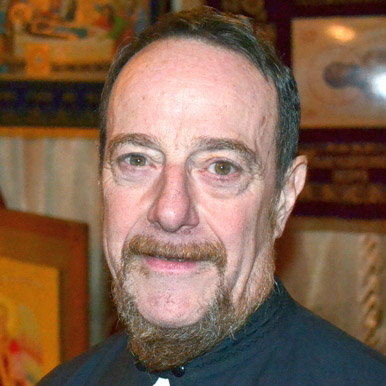 Fr. Emmanuel Kahn