
The gospel reading today from the opening chapter of the Gospel of St Matthew explains the genealogy of Jesus Christ—his many ancestors on earth from Abraham to Holy Mary. The following reading from the book of Hebrews considers the role of faith among those ancestors of Jesus Christ. The question I want to ask today is: Why is the ancestry of Jesus Christ so important? Why did the great evangelist and storyteller St Matthew begin his gospel with a list of nearly 50 names?
A note in The Orthodox Study Bible points out that this stress upon the human ancestry of Jesus Christ “identifies [Him] with the human condition and that He takes [that human condition] on Himself and becomes part of it.” Like St Matthew, St Luke too sets out in chapter three of his gospel a long list of the ancestors of Jesus Christ, all the way back to Adam. As several early Church Fathers have pointed out, “What Matthew publishes in order of kingly succession, Luke has set forth in order of priestly origin.” Therefore, the human ancestry of Jesus Christ is from both kings and priests, which is appropriate because Jesus Christ serves as both King and High Priest for all of humanity.
Many of the ancestors of Christ listed by St Matthew and St Luke were sinners. However, it is our very sinful nature that Christ Himself came to heal. St John Chrysostom quotes verse 21 of the opening chapter of this Gospel: “For He will save His people from their sins.” Then the great fourth century preacher asks: “From what are the people being saved? Not from visible warfare or barbarians but [from] something far greater: from their own sins, a work that had never been possible to anyone before [the birth of Jesus Christ]” [end of quote]. Like the ancestors of Christ listed by St Matthew, we are each being offered the opportunity to be saved from our own sins, because through Christ we receive the ability to repent of those sins from the past and to seek forgiveness in the present, both in words and in our hearts.
Among those ancestors of Jesus Christ listed by St Matthew was a Moabite widow named Ruth who is urged by her Israelite mother-in-law Naomi to return to her earlier life in Moab. However, in the opening chapter of the Book of Ruth in the Old Testament, Ruth says to Naomi “Do not ask me to leave you or to turn back from following you; for where you go I will go, and where you lodge I will lodge; your people shall be my people, and your God my God” [end of quote]. Later Ruth marries Boaz, an Israelite relative of Naomi, who is also listed in the genealogy of Jesus Christ. As the Ancient Christian Commentary on Scripture states: “Boaz by the merit of Ruth’s faith took her as his wife, so that through this sanctified union a royal nation might be born.”
That “royal nation” is us—Christians. We follow Jesus Christ, the person who challenged both Jews and Greeks with the fact that He, the Messiah, had been born. The Greek word “Christ” and the Hebrew word “Messiah” both refer to the same person—Jesus Christ. At times, each of us will face the same challenge as Ruth. As we grow older, shall we turn back to our old lives and cultural experiences; or shall we go where Christ leads us to be actively part of His people? What Ruth said to Naomi is what each of us can decide to say to Christ and His Church: “Where you go, I will go…. Your people shall be my people, and your God, my God.”
I am especially aware of the importance of what Ruth said to Naomi, because some 55 years ago that was what I as a Jew said to Sylvia as a Christian: “Where you go, I will go…. Your people shall be my people, and your God, my God.” Whenever any of us leave behind our past—whenever we grow up in some important way—we are each confronted with a difficult decision: Are we going to follow Christ? How are we going to do it?
The reading today from the book of Hebrews sets out a response we can each make when, like Abraham, we are “called to go out to a place … not knowing where [we are] to go.” We travel “in faith” to a place “which has foundations, whose builder and maker is God” [end of quote]. Make no mistake: The Lord calls each of us in faith to different places which have their foundations, “whose builder and maker is God.” However, even when the Lord calls us, He does not decide whether each of us with our own free will and ability to make our own decisions will travel in faith to those places that He has prepared for us. We each make that decision for ourselves, for the Lord, for the Church. It may not be an easy decision. Like me, you may well hesitate for some months. However, as you grow older and wiser, you learn to make your own decisions.
In J. S. Bach’s “Christmas Oratorio” anguished voices long for the coming of the Messiah and cry out “Ah, when will that time appear then? Ah, when will His people’s hope come?” Immediately comes the reply: “Hush, He is already here.” As we prepare for Christmas, it is good to remind ourselves every day that the Messiah, Jesus Christ, is here with us in the Orthodox Church. This is the Church based firmly on the foundations established by Jesus Christ and His apostles. This is His Church; and when we experience within ourselves that the Messiah is indeed here with us, then His Church becomes our Church. Do share that experience with me.
The reading from Hebrews, chapter 11, verse 32 ends: “What more shall I say? For time would fail me to tell of …”—and a list of people with courage follows, including David and Samuel and the prophets, who, and I quote “conquered kingdoms, enforced justice, received promises … [and] won strength out of weakness” [end of quote]. It is faith in God, shown in our prayers and actions, that wins the strength of God to move beyond our personal weaknesses and problems. Let us then rejoice together that we each have within us the strength of God to follow Christ and His people in His Church, that has become our Church because of our faith in Christ.
And so we ascribe as is justly due all might, majesty, dominion, power and praise to God, Father, Son and Holy Spirit, always now and ever and unto the ages of ages. Amen
Father Emmanuel Kahn
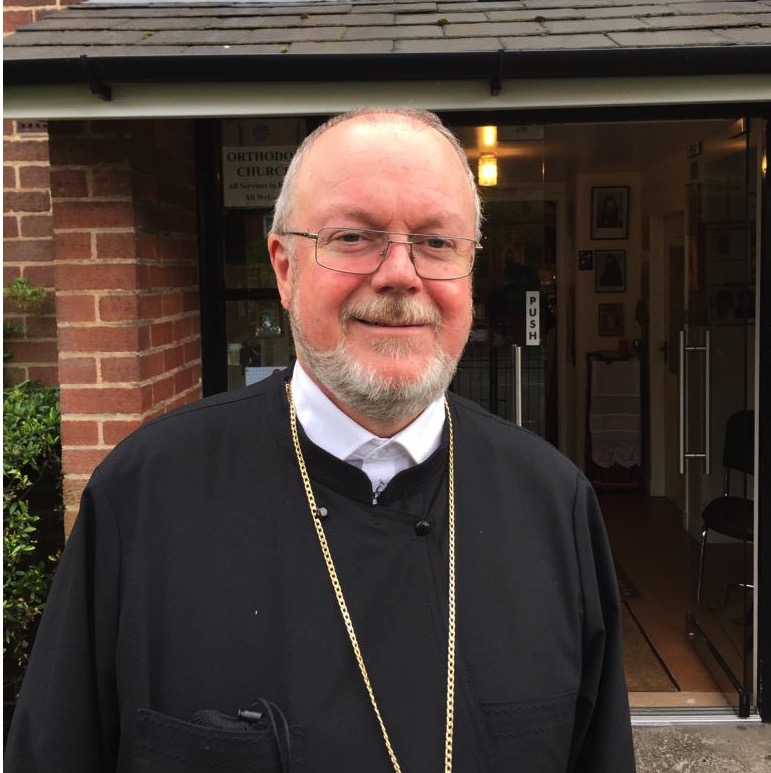 Archpriest Gregory Hallam
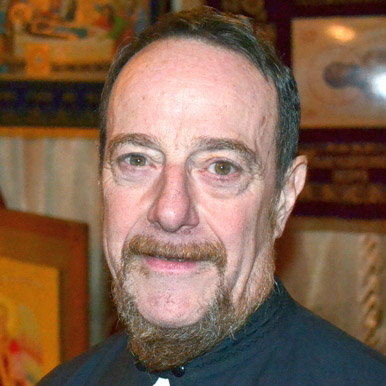 Fr. Emmanuel Kahn