
The reading we have just heard from the sixth chapter of the Gospel of St Matthew offers us a remarkably full view of life—full of choices that we all make in our lives. The single verse that sums up the message of this Gospel is perhaps verse 21: “For where your treasure is, there your heart will also be.” Now, we can all have different answers to the question: “Where is your treasure?” In other words, “what is really important to you in life?” Surprisingly, the source of the English word “treasure” is thesaurus in both Greek and Latin. Now, a thesaurus has come to mean a collection of synonyms—a collection of words that have the same meaning. That suggests to me that a treasure is not one thing, but rather a direction, a hope, a striving to move in a certain direction.
The choice that St Matthew offers us in the words of Jesus Christ is whether “to store up treasures for [ourselves] on the earth” or “to store up for [ourselves] treasures in heaven.” It’s not easy to say precisely what these treasures are. St Matthew offers us guidelines, rather than a single answer. In the very next verse, chapter 6 verse 22, St Matthew quotes Jesus Christ as saying: “The eye is the lamp of the body. So, if your eye is sound, your whole body will be full of light; but if your eye is not sound, your whole body will be full of darkness. If then the light in you is darkness, how great is the darkness.” Let’s try to understand the meaning of that rather puzzling statement about light and darkness in the lives of each person who lives on earth.
“The eye is the lamp of the body,” wrote St Matthew. Now, we all know that a lamp is defined as “a piece of equipment that is designed to give out light.” So it is with the eye, which is the part of the body that enables us to see light. To explore the nature of light, we need to understand colour. Marion Deuchars in her beautiful book Colour explains with lots of pictures and few words that the ancient Greeks saw colour as moving “from dark to light. So blue, for example, was a bit lighter than black, [while] yellow was a bit darker than white [while] red and green were in the middle.” Many centuries later Isaac Newton changed how we understood light and colour. He showed that the white light in a prism was composed of its “component colours: red, orange, yellow, green, blue and violet;” and objects appear to be “certain colours because they absorb and reflect different amounts of light.”
This scientific understanding of colour and light has a spiritual meaning as well. The amount of light that we absorb in our eyes guides us in our ability to see the light of love in other people, in our ability to see the bright side of life, in our ability to reach out to the life that the Lord wishes to give to each of us. That great fourth century preacher and theology, St John Chrysostom, preached about this sixth chapter of the Gospel of St Matthew, and I quote: “Just as when the eyes are blinded, most of the energy of the other members [of the body] is gone, their light being [put out], so also when the mind is depraved [that is, morally corrupt and thinking of evil things], your life will be filled with countless evils….For just what the eye is to the body … the mind [is] to the soul.” In other words, just as the eye brings light to the body, so the mind with its ability to think and pray draws our souls closer to God. Our bodies and minds and souls are a unity bringing us light and life and drawing us closer and closer to the Lord.
St Matthew concluded: “If then the light in you is darkness, how great is the darkness.” St John Chrysostom reflected that those “who destroy the spring may also dry up the river, [because those] who have [put out] the understanding may have confounded [that is, mixed up and confused] all [their] actions in this life.” In other words, we need to take the time to bring the light of God’s presence into our lives each day. We need to pray, both at home and at church, about how the Lord wishes to bring His light into our lives.
I close with a question that Marion Deuchars asks: “Why do children paint rainbows but adult don’t?” Well, perhaps children do paint more rainbows than adults. Perhaps you children in your openness to life and to light and to the Lord can come closer to Christ than many of us adults. But I do believe that however young or old we are, all of us can paint rainbows filled with light and draw closer to the Lord and His Church.
So be it, as we ascribe as is justly due, all might, majesty, dominion, power and praise to God, Father, Son and Holy Spirit, always now and ever and unto the ages of ages. Amen.
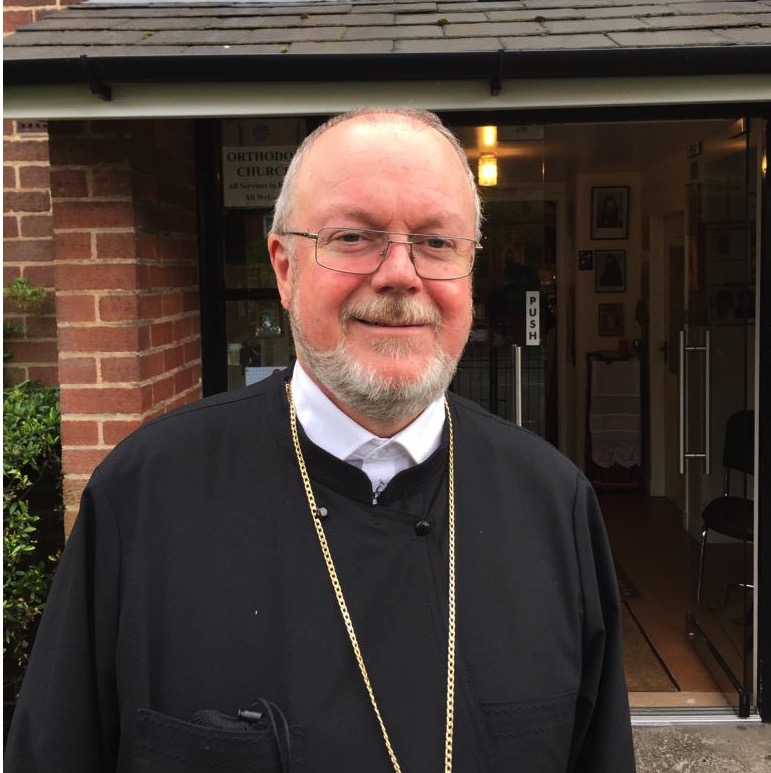 Archpriest Gregory Hallam
 Fr. Emmanuel Kahn