
Power in Weakness; and Death Destroying Life
In the name of the Father and of the Son and of the Holy Spirit. God is one. Amen.
On this 19th Sunday after Pentecost the Gospel reading is from the 7th chapter of the Gospel of St Luke. That is certainly appropriate, as one of the saints we remember today is the Holy Apostle and Evangelist Luke himself—the author of both the Gospel of St Luke and the Acts of the Apostles. Luke was a remarkable person. He was the only one of the apostles who was a Gentile before his decision to become Jewish and then to follow Christ. He was the only one who was a physician; and, as far as we know, he was the only apostle who painted icons. The Orthodox Study Bible also considers him as the historian among the apostles, because he linked Biblical events to specific dates. That is quite a combination of traits—a person with the courage to grow spiritually and discover Christ, a medical doctor, a painter of icons and an historian.
The Gospel today from the Gospel of St Luke, chapter 7, verses 11 to 16, tells of how Jesus Christ raises from the dead the only son of a widow in the village of Nain, a small town about six miles from Nazareth. The fifth century Patriarch of Alexandria, St Cyril points out that, and I quote: “No one summoned [Jesus] to restore the dead man to life, but he comes to do so of his own accord…. The dead man was being buried, and many friends were conducting him to his tomb. Christ, the life and resurrection, meets him there. He is the Destroyer of death and corruption. He is the One [in whom, as written in the Book of Acts, chapter 17, verse 28] ‘we live and move and have our being.’ He is [the One] who has restored the nature of man to that which it originally was….” St Cyril continues with a question, “Why did Jesus touch the bier [on which the dead man lay and say] ‘Young man, I say unto thee, arise’? St Cyril’s answer draws us deeply into this gospel passage. “It was” writes St Cyril “that you might learn that the holy body of Christ [produces] the salvation of man….The flesh of Christ … has the power of giving life and [destroying] the influence of death and corruption because it is the flesh of the Word, who gives life to all.” St Cyril concludes with a blessing for each of us, and I quote again: “May our Lord Jesus Christ also touch us [so] that delivering us from evil works … he may unite us to the assemblies of the saints,” concludes St Cyril.
That is a bold blessing that St Cyril is offering us—that the Lord Jesus Christ can “deliver us from evil” and “unite us to … the saints.” That blessing is grounded in the healing of this young man, who was dead and was raised from the dead by Jesus Christ. What this Gospel passage and St Cyril are saying to us is that Christ has the wish and the power to deliver us from any evil in our lives if we pray to Him for that deliverance.
Now, we may not receive from the Lord Jesus Christ exactly what we ask for. That was certainly the experience of St Paul in today’s epistle from Second Corinthians, chapter 11, verse 31 to chapter 12, verse 9. Three times St Paul asked the Lord to remove some “thorn in the flesh”—some unknown pain—but the Lord told him: “My grace is sufficient for you, for my power is made perfect in weakness.” That was certainly not the answer for which St Paul hoped, but St Paul understood that he was being asked to trust in the Lord and not in his own strength. St Paul’s response was impressive. He told the Corinthians, and I quote: “I will all the more gladly boast of my weaknesses, that the power of Christ may rest upon me,” concluded St Paul.
Whether or not God responds to our specific prayer requests, we too, like St Paul, can trust God to care for us, to meet our needs and to help others. However, note that it is not by becoming more powerful, but rather by accepting our weaknesses. In other words, if we want to follow St Paul in having “the power of Christ [resting] upon [us], then we have to accept our weaknesses, our limitations, our inability to be perfect people. When we deepen our trust in Christ, we receive the “power of Christ”—the guidance we need to draw closer to Him and His unique plan for each of our lives. As Father Gregory preached last Sunday, our goal is “a disciplined mind and a pure heart.” To reach that goal, we have to be guided by Jesus Christ, not by our self-will.
This battle that St Paul fought to have “the power of Christ” resting upon him is not a secular search for self-improvement, but a spiritual challenge that we each face. As St Paul wrote in Ephesians chapter 6, verses 10 to 13, and I quote: “Be strong in the Lord and in the strength of his might. Put on the whole armour of God, that you may be able to stand against the wiles [that is, the cunning and trickery] of the devil. For we are not contending against flesh and blood, but against the world ruler of this present darkness, against the spiritual hosts of wickedness in the heavenly places. Therefore, take the whole amour of God, so that you might be able to resist [the devil] and, having accomplished all things, take your stand,” wrote St Paul.
Origen offers a helpful interpretation of what St Paul means by seeking to “be strong in the Lord.” Origen writes, and I quote: “To ‘be strong in the Lord’ is to be strengthened in word and wisdom and the contemplation of truth. All these qualities are [included] in the titles applying to Christ. The greatest of these [qualities] is the strength of his might, which is stronger than all human virtues combined. Moral corruption lacks power in his presence. This one virtue, being strong in the Lord, is inconceivably powerful,” concluded Origen. In other words, if we seek truth in our minds and in our hearts, we can become “strong in the Lord” and avoid the moral corruption into which the devil tries to draw us.
To be “strong in the Lord” and to avoid “moral corruption” each of us face the same three temptations—the same three trials—that the devil placed before Jesus Christ in the desert after He had fasted for forty days—to be influenced by the world, the flesh or the devil. However, as St Paul points out in the First Letter to the Corinthians, chapter 10, verse 13; and I quote: “No temptation has overtaken you that is not faced by others. God is faithful. He will not let you be tested beyond what you are able to bear, but with the temptation [He] will also provide a way out so that you may be able to endure it.”
St James, in his letter, chapter 1, verses 13 to 15 offers a helpful definition of temptation. St James reminds us that, and I quote: “Let no one say when he is tempted, ‘I am tempted by God;’ for God cannot be tempted with evil and He Himself tempts no one; but each person is tempted when [they] are lured by [their] own desire. The desire when it has been conceived gives birth to sin; and sin when it is full-grown brings forth death,” concluded St James.
Just as Our Lord Jesus Christ took the initiative in Nairn and raised the young man from the dead, so He will take the initiative in each of our lives and raise us from temptations and sin and moral corruption. But we do have to ask Him in prayer for His help. Our salvation is a joint experience in which God and each of us participate fully.
And so, we ascribe as is justly due all might, majesty, dominion, power and praise to God, Father, Son and Holy Spirit, always now and ever and unto the ages of ages. Father Emmanuel Kahn
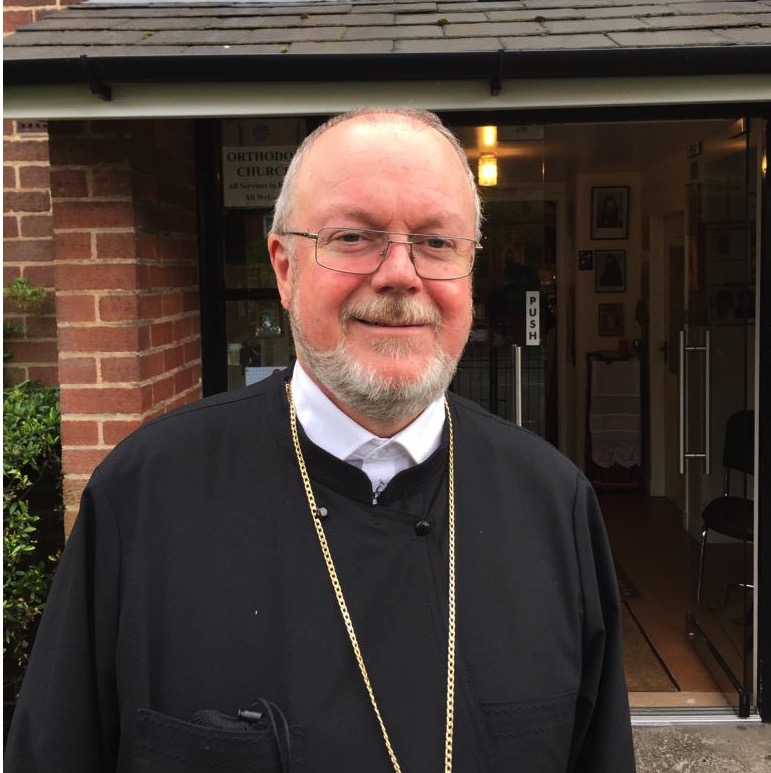 Archpriest Gregory Hallam
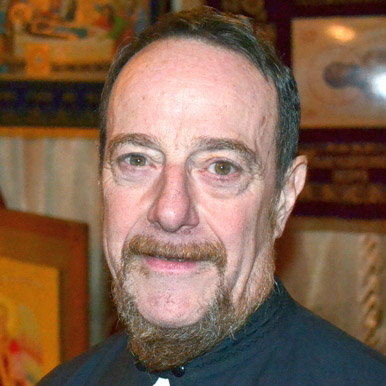 Fr. Emmanuel Kahn