
Today we remember the death the Mother of God, the Theotokos—from the Greek words, theo and tokos for “The God-bearer”—the person who bore in her womb the Son of God, Jesus Christ. How should we remember the Mother of God today? On this day of her Dormition—her falling asleep in the Lord—we may not yet be ready either to celebrate or to mourn. Perhaps you and I need time to understand how the life and death of the Mother of God relates to each of us.
The First Canon of Canticle Three for the Dormition Matins today, set out in The Festal Menaion is a good place where we can reflect on how the life and death of the Mother of God relates to each of us. That canon contains a beautiful prayer to Christ: “O Christ, the Wisdom and the Power of God, who creates and upholds all, establish the Church unshaken and unwavering; for only You [Christ] art holy, [and have] Your resting place among the saints. The glorious apostles knew you, O Virgin without spot, to be a mortal woman and at the same time, beyond and above nature, the Mother of God . . . as [the apostles] gazed upon you shining with glory, the tabernacle that had held God.”
This morning let us join the apostles and seek to know The Theotokos—“a mortal woman” and “the tabernacle that had held God.” To join the apostles and know The Theotokos, it is helpful to understand how the Theotokos and Jesus Christ related to each other on earth. As you hear this sermon, pray as you listen and reflect about how close we as Orthodox Christians are to the Theotokos herself, and how that closeness to the Theotokos draws each of us closer to Jesus Christ.
When the second person of the Holy Trinity, the Logos, the Word, desired for our salvation to unite Himself to our human nature within the womb of Holy Mary, He needed her consent. She was at first puzzled. However, as set out in the first chapter of the Gospel of St. Luke, she then responded with faith in God. Holy Mary told Archangel Gabriel: “Behold the maidservant of the Lord! Let it be to me according to your word.”
Holy Mary’s response to the conception of Jesus Christ within her teaches us two important lessons. First, as a study note in the Orthodox Study Bible for Luke Chapter 1, Verse 38 states: “The Incarnation is not only the work of God, but involves the free response of mankind in the person of Mary.” Second, Holy Mary’s faith is a model for how we too can relate to God with the free response of faith. If we believe in the Incarnation—if we believe that the divine Christ became the fully human and fully divine Jesus Christ, then we too with our faith become participants in the Incarnation. We may not at this time or at any time in our lives know for sure precisely how we should balance prayer and action, how we are to participate in the Incarnation and the work of God. However, we can live with faith in God and see what happens. That was what Holy Mary did; and that is what we can do, too.
Now, in order to understand how Holy Mary and Jesus Christ related to each other during their lives on earth, let us consider certain experiences that the Gospels tell us they shared together. When Jesus Christ was about 13 years old, Holy Mary lost Him for three days. The Gospel of St. Luke, Chapter 2, Verse 46, tells us that Jesus Christ had remained in the Temple precincts “sitting in the midst of the teachers, both listening to them and asking them questions.” Holy Mary and St. Joseph did not know where Jesus Christ was. When Holy Mary found Jesus Christ, she said to Him in Verse 48, “Son, why have You done this to us? Look, Your father and I have sought you anxiously.” However, Jesus Christ told them, “Did you not know that I must be about My Father’s business?” Clearly, Jesus Christ knew at the age of 13 that His Father was God the Father, not His step-father, St. Joseph. How much Holy Mary knew is difficult to tell, but the Gospel of St. Luke tells us that she “kept all these things in her heart. And Jesus [Christ] kept increasing in wisdom and stature, and in favor with God and men.”
By the time Jesus Christ was 30, Holy Mary knew that her Son had great power to intercede with events and people in the world. At the marriage celebrations in Cana, set out in Chapter 2 of the Gospel of St. John, it is Holy Mary who points out to Jesus Christ that “they have no wine”—a dreadful situation for a wedding in first century Palestine. Jesus Christ, after an initial hesitation, turns water into wine, manifesting “His glory; and His disciples believed in Him.” Thus it was the prayer and confidence of Holy Mary in the power of her Son, Jesus Christ that brought His disciples to deepen their faith in Him. A study note in the Orthodox Study Bible reflects that: “Here is an example of Mary’s gift of intercession. Even now, Mary continually speaks to her Son on our behalf and is our preeminent intercessor before His throne. This is declared in the words of an Orthodox prayer: ‘The intercessions of a mother have great effect to win the favour of the Master [Jesus Christ].’ ” So it was the prayers of His mother, that alerted Jesus Christ to the fact that the time had come for Him to begin His public ministry. However, Holy Mary did not attempt to intervene in that ministry, even though she was certainly a person who believed in the ministry of her Son.
When Jesus Christ was in His early thirties, in the midst of His ministry on earth, His mother and stepbrothers or cousins went to speak to Him, according to the Gospel of St. Matthew, Chapter 12, Verses 46 to 50. This was the occasion on which Jesus Christ said, “Who is My mother and who are My brothers? And [Jesus Christ] stretched out His hand toward His disciples and said, ‘Here are My mother and My brothers! For whoever does the will of My Father in heaven is My brother and sister and mother.” Jesus Christ stretches out His hand toward us today and says the same words to us as He said to His first century disciples: “Whoever does the will of My Father in heaven is My brother and sister and mother.”
The fifth century Patriarch, Cyril of Alexandria points out firmly in his Commentary on the Gospel of St. Luke, and I quote: “Do not let anyone imagine that Christ spurned the honor due to His Mother, or contemptuously disregarded the love owed to His brethren. . . . What, therefore, does Christ wish to teach?” asks St. Cyril. The answer that St. Cyril gives is sound; and I quote: “The object [of Jesus Christ] is to highly exalt His love toward [all] those who are willing to [obey] his commandments. . . . The greatest honour, the most complete affection, is that which we all owe to our mothers and brethren.” Therefore, says St. Cyril, Jesus Christ is extending, not restricting, the depth of love “which we all owe to our mothers and brethren,” to all of those “who hear His word and do it.” Jesus Christ is not rejecting Holy Mary, but pointing out to us that His relationship to His mother is a model of the depth of love that He extends to everyone who seeks to do His will.
In reflecting on the love that Jesus Christ and The Theotokos shared, let us consider one final scene—when Jesus Christ saw His mother and the apostle St. John standing by the cross outside the walls of Jerusalem, watching and praying in the midst of the Crucifixion. According to the Gospel of St. John, Chapter 19, Verses 26 and 27, Jesus Christ “said to His mother, ‘Woman, behold your son!’ Then He said to the disciple [John], ‘Behold your mother!’ And from that hour that disciple took her to his own home.” In saying to the Theotokos, “Woman, behold your son!” Jesus Christ was ensuring that His mother would be protected and connected to those who loved her. In saying to St. John, “Behold your mother!” Jesus Christ was ensuring that St. John knew that the Theotokos was to be protected by him and connected to him during the remainder of his long life as if he were her son. Remarkably, today we are in the same position as St. John. Jesus Christ says to each of us, “Behold, your mother!”
The Second Cannon of Canticle Four for the Dormition Matins today has a prayer from us to the Mother of God: “O Mother of God, thou living and plentiful fount, give strength to those united in spiritual fellowship, who sing hymns of praise to thee: and in thy divine glory vouchsafe unto them [that’s us!] crowns of glory.”
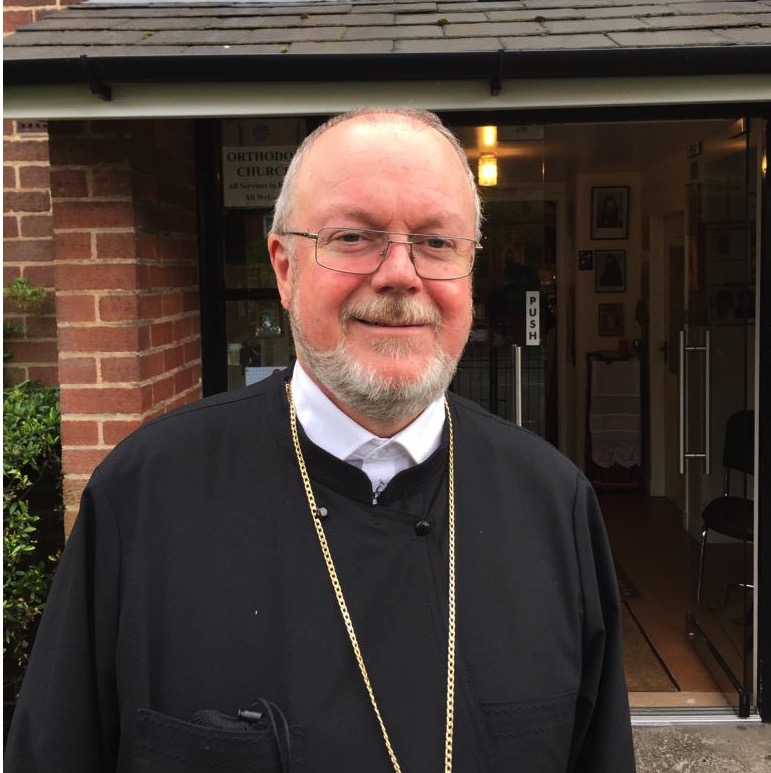 Archpriest Gregory Hallam
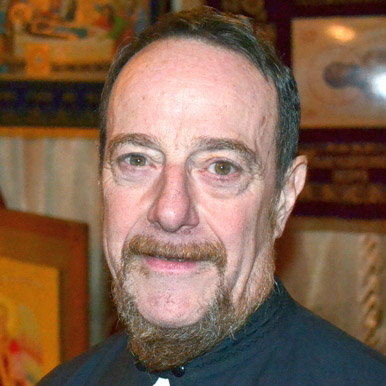 Fr. Emmanuel Kahn