
The Holy Cross which we exalt today can only be lifted up at a personal level within the human heart. Here, in the human heart we must carve out a Cross-shaped impression so that the Holy Cross of our Lord Jesus Christ may be planted there; for only if it is planted there will it grow and bear fruit. There are three essential stages in the planting of the Cross in the heart and I propose to examine these carefully this morning.
First we have to create an impression, a shape of the Cross in our hearts, ready to receive it. You will recall those infant toys that consists of variously shaped holes into which wooden blocks are placed. The child must learn through testing and experience which shape fits in which hole. Likewise, the Cross can only fit in a Cross-shaped impression. So how do we go about creating an impression of the Cross in our hearts? The answer is simple and disarming: by crucifying our ego, by putting pride to death in our hearts. Listen to St Paul:
I have been crucified with Christ; it is no longer I who live but Christ who lives in me (Galatians 2:20)
Notice how St Paul refers to this self-crucifixion in the past tense. Such was the state of his spiritual advancement that he could honestly refer to the death of his own pride as accomplished. It was not always the case with him as the seventh chapter of his letter to the Romans makes clear:
I find then a law, that evil is present with me, the one who wills to do good. For I delight in the law of God according to the inward man. But I see another law in my members, warring against the law of my mind, and bringing me into captivity to the law of sin which is in my members. O wretched man that I am! Who will deliver me from this body of death? I thank God—through Jesus Christ our Lord! So then, with the mind I myself serve the law of God, but with the flesh the law of sin.
(Romans 7:21-24)
Clearly, between these two references, we have a time during St Paul’s life when he actually managed to achieve by divine grace the carving out of the impression of the Cross in his own heart through the death of his ego and the coming to abide there of the Risen Christ by the power of his Resurrection. Note, however, that this is only the planting of the Cross through a deep abiding repentance and the humility of spirit that goes along with that. We are still only at the first stage. What then is the second?
After the Cross is planted in the heart it needs to be watered. The tree of the Cross was first watered with the Blood of God made Man. This is what gives the Holy Cross its powerful and saving significance: the broken Body and the shed Blood of Christ, dying for all. In the Eucharist we are fed with this Body and with this Blood. Without the regular reception of Holy Communion we have nothing with which to feed and water the planted Cross in our hearts, but if we do partake of the Holy Mysteries regularly and with faithful and repentant hearts, then the tree of the Cross within will not remain inert but come to life and grow. Deep roots in the Divine Compassion will penetrate the soil, the humus of our humility. Shoots, then branches, will sprout from the stem, showing that the life of Christ within us as a Divine Sap is bringing us newness of life, wisdom and a power to serve that same Divine Compassion.
The third and final stage of the planting is the bearing of good fruit. When, through repentance, the fullness of the life of Christ dwells within our hearts then the Holy Spirit will have less and less impedance to His work within us, and His work is to bring forth that good fruit. St Paul reminds that the fruit of the Holy Spirit is:
… love, joy, peace, longsuffering, kindness, goodness, faithfulness, gentleness, self-control. Against such there is no law. (Galatians 5:22-23)
Sadly some Christians think that these fruits of the Holy Spirit can be acquired without the Holy Cross being planted in the human heart, without the transformation of the mind, the heart and the will that this makes possible. Instead they would prefer an effortless, static and moralising version of Christianity that steers well clear of a deep and abiding repentance. Let it be not so among us in this community. We come to Christ, the Wounded Healer, to use T.S. Eliot’s evocative phrase and as Eliot continues in “East Coker”:-
The wounded surgeon plies the steel
That questions the distempered part;
Beneath the bleeding hands we feel
The sharp compassion of the healer’s art
Resolving the enigma of the fever chart. Then…
The dripping blood our only drink,
The bloody flesh our only food:
In spite of which we like to think
That we are sound, substantial flesh and blood—
Again, in spite of that, we call this Friday good.
This feast of the Exaltation of the Holy and Life-Giving Cross is then a direct reference to the Passion and Death of Christ, a Cross planted in the human heart. We exalt Christ today by bearing such fruits as befits repentance as St. John the Baptist preached.
Therefore, bear fruits worthy of repentance, and do not think to say to yourselves, ‘We have Abraham as our father.’ For I say to you that God is able to raise up children to Abraham from these stones. And even now the axe is laid to the root of the trees. Therefore every tree which does not bear good fruit is cut down and thrown into the fire.
So, brothers and sisters, let us plant the tree of the Cross in our hearts that we be not cut down by any evasion, indifference or laziness which ultimately comes from the father of lies.
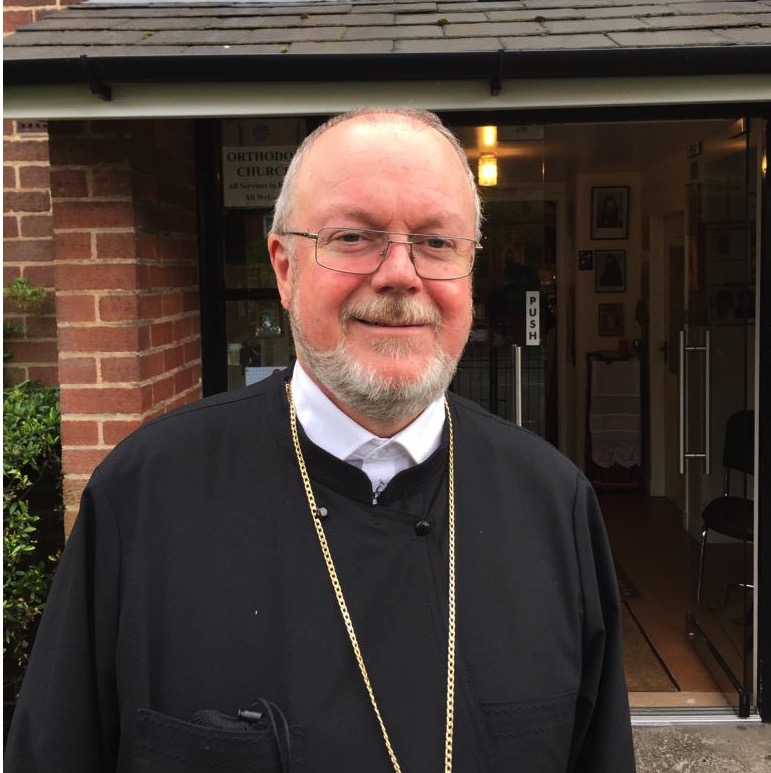 Archpriest Gregory Hallam
 Fr. Emmanuel Kahn