
The Fair Flower of Israel in the Temple of the Lord
In the name of the Father and of the Son and of the Holy Spirit. God is one. Amen.
Today we celebrate an important event in the life of The Theotokos—her entry at a young age into the Temple. This is the second great feast of the Mother of God, following our celebration in September of her birth. We remember not only her entry into the Temple in Jerusalem, but also the change in her home, from living with her parents to living and being educated in the precincts of the Temple. Surprisingly, the parents of Holy Mary, Joachim and Anna, are not mentioned in the Bible, although The Synaxarion: The Lives of the Saints of the Orthodox Church considers both of them as saints in entries for the 25th of July and the 9th of September.
There are many stories about Joachim and Anna and Holy Mary in the Protevangelion of James, which are not part of the canon of the Orthodox Bible. As Mother Mary and Metropolitan Kallistos point out in The Festal Menaion, and I quote: “What matters is not the historical exactness of the story but its inner meaning. This account of [Holy] Mary’s Entry into the temple and of her dwelling there signifies her total dedication to God, in readiness for her future vocation as Mother of the Incarnate Lord. At the Annunciation, the Holy Spirit overshadowed her at the word of the angel and she conceived the Saviour; but the Spirit had also dwelt within her from infancy, preparing her in body and soul to be a fitting tabernacle for the Deity—a living Temple, a personal Holy of Holies. Such is basically the spiritual meaning of the feast. Its chief theme is this indwelling grace of the [Holy] Spirit, present and active within her from her earliest moments,” concluded Mother Mary and Metropolitan Kallistos [pp. 51-52].
Now, pause to consider that each of us as baptised Christians isprivileged to have the Holy Spirit dwelling within us throughout our lives. Mother Mary and Metropolitan Kallistos reflect how, and I quote: “The whole history of the Old Covenant points toward [the Theotokos]: and for this reason the Orthodox Church constantly discerns, throughout the pages of the Old Testament, veiled references and allusions to the Theotokos. The long sequence of patriarchs, prophets, priests, and kings reaches its culmination in the daughter of Joachim and [Anna]. Born under the Old Covenant, she is the last and greatest of the righteous men and women of Israel: in her is summed up all the holiness and faith of God’s chosen people the children of Abraham. When she answered [the Archangel Gabriel] at the Annunciation, ‘Be it done to me according to thy word,’ she spoke not only for herself but as their representative, in the name of them all. [The Theotokos forms] the link between the Old and the New, between the Law and Grace,” concluded Mother Mary and Metropolitan Kallistos.
In a modern context, it could be said that the Theotokos left home at an early age. With her Entry into the Temple, her nursery school of learning became the Temple itself. This was not the Temple of Solomon which had been destroyed by the Babylonians in 587/586 BC nor the Temple which Zerubbabel rebuilt after the return of the Israelites from exile. As Georges Barrois explains in his book, Jesus Christ and the Temple, this was the Temple of Herod, which the king had built to “help him in winning favor of his Jewish subjects” [p. 69]. It was an immense architectural structure. Writing in The Temple: Its Ministry and Services as They Were at the Time of Jesus Christ, Alfred Edersheim explains how and I quote: “It is almost impossible to realise the effect which would be produced by a building [with a single porch that was] longer and higher than York Cathedral, standing on [top of] a solid mass of masonry [in itself already] almost equal in height to the tallest of our [English] church spires” [p. 21]. The Temple into which Joachim and Anna brought their child, Holy Mary, was an awesome structure indeed.
However, their and our interest in Herod’s Temple is not in its architecture, but in its worship, its liturgy, and the life within the precincts of the Temple. As Benjamin Williams and Harold Anstall explain in Orthodox Worship: A Living Continuity with the Synagogue, the Temple and the Early Church: “The worship of God in the Temple in Jerusalem was the first and most prominent focus of Jewish worship” [p. 10]. There was a special court for women; and much loving care extended to those who lived and worshiped in and around the different courts of the Temple. Some parents today in Great Britain still make the decision to entrust the education of their children at age eight to boarding schools. Joachim and Anna entrusted the education of Holy Mary at an even younger age to those who taught in the Temple. Why?
The Tradition is that Joachim and Anna had promised the Lord that Holy Mary who was born late in their lives would be dedicated to the Lord. The Temple was the place where that dedication could be lived out for the next decade until she reached marriageable age—which was quite young among the Jews of ancient Palestine, about 13 or 14. This Temple was not an austere or frightening place, but a beautiful place in which to worship the Lord. In the Book of Acts, chapter 2, verse 46, St Luke writes, and I quote: “Day by day, attending the temple together and breaking bread in their homes, they—[the early Christians]—partook of food with glad and generous hearts, praising God and having favour with all the people.” St Luke also relates in Acts, chapter 3, how St Peter healed “a man lame from birth” as they “were going up to the temple at the hour of prayer” at three p.m. in the afternoon. And in Acts, chapter 5, when “an angel of the Lord opened the prison doors” and brought St Peter and his fellow apostles out of prison, the instructions of the angel were clear: “Go and stand in the Temple and speak to the people all the words of this Life”—that is, the Life with Christ. Thus, it was highly appropriate that the Theotokos should live her early life in the precincts of the Temple in preparation for the Incarnation.
In our parish Weekly Lectionary Guide, Father Gregory wrote: “On this Feast of the Theotokos and Ever-Virgin Mary we recall the importance of following her blessed example in seeking out the will of God for our lives and working with the Lord to fulfil that.” In the opening of the Gospel today from the 10th chapter of St Luke, that “seeking out the will of God” is exactly what Saints Mary and Martha were doing throughout their lives, albeit that Mary chose the better portion through contemplation and prayer. And in the closing of today’s Gospel from the 11th chapter of St Luke, verse 28, Jesus Christ Himself blesses “those who hear the word of God and keep it.” May we too be blessed by God, in unity with Christ Himself, the Theotokos and Joachim and Anna.
And so, we ascribe as is justly due all might, majesty, dominion, power and praise to God, Father, Son and Holy Spirit, always now and ever and unto the ages of ages. Father Emmanuel Kahn
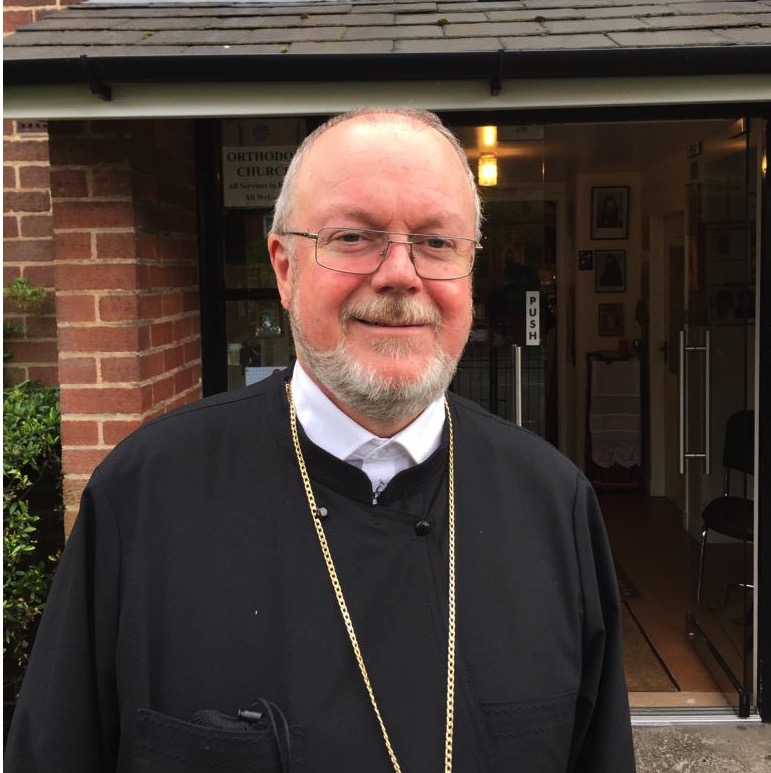 Archpriest Gregory Hallam
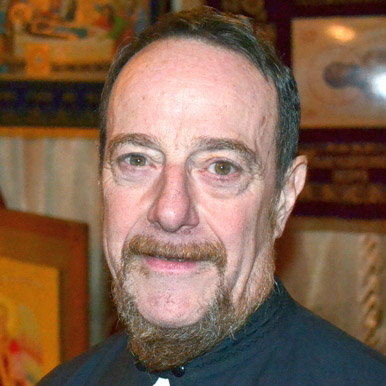 Fr. Emmanuel Kahn