
The Epistle today from the tenth chapter of Romans is very encouraging: “If you confess with your mouth, ‘Jesus is Lord,’ and have faith in your heart that God raised Him from the dead, you shall be saved. For one has faith in the heart for uprightness and confesses with the mouth for salvation.” The dictionary defines “uprightness” as “having integrity and being morally correct.” Therefore, to “have faith in the heart” guides us to personal integrity and morality which leads to salvation. Those three goals—personal integrity, morality and salvation—are a unity. If we wish to be saved to live forever with the Holy Trinity in heaven, we first need to learn how to grow our own personal integrity and morality here on earth.
That is certainly a challenge. Personal integrity, morality and salvation are goals that can only be achieved by life-long commitment. St Ambrose, the fourth-century theologian, preacher and teacher of St Augustine, called the heart and the mouth “the twin trumpets that guide us to “the grace of resurrection.” He urged, and I quote: “Let [those trumpets] always sound together in harmony for us that we may always hear the voice of God. Let the utterances of the angels and prophets arouse us to hasten to higher things,” concluded St Ambrose [On the Death of His Brother Satyrus 2.112]. That’s beautiful, isn’t it? With our hearts and our mouths, working together in harmony, we each learn to “hear the voice of God.” Notice that the path to hearing “the voice of God” guiding us to personal integrity, morality and salvation is by listening to the angels and the prophets.
Let’s see now if St Ambrose is right, especially in his claim that the angels guide us to the Lord. Let the two Archangels Gabriel and Michael lead the way. Archangels are the highest rank of angels, the ones that attend to God and that He trusts with His most important messages and interventions to humanity. It was Gabriel who came to Zechariah, the father of John the Baptist, and told him that he and his wife Elizabeth were soon to have a son (Luke 1.8-17). It was Gabriel who came to Holy Mary to tell her that the Christ, the Messiah, would soon be coming into her womb (Luke 1.26-38). As St Bede points out, the word “Gabriel means ‘strength of God’” [Homilies on the Gospels 1.3]. It was that strength and power of God to intervene in human lives that Archangel Gabriel was communicating to both the High Priest Zachariah and to Holy Mary.
In the fifth century, St Leo the Great, pointed out that the presence of the Holy Spirit that came upon Holy Mary also comes to each of us. St Leo preached, and I quote, “Each one is a partaker [that is, a participant in] this spiritual origin in regeneration. To everyone, when he [or she] is reborn the water of baptism is like the Virgin’s womb for the same Holy Spirit fills the font who filled the Virgin,” concluded St Leo [Sermon 24.3]. That is a powerful insight. Perhaps we don’t immediately link ourselves to Holy Mary when we are baptised, but it’s true. The same Holy Spirit comes to each of us as came to the Theotokos. As St John the Monk, probably the seventh-century theologian St John of Damascus, has sung in the Stichera of Annunciation, “[Great] wonder! God is come among humanity….The timeless enters time…. ‘Rejoice, you who are full of grace; the Lord who has great mercy is with you [Holy Mary],’” concluded St John. The interventions and guidance of the angels in the Bible and in our lives is “timeless” and ever-present. Let’s move from the Archangel Gabriel to the Archangel Michael.
The Archangel Michael appears in both the book of Daniel, the last book of the Old Testament, and in the book of Revelation, the last book of the New Testament [See also Jude 9 and Zechariah 3-4, and the notes in The Orthodox Study Bible on these verses]. In the book of Daniel when Daniel sees the Archangel he says, “My insides churned within me so I have no strength … nor is any breath left in me” [Daniel 10.13-17]. If the Archangel Michael appeared to any of us I think we too would experience the same lack of strength and breath. But it is very unlikely that any of us are going to see the Archangel Michael, because he came to communicate a specific message to Daniel. Michael is a fighter—a fighter for the Lord. Just as Michael came in the book of Daniel to fight the Persians, so Michael comes in the book of Revelation to fight the devil and his evil angels [Revelation 12.7 f.].
Whereas the Archangel Gabriel announced the coming of Jesus Christ into the world, the Archangel Michael announces the triumph of Jesus Christ over Satan. The author of the book of Revelation, the apostle St John, writes in chapter 12, verses 10 and 11, that “I [John] heard a loud voice in heaven saying, ‘Now has come about the salvation and the power of the Kingdom of God, and the authority of His Anointed [the Christ]…. And they [that is, the martyrs who gave up their lives] conquered him by the blood of the Lamb and by the word of their testimony….,” concluded St John. Now, we are not at the end of the world, but we do live today under “the power of the Kingdom of God and the authority of his Anointed [the Christ].” There is dispute among theologians as to whether this battle between the Archangel Michael and Satan takes place before the creation of the world or just before the end of the world [See the note in The Orthodox Study Bible on p. 1731 for Revelation 12.7-12]. Whatever the timing and nature of that battle, as St John the Monk has sung, “God is come among humanity…. The timeless enters time…. ‘Rejoice, you who are full of grace.’”
So, we too can rejoice with the Theotokos that our God and Her God has “come among humanity.” We can rejoice that the Archangels Gabriel and Michael and the many angels that support them are present not only in the lives of the Theotokos and Zachariah and Daniel, but in our lives, too, seen or unseen.
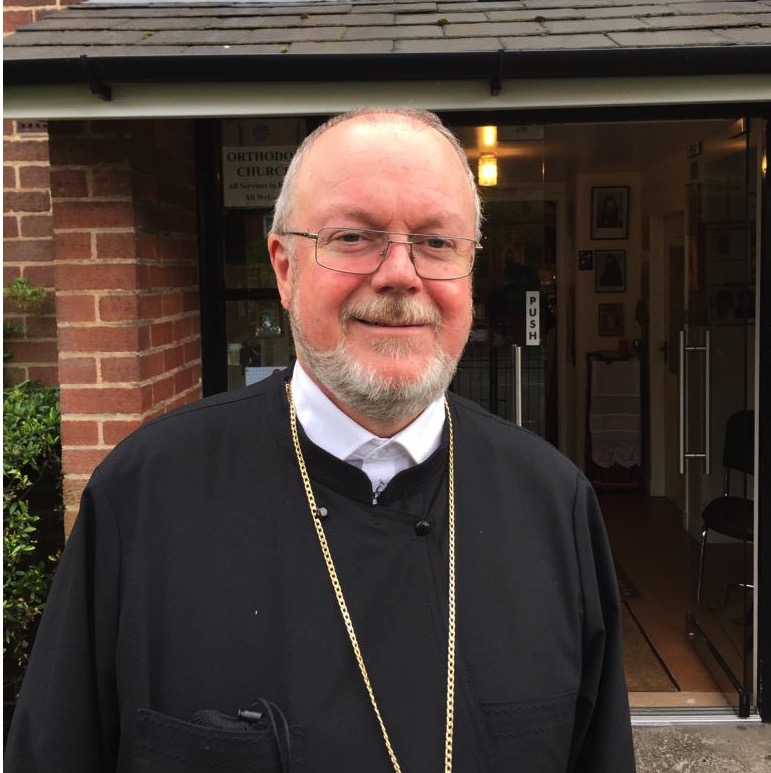 Archpriest Gregory Hallam
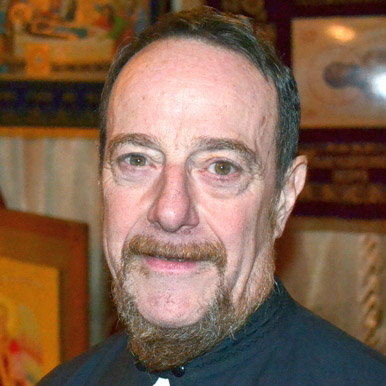 Fr. Emmanuel Kahn