
In the name of the Father, of the Son, and of the Holy Spirit. Amen.
We’re continuing our reading from the epistle to the Romans, sweet people. I mentioned last week, and I’m going to continue the same theme from last week, about bringing good out of evil. This morning we had our reading from the eighth chapter of Romans, that all those who are led by the Spirit of God, they are the children of God. A little later in that chapter it says, and I quoted to you many times, that God causes all things to work for the good of those who love him, including evil. And that thesis enunciated in chapter eight in Romans is worked out in chapters 9-11 in a dialectic of history, about how God brings good out of evil. That’s worthy of more consideration than we gave it last week.
Point one, let’s talk about divine providence and sin. Last week, we reflected on the story of Joseph’s brothers, and particularly the words that Joseph speaks to them in chapter 45 of Genesis: “You meant evil, but God caused it for good.” Man’s sin; God’s providence. Among Joseph’s brother’s there’s a special case of Judah. Remember the story of Joseph has an insertion within it. It’s wonderful crafting; wonderfully crafted. The brothers get Joseph sold into slavery, he goes down into Egypt, they want to—the author wants to suggest the passage of years, 20 years, so he throws in another story, and that’s the story of Judah and Tamar, and after that story then he comes back to Joseph who’s in prison, or he’s working down in Egypt.
In the special case of Judah, the sin was incest. There’s one, that’s a sin where the outcome of it is usually very bad. But notice that this sin of incest pertains even to our Lord’s genealogy. That’s in there. In Matthew’s genealogy, that sin of incest is in there. The sons of Judah were begotten of Tamar, but it took centuries for the significance of this to come clear. When we say that God brings good out of evil, that doesn’t mean you’re going to see it right away. It may mean it’s going to be seen a thousand years from now, because a thousand years in his sight are like an instant. So to say that God brings good out of evil does not mean that we perceive this right away; it doesn’t really mean that we perceive it ever, because God sees far ahead in history, he sees all the way to the end of history, and we do not. We do not see to the end of history.
This point of the divine providence was enunciated by the Prophet Ezekiel back during the Babylonian captivity in the mid-sixth century BC, and it’s this: God wills all men to be saved and to come to the knowledge of the truth. That’s God’s will, and to that end God makes use even of man’s disobedience and man’s infidelity. The instance I cite to you is that of Jonah. You all know the story of Jonah. God tells Jonah, “Go over to Syria; go over to Nineveh, and tell them to repent.” Everybody remember that story? You’re going to get a glimpse of it in that masterful production called the St. James calendar. The St. James calendar for next year has a print of a picture of the storm on the sea and Jonah being tossed overboard into the sea. When God is faced with the disobedience of Jonah, he moves to Point W, second plan.
So Jonah’s disobedient: instead of going east, he goes west. He goes down to Joppa, and he catches a ship sailing for Tarshish. Tarshish is the city of Cadiz. To get to the city of Cadiz you’ve got to pass out of the Mediterranean and up around the coast of Spain. In other words, about as far as you can possibly get from where God wants him to go. If he had known about a ship to Ireland, that’s the one he would have taken. But it wouldn’t have made any difference: God wanted him in Nineveh. But what happens—you know what happens; you know the story. There’s a big storm, and the mariners are wondering who is responsible for this storm. The mariners figured out that it’s Jonah, and he confesses. And they don’t want to—they pray God to forgive them—but they throw him overboard. God will take care of Jonah. He wants him in Nineveh; he’ll get him there.
But notice there that the mariners believe in the Lord. Now the Lord is the God of the Israelites, but the mariners believe in the Lord. These mariners were not Jews! Jewish sailors in antiquity almost don’t exist. Didn’t need to: you had the Phoenicians, their neighbors. They let the Phoenicians take all the risks; the Phoenicians go out. These are Phoenicians calling upon the name of the Lord and offering sacrifice. In other words, Jonah’s infidelity, Jonah’s disobedience, lead directly to the conversion of these Phoenicians. Had Jonah not obliged God to send in Plan W, would these mariners have ever been converted? We don’t know! We don’t know. We don’t know the future; we certainly don’t know the hypothetical. “What if” is not usually a good or a useful question when we are dealing with the ways of God. What we do know is this: we know how God saved the mariners, and he saved them through the disobedience of Jonah.
Now the gospel of John contains a very subtle instance of God’s providence with respect to sin. Let me share it with you. Let me begin to read to you the beginning of the fourth chapter of the gospel of John, and I want you to be reminded of it when you kiss the icon in the back, because that icon in the back, that I set out on the tetrapod this morning, is from the fourth chapter of John. And you’re wondering, “Why is that here? It’s not supposed to be here; it’s for paschal season.” No, I have a special reason why it’s there. The fourth chapter of John says:
Jesus left Judea and departed again to Galilee.
That’s the sort of thing you have to pay close attention to. He left Judea and departed again to Galilee. Now he left Judea why? The context is the activity of the enemies of Jesus, who are identified in verse one: the Pharisees. So Jesus is fleeing, escaping, from a plot of the Pharisees. So he leaves Judea and goes to Galilee. But then comes the really subtle point. Here’s what it reads.
And he must needs go through Samaria.
“And he must needs go through Samaria”: we would never say that in contemporary English, I think. “He must needs go,” I don’t think we would say that. Did you ever notice that about the word “must”? It has only the present tense. You can’t say, “So-and-so musted,” or “Whats-her-name will must.” It only has the present tense. If you want some other tense, you must work around it; the word “must” will not—it simply will not conjugate. The word “must” in Greek is dee or dei; you transliterate it as d-e-i. Here it’s very interesting. It’s in the imperfect tense, which in English would be, literally, “He was musting.” Very difficult to get that across in English: He was musting. He needed to go through Samaria.
Now there’s the grammatical part, but it makes it very easy to miss John’s point here. In fact, I’m not much shy of 80 years old, and I’ve been reading the Bible since I was a small child, but I missed this point until just a few weeks ago because it’s so subtle. The point is this: it is so easy not to notice that Jesus, from a human perspective, was not obliged to go through Samaria in order to reach Galilee. I know Samaria sits between Galilee and Judea; I know that. But you’re not obliged to pass through it to get from one to the other. There are ways around it, and there was a good incentive for Jews to take a way around it so they wouldn’t have to associate with the Samaritans. They could easily take an eastward pass and move up through the Decapolis.
So what does it mean there? “He must needs go through Samaria.” He didn’t skirt Samaria by going in an easterly pass. John said he had to go through Samaria. You see, John is seeing things from God’s perspective. That word dei, “dei,” appears repeatedly through the gospel of John: must, must, must. It’s thematic in the gospel of John. It always refers to the Father’s will. “I must do this, because God wants it or has decreed it.” You see, if Jesus had not gone through Samaria, he would not have met the Samaritan woman at the well, and you would not have that icon back there, and you wouldn’t have this sermon here this morning. What John has in mind to say is this: God knew exactly who would be at that well the next day at exactly the time she would arrive. God has it all figured out.
Let me give you a metaphor not from football this morning, but from baseball. You see, God has a golden glove; he can catch any bounce. God has never made an error. He’s very high on runs, hits; very low on errors: God never has an error. God is managing events in order that the Samaritan woman would meet her Savior, and this is the meaning of that verb, dei, d-e-i, throughout John. Because Jesus went through Samaria that day, a whole village of Samaritans was brought to salvation, and the Orthodox Church has celebrated that event in music, in art, and even in our liturgical calendar.
Point two: remember, the theme here is divine providence in the moral order; point two in divine providence in the moral order. Divine providence does not excuse me—it excuses no one—from the necessity of repentance. Just because God brings good out of evil does not excuse us from repenting of the evil. We sinners are always obliged to repent. The conversion of the mariners did not excuse the infidelity and the disobedience of Jonah. And Jonah’s going to be punished by that disobedience by spending a little time in retreat, at the bottom of the ocean. I don’t know what path that whale took to get from somewhere in the Mediterranean to way over on the Persian Gulf. That’s a very—without the Suez Canal, that’s a very hefty trip. All we know is that Jonah made the trip, and he made it in three days. A very fast whale!
You see, beloved, looking over our lives, we may perceive how the Lord of history has made use of our sins in order to bring certain blessings into our lives. I doubt that there’s an adult here who can’t see that, looking back over his life. God made blessings even of our sins, to bring goodness into our lives. But that insight does not obviate the necessity of our repentance nor does it remove the obligation to mend our lives. God’s action in the past does not mitigate our responsibilities in the present or the future. And this brings me to point three.
Point three I consider a matter of grave moral seriousness. In fact, in preaching on this point I really feel like a voice crying out in the wilderness, because I’m crying out against an error. We expect to find it in the world, but you find it now in the Church, a serious error. Let me insist on point three here: that bringing good out of evil is not a moral principle, because we human beings cannot do it. It is not within our power to bring good out of evil. So bringing good out of evil can never serve as a guide to our own conduct. Bringing good out of evil is what God does; it is not something that we may presume to try.
Human beings may never do evil in order to produce good. If you’ve never heard it before, if you never hear it again, please hear it this morning. Human beings may never ever do evil in order to produce good—ever! Divine providence does not destroy nor does it fudge the difference between good and evil. There’s a common fallacy these days that I will call and other people have called “results-based morality”: “What is the expected outcome of what I do?” And that’s the basis of whether I do it or not. We do not know the future!
Let me give you a for-instance. It’s a very serious for-instance. The seal of confession—I lament that this seal of the confession is now being debated among the clergy. It is a principle, an inviolable principle, that the priest may never violate the seal of the confessional—ever! Not to save the world from starvation, not to prevent a nuclear holocaust—he may never do this! To violate the seal of confession is a terrible sin, and as a priest I am never justified in violating that seal. I have spoken to priests who think this is a matter for debate. It is not. It has never been a matter of debate. The minute I hear a priest debating that question, I will never make confession to that priest! That would destroy the very sacrament of Christ. You don’t— That’s not something you can fudge on at all.
Let me give you another example. A physician may never murder an unborn baby for any reason whatsoever, not even to save the mother’s life. He may never directly take the life of the unborn baby. There are no reasons to justify that, no matter what the purpose. It is a principle, an inviolable principle that we never take the life of an innocent person, at any stage of life. That’s a hard saying, but I may never do it. Human beings must not presume to take the place of God.
I have to say that, because we’ve had the last two weeks two political conventions in which it is very obvious that people are trying to take the place of God. I didn’t watch much of it, but I picked up a bit on the news; in fact, I never turned on the conventions. I have neither a lofty mind nor a strong stomach; I can’t really… But what I’ve seen in the news, it was two weeks of making promises that no government could possibly keep, promises that even God doesn’t presume to make! All the free stuff we’re going to be given! God doesn’t even promise us that free stuff; God promises us our daily bread. The message of those conventions is: You don’t have to trust God any more; we will take care of you.
Human beings must not presume to take the place of God. This, in fact, is the ultimate pride. At all times, our responsibility is to love good and hate evil, and never worry about the results. To love good and hate evil, and never concern ourselves with the results. This is always the only correct moral path. We are not God. He governs the order of history, and we presume to do so only at our own peril.
Each morning at matins, and we certainly had it this morning at matins, there’s a phrase that appears in both the second and the third prayer at matins, the prayers that the priest prays while the chanters are doing the hexapsalmos. It says this: “Thy precepts are a light upon the earth. Thy precepts are a light upon the earth.” That’s the light which has been given to us. We follow “thy light,” which is “thy precepts,” not our own speculations, not our own theories: “thy precepts.”
It would seem to me that the voice, the clearest voice that has spoken to this point within the last couple of centuries was a Russian Orthodox voice. I’m referring to one of the greatest theologians in modern times, a man by the name of Fyodor Dostoevsky. In his novel, Crime and Punishment—that novel must be read; indeed, it must be read more than once! If you consult Mr. Letendre, he’d probably tell you it must be read in Russian. [Laughter] I’ve tried to read it in Russian, but it’s pretty rough going in Russian! See, that’s the sin of Raskolnikov, and Raskolnikov is the man who’s trying to be Nietzsche’s Ubermensch.
Raskolnikov is going to kill this widow because he has a plan to make the whole of humanity better. He’s going to launch a whole reform of human life. To do that, he has to kill this widow, this pawnbroker. After all, he reasons, she deserves to die. She’s been taking advantage of people for all these years. Time for her— and nobody’s going to miss her. So he takes out his axe—I’m not encouraging you to read the novel, am I. You’re like: “Oh gosh, that’s disgusting!” [Laughter] He’s going to kill her, but of course Alyona walks in and witnesses it. He has to kill Alyona. Alyona is pregnant; the baby dies. See, he was committing a present sin for a future blessing. He just killed the future.
Why did Dostoevsky write this story? Because he saw that is exactly what Europe was contemplating, back in the late 19th century, where governments were taking the place of God. In prophetic insight, Dostoevsky sees what that’s going to lead to. He did not know specifically about the Battle on the Marne, but he prophesied World War I. He did not know about the bombing of Pearl Harbor, but he prophesied World War II. He saw it was all there in germ because it followed logically from the moral presumption made by human beings who believed in progress and who believed that certain things, certain evils had to be endured; we had to go through them. We have to go through these things. A combination of sociology and Darwin: certain species have to die, certain things have to perish in order to bring about progress.
The 20th century, the century just behind us, tells the opposite story, tells about man’s presumption, and the problems we face in the world today are easily traced to a moral philosophy that emerged in the 19th century. We ourselves, my brethren, must guard ourselves against this sort of thing, must love what is good, hate what is evil, and leave the rest to God. Amen.
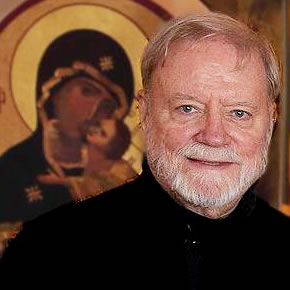 Fr. Patrick Henry Reardon