How to Be an Orthodox Christian
How to Live the Orthodox Life
Deacon Seraphim Richard Rohlin presents in podcast form many of the catechetical lessons, materials, and videos that he uses as a catechist at the St. Seraphim Cathedral in Dallas, Texas. This series is an introduction to catechism for the use and benefit of Orthodox Christian parishes around the world, and for people who are interested in becoming Orthodox Christians, who want to learn more about the Faith, or go deeper into the same Faith that they have already received. It is not intended to substitute for or replace instruction in the Faith from your own spiritual Father.
Support podcasts like this and more!
Donate Now
Monday, June 15, 2026
50 mins
The Moral Life (Part 2): Sexuality, the Sanctity of Life, the Tongue, and Possessions [EP. 9]
Picking up the framework from Part 1, Dcn Seraphim applies it to the specific moral questions where the Church's teaching most visibly cuts against the assumptions of our age. He begins by rejecting the quiet gnosticism of the modern world and affirming the goodness of the body, then takes up sexual ethics at length, working from Genesis 1 and Ephesians 5 to chastity, marriage as the icon of Christ and the Church, fornication, pornography, and the image of God in the human person. Finally, he talks about the discipline of the tongue: lying, gossip, judgment, and the new domain of online conduct.
Handouts and resources: https://drive.google.com/drive/folders/16IQ-i3cukC75VMFRqGP1q9oLoED_uXa-?usp=sharing
Monday, June 8, 2026
38 mins
The Moral Life (Part 1): The Ten Commandments, the Sermon on the Mount, and the Transformation of the Heart [EP. 8]
In the first of two episodes on the moral life, Dcn Seraphim works through the two great moral texts of Scripture — the Ten Commandments given to Moses on Sinai, and the Sermon on the Mount given by Christ to His disciples on a mountain in Galilee — and shows how Christ does not abolish the law given to Moses but fulfills it, taking it inward into the dispositions of the heart. The Decalogue marked off Israel by clear external standards of conduct; the Sermon on the Mount addresses a new community, the Church, in which God is concerned not only with our outward actions but with our inner thoughts, our affections, and the very movement of our wills.
Handouts and resources: https://drive.google.com/drive/folders/1z-OVpbdZqhEDT0v3M9tipcdb-_frY4zP?usp=sharing
Monday, June 1, 2026
36 mins
Holy Tradition: Scripture, Councils, Fathers, and Liturgy [EP. 7]
Where does all of it come from — the eastward-facing altar, the icons, the hymns, the precise theological claims woven into every prayer? In this episode Dcn Seraphim takes up the question of Holy Tradition: not a rulebook or a second Bible, but the whole living transmission of the Christian faith from the Apostles to today, the river in which Scripture itself flows. Drawing on St. Paul, St. Irenaeus, the ecumenical councils, and the witness of saints from St. Athanasius to St. Sophrony of Essex, he shows how the Church discerned the canon, defined the faith at councils like Nicaea and Ephesus, and continues to confess that faith in her worship under the principle of lex orandi, lex credendi — the law of prayer is the law of faith.
Handouts and resources: https://drive.google.com/drive/folders/1CD0DyDFbR8DEr1yNyb_N2tdrrX8PCmUL?usp=sharing
Intro: 0:00
Two Modes of Transmitting Tradition: 4:04
Scripture in Tradition: 6:45
St. Irenaeus on Tradition: 12:06
Conciliary Principle/Councils : 13:56
Fathers of the Church: 21:45
What the Church pray is what we believe: 26:14
tradition vs. “T”radition: 30:36
Closing statements: 32:16
Tuesday, May 26, 2026
35 mins
How to Read the Holy Scriptures [EP. 6]
In this episode, Dcn Seraphim explores the Orthodox understanding of the Holy Scriptures as a verbal icon of Christ — a living encounter with the One who speaks through every page, from Genesis to Revelation. He looks at how the Church gave us the Bible, why Orthodox Christians use the Septuagint, what is meant by reading Scripture with the Fathers, and why typological reading is not an invention of the Fathers but an extension of the way the New Testament teaches us to read the Old. Along the way he draws on St. Irenaeus, St. Theodore the Studite, St. Isaac the Syrian, and St. John Chrysostom, and shows how the hymns and readings of the Divine Liturgy are themselves the Church's living school of biblical interpretation. The episode ends with practical guidance for daily Scripture reading at home.
Monday, May 18, 2026
51 mins
Almsgiving: How to Be Like God [EP. 5]
In this episode, Dcn. Seraphim takes up the third great discipline of the Sermon on the Mount and shows why the Orthodox Church understands almsgiving not as an optional extra but as the practice by which we become like the God who gives Himself away. Drawing on Christ's teaching in Matthew 6 and 25, the Book of Tobit, the parable of the Widow's Mite, and the writings of Sts. Basil, Gregory the Theologian, John Chrysostom, and Clement of Alexandria, he traces almsgiving back to its roots in the very nature of the Trinity. He then turns to the practical questions: tithing, the corporal and spiritual works of mercy, parish stewardship, and how the whole Divine Liturgy forms us as a school of giving.
Show notes: https://drive.google.com/file/d/1WENS_5xjgyLnr5kJQPTiK3qqYTgi5Hd6/view?usp=sharing
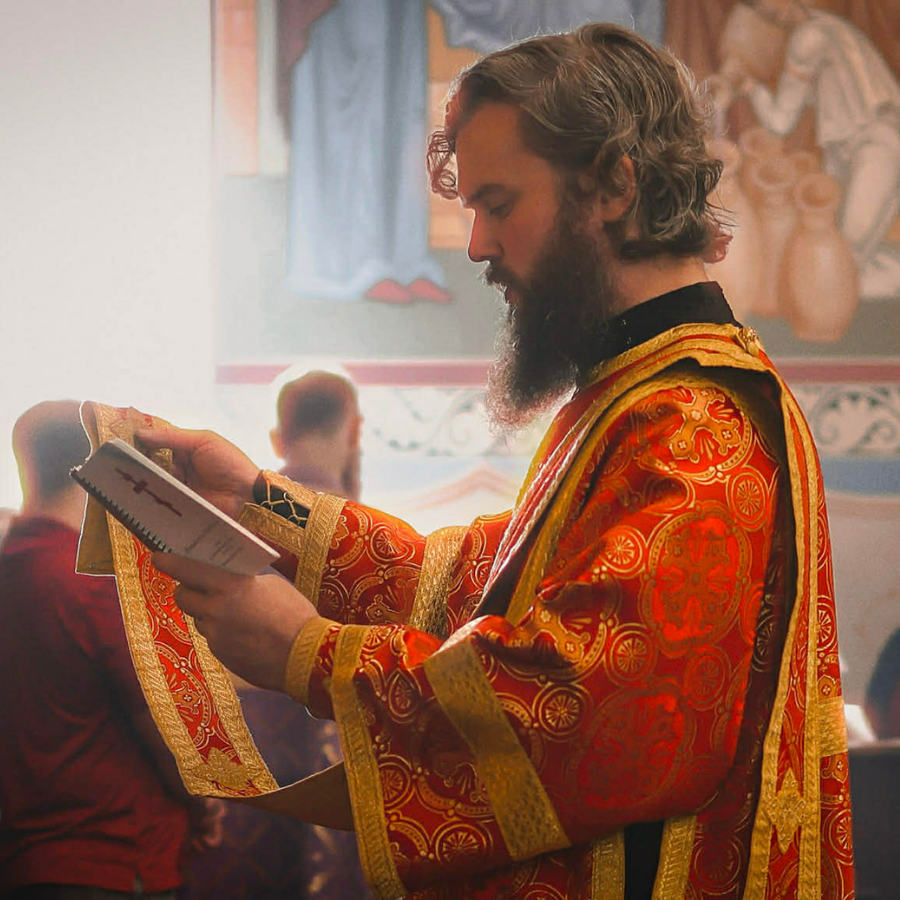 Dcn. Seraphim Richard Rohlin